

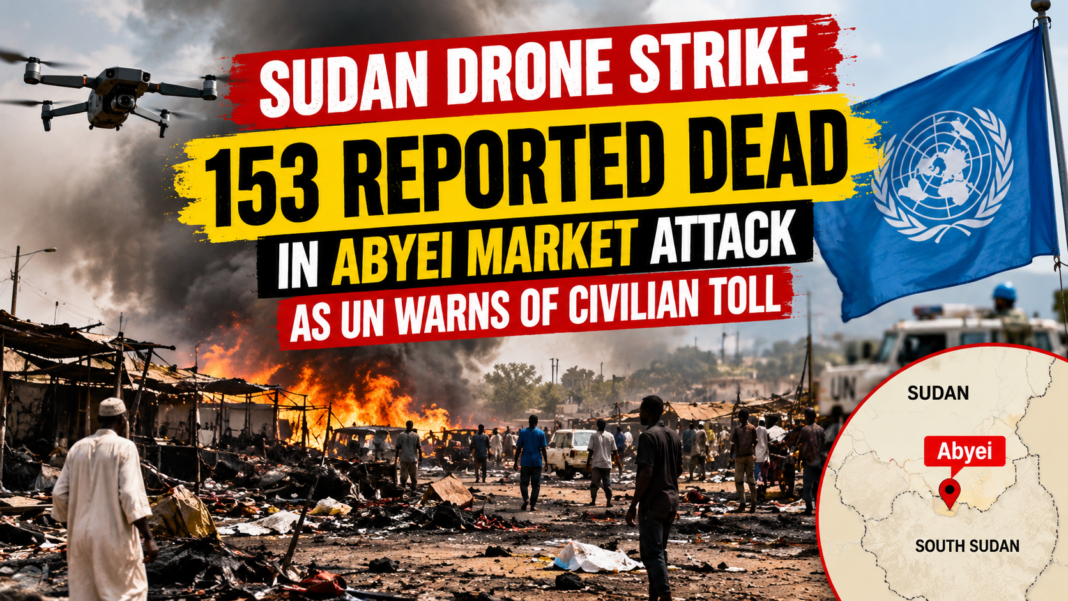
A deadly strike on Amiet Market in the disputed Sudan–South Sudan border region has raised fresh concerns about civilian protection, escalating drone warfare and the worsening humanitarian crisis.
At Least 153 Deaths Reported After Drone Strike
A drone strike on Amiet Market in the disputed Abyei region has reportedly killed at least 153 people, according to the area’s caretaker information minister, as the continuing conflict in Sudan raises fresh concerns about civilian safety.
The attack took place on Monday, October 19, near Abyei, a territory claimed by both Sudan and South Sudan. According to local official Yohanna Akol Ngor, the strike hit the market and a nearby fuel depot, triggering a fire that complicated recovery operations.
Reuters and the Associated Press reported the death toll on October 20, citing local authorities. The final number of casualties may change as officials continue to account for missing people and recover bodies.
The United Nations separately confirmed that drone attacks near Amiet Market and Todach had killed at least 28 civilians, with many others injured or unaccounted for, according to its October 20 briefing. The UN figure reflected the information available to it at that stage and should not be interpreted as a final count for the Amiet Market attack alone. Reuters
The incident has highlighted the growing risks faced by communities living in areas affected by Sudan’s war.
Sudanese Military’s Account and Local Officials’ Allegations
Local authorities in Abyei have blamed Sudan’s military for the attack. However, responsibility for the strike and the circumstances surrounding the reported civilian deaths must be distinguished from claims made by the parties involved.
A senior Sudanese military officer, speaking anonymously to the Associated Press, said the military had targeted fuel tankers arriving from South Sudan that were allegedly carrying supplies for the paramilitary Rapid Support Forces (RSF).
The officer claimed that those killed were RSF members and people involved in fuel smuggling. That account has not been independently established in the available reporting.
Reuters also reported that diplomatic sources, an aid worker and a conflict expert said the strike hit a fuel depot that had previously been used to supply the RSF.
These accounts indicate that a fuel facility was reportedly involved, but they do not independently establish the identity of every casualty or the circumstances of each death. The distinction is important when reporting an attack in an active conflict zone. AP News
United Nations Condemns Drone Attacks
The United Nations has condemned the recent drone attacks in Abyei and other parts of Sudan.
In a statement released on October 20, UN Secretary-General António Guterres expressed concern over attacks near Amiet Market and Todach that killed civilians, including women and children. He said the casualty toll was expected to rise as the United Nations Interim Security Force for Abyei (UNISFA) continued verifying the numbers.
The UN also reported that many people remained missing.
Following the attacks, UNISFA deployed medical personnel, firefighting resources and quick-reaction forces to assist with emergency treatment, evacuate casualties and help prevent fires from spreading.
The Secretary-General reiterated that parties to an armed conflict must respect their obligations under international humanitarian law and protect civilians and civilian infrastructure. unisfa.unmissions.org
The reported attack comes amid growing international concern over the use of drones in Sudan’s conflict and the resulting damage to communities already struggling with years of violence.
Medical Teams Treat Injured Survivors
The attack has also placed additional pressure on medical services in the region.
Doctors Without Borders, also known by its French acronym MSF, reported treating more than 20 wounded people at Ameth Bek Hospital. Some patients suffered severe burns and required urgent medical attention.
The reported damage and casualties underline the challenges faced by healthcare workers in conflict-affected areas, where emergency facilities may have limited resources and access to medical supplies can be difficult.
The final number of injured people and the extent of their injuries require continued verification. AP News
Why the Abyei Region Matters
Abyei lies between Sudan and South Sudan and remains the subject of a longstanding territorial dispute.
South Sudan became independent in 2011, but the status of Abyei remained unresolved. The region has strategic importance because of its location and oil-related interests.
Its proximity to areas affected by Sudan’s conflict has increased security concerns, particularly as fighting between Sudan’s armed forces and the RSF continues.
The war began in April 2023 and has caused widespread displacement, disrupted essential services and contributed to a severe humanitarian emergency.
The latest attack demonstrates how the conflict’s consequences can extend beyond the main areas of fighting, threatening people who depend on markets, transport routes and other essential infrastructure.
Why This Development Matters to India
For India, the developments in Sudan are relevant to foreign policy, the safety of Indian nationals, humanitarian concerns and broader engagement with African countries.
India maintains diplomatic and economic relationships across Africa. Continued instability in Sudan is therefore an important regional development for Indian policymakers to monitor.
However, there is no verified evidence in the sources reviewed for this report establishing that the Amiet Market attack will directly affect India’s fuel prices, trade or national security.
Any assessment of the attack’s implications for India should be based on official Indian government statements, verified information about Indian nationals in the region and evidence of any wider economic consequences.
For Indian readers, the immediate significance of the incident lies in the humanitarian toll and the international response to protecting civilians.
If India’s Ministry of External Affairs issues a statement or publishes updated travel advice concerning Sudan, that information should be incorporated into subsequent reporting after verification.
What Happens Next?
The immediate priorities are to establish the full casualty figures, identify missing people, provide medical treatment to survivors and clarify the circumstances of the attack.
The UN’s ongoing casualty verification and further information from local authorities and humanitarian organisations will be important in establishing a clearer picture.
The incident also raises broader questions about civilian protection during armed conflict and the responsibilities of parties carrying out military operations near populated areas.
For communities already affected by displacement and shortages of essential supplies, further violence can deepen existing hardship.
As more information becomes available, independent verification will remain essential to understanding the scale of the attack and determining responsibility.
Global Nexus Media will continue to follow verified updates from the United Nations, humanitarian organisations and established news agencies as further information emerges.


