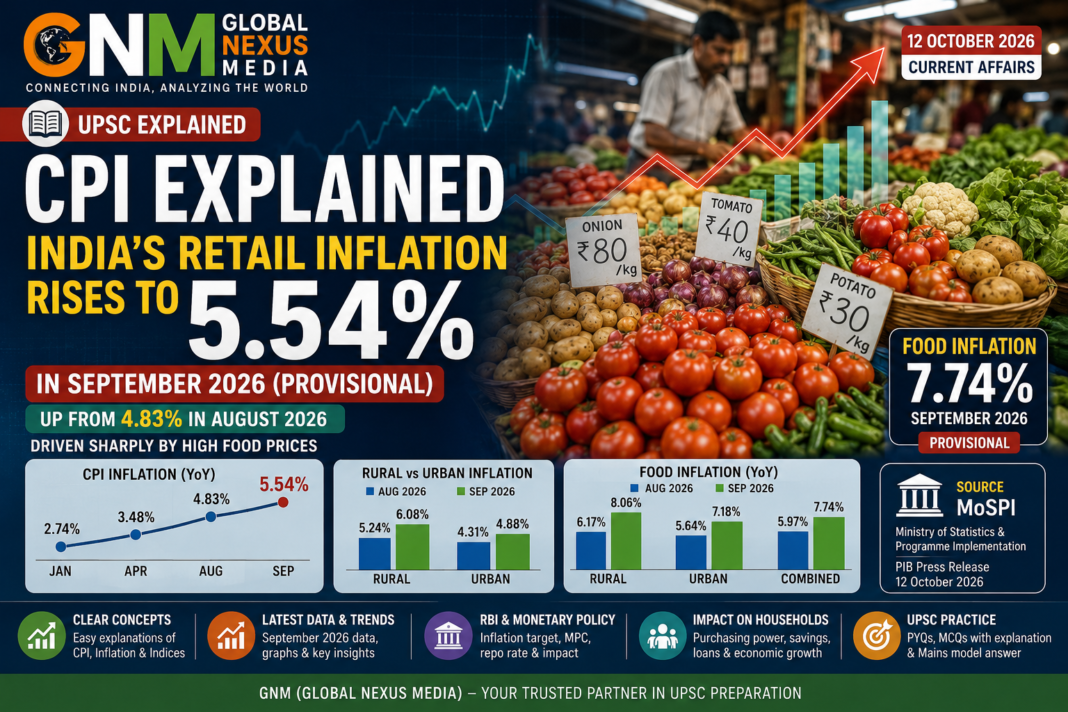
Why food prices matter, how the Consumer Price Index works, and what rising inflation means for households, the RBI and the Indian economy.
Global Nexus Media | UPSC Explained | 13 October 2026
UPSC syllabus: GS Paper III — Indian Economy, inflation, monetary policy and price stability.
Key takeaway: India’s retail inflation increased to 5.54% in September 2026 from 4.83% in August. Food inflation rose to 7.74%, while rural inflation reached 6.08%. The figures highlight the importance of food prices, inflation measurement and monetary policy in understanding India’s economy.
1. Why is this in the news?
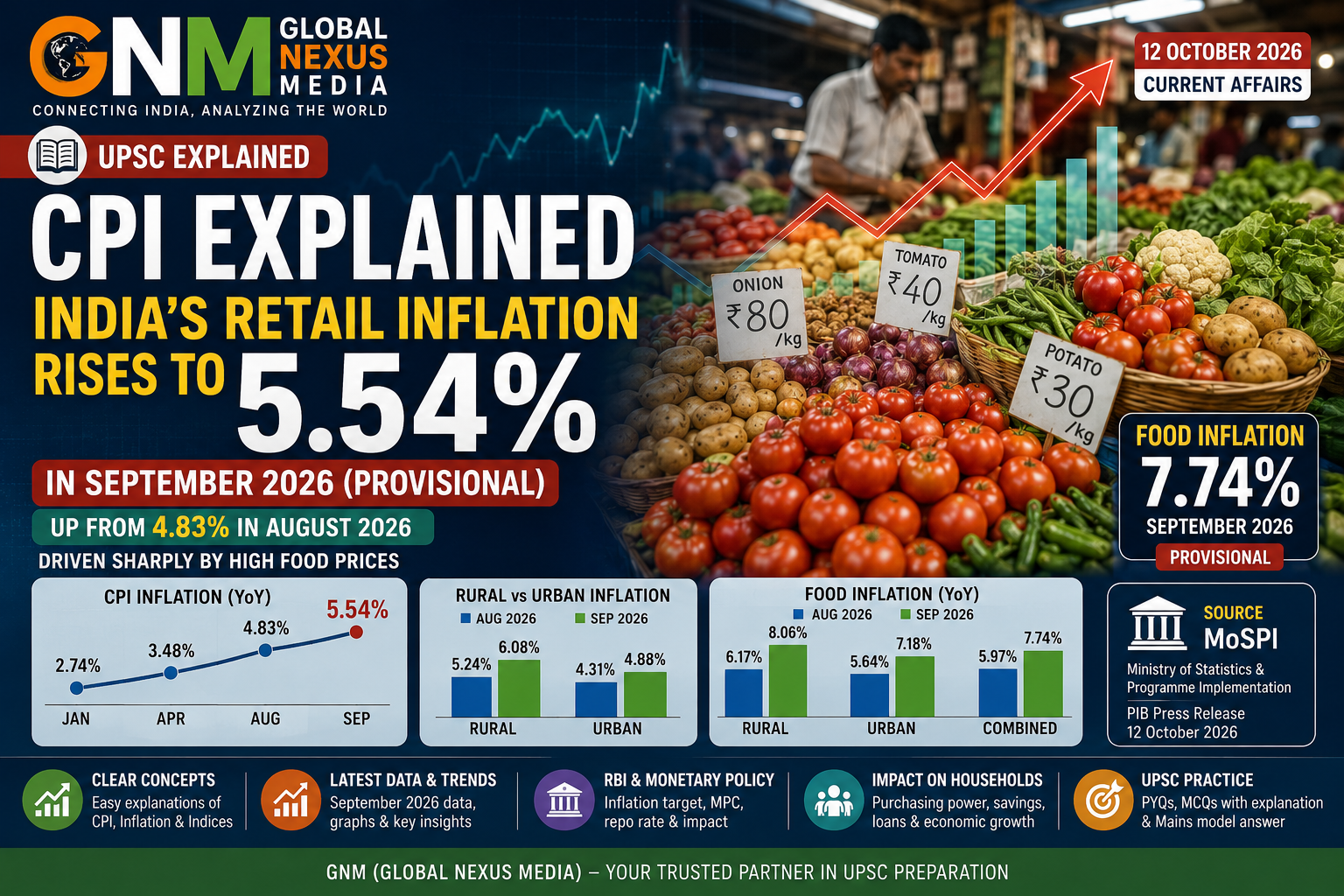
India’s retail inflation, measured by the Consumer Price Index (CPI), increased to 5.54% in September 2026, compared with 4.83% in August. Food inflation, measured by the Consumer Food Price Index (CFPI), rose from 5.97% to 7.74%.
The figures were released by the Ministry of Statistics and Programme Implementation (MoSPI) on 12 October 2026. September’s figures are provisional, whereas August’s figures are final.
The rise matters because inflation affects the cost of living, household purchasing power, business costs, interest-rate decisions and economic planning.
Important distinction: Inflation measures the rate at which prices change over time. It does not mean that every product has become more expensive by the same percentage.
Official source: MoSPI — CPI release for September 2026
2. What is inflation?
Inflation is a sustained increase in the general price level of goods and services in an economy over time.
When inflation rises, money generally buys fewer goods and services than before, assuming income does not increase at the same rate.
For example, if a household spends ₹1,000 on a particular basket of goods and the price of that same basket rises by 5%, it would cost ₹1,050.
This illustrates the effect of a price increase on purchasing power. It does not mean every household’s actual expenditure will rise by exactly 5%, because spending patterns differ.
Three terms every aspirant must understand
Inflation: The rate at which the general price level rises.
Disinflation: Inflation is still positive, but the rate of increase slows. For example, a decline in inflation from 6% to 4% is disinflation.
Deflation: The general price level falls over time, producing a negative inflation rate.
A decline in inflation does not necessarily mean that prices have returned to earlier levels. If inflation falls from 8% to 4%, prices are generally still rising, just more slowly.
3. What is the Consumer Price Index?
The Consumer Price Index measures changes over time in the prices of a representative basket of goods and services consumed by households.
In India, the National Statistical Office (NSO), under MoSPI, compiles and releases CPI statistics.
The index covers categories such as food, clothing, housing, health, education, transport and other household expenditure groups.
The CPI is important because it helps policymakers understand changes in the cost of living and provides the principal inflation measure used in India’s monetary-policy framework.
How is CPI inflation calculated?
The standard year-on-year calculation is:
Inflation rate = [(Current CPI − CPI one year earlier) ÷ CPI one year earlier] × 100
Suppose the CPI index was 105 one year ago and is now 110.25.
Inflation would be:
[(110.25 − 105) ÷ 105] × 100 = 5%.This is a simplified illustration, not India’s actual September 2026 calculation.
What does the base year mean?
A base year is the reference period against which an index is constructed. It provides a benchmark for measuring price changes.
India’s CPI series used for the September 2026 release has 2024 as its base year, represented as 2024 = 100.
The index value of 109.49 for the combined CPI in September 2026 does not mean that inflation was 9.49% during September. It represents the index level relative to the base-year reference, while the reported 5.54% inflation rate measures the change compared with September 2025.
UPSC trap: An index number and an inflation rate are different concepts.
4. What do the September 2026 figures tell us?
| Indicator | August 2026 | September 2026 |
|---|---|---|
| Headline CPI inflation | 4.83% | 5.54% |
| Food inflation | 5.97% | 7.74% |
| Rural CPI inflation | 5.24% | 6.08% |
| Urban CPI inflation | 4.31% | 4.88% |
| Rural food inflation | 6.17% | 8.06% |
| Urban food inflation | 5.64% | 7.18% |
August figures are final; September figures are provisional. Source: MoSPI.
The three major findings
First, headline inflation accelerated. The annual CPI inflation rate increased by 0.71 percentage points, from 4.83% to 5.54%.
Second, food inflation increased faster. The food inflation rate rose by 1.77 percentage points, from 5.97% to 7.74%.
Third, rural inflation was higher than urban inflation. Rural CPI inflation reached 6.08%, compared with 4.88% in urban areas. Rural food inflation also exceeded urban food inflation.
These differences matter because household expenditure patterns, food availability, transport costs and local market conditions vary across regions.
The data establishes the movement in inflation rates. Identifying the precise contribution of each cause requires further analysis of prices, supply conditions and the CPI basket.
5. Why are food prices important?
Food is an essential part of household expenditure. Changes in the prices of vegetables, cereals, pulses, oils and other food items can have a significant effect on household budgets.
The September release recorded particularly high year-on-year inflation in several individual items.
| Item | August 2026 | September 2026 |
|---|---|---|
| Onion | 48.78% | 108.09% |
| Ginger | 73.82% | 62.85% |
| Garlic | 43.60% | 54.62% |
| Lemon | 15.15% | 36.41% |
| Potato | −13.15% | −11.50% |
| Tomato | −31.09% | −8.62% |
These are item-level year-on-year inflation rates, not changes from August to September. September figures are provisional. Source: MoSPI.
Onion prices were more than twice their level a year earlier according to the reported inflation rate. Ginger inflation remained high but moderated, while garlic and lemon inflation accelerated.
At the same time, potato and tomato prices remained below their year-earlier levels. Their negative inflation rates indicate lower prices compared with the corresponding period last year, not necessarily a fall in prices between August and September.
Why can food inflation rise sharply?
Food prices may be affected by several factors:
- Adverse weather, crop damage or uneven rainfall.
- Disruptions in harvesting, storage, transport and distribution.
- Seasonal changes in production and market arrivals.
- Differences between demand and available supply.
- Fuel, transport and input costs.
- Changes in international prices or trade conditions, where relevant.
These are possible causes of food-price volatility. The CPI release by itself does not establish the precise contribution of each factor to September’s increase.
Why is food inflation important for poorer households?
Lower-income households often spend a larger share of their budgets on essential goods. When food prices rise, they may have less money available for education, health, transport and other needs.
Food inflation can therefore have consequences for nutrition, real income, household savings and inequality.
6. Headline inflation versus core inflation
Headline inflation measures inflation across the overall CPI basket.
Core inflation is a supplementary measure intended to identify more persistent underlying price pressures by excluding selected volatile components, commonly food and fuel. The exact definition may differ across institutions and analytical frameworks.
Why does the distinction matter?
Food prices can change sharply because of weather and supply conditions. Looking at core inflation can help analysts assess whether price pressures are also present across a wider range of goods and services.
However, core inflation is not a replacement for headline inflation. Food and fuel remain important to household welfare even when their prices fluctuate.
UPSC takeaway: Headline inflation reflects the overall consumer price movement; core inflation helps assess underlying price pressures.
7. CPI versus WPI: a frequently tested distinction
The Consumer Price Index and Wholesale Price Index measure prices at different stages of the economy.
| Feature | CPI | WPI |
|---|---|---|
| Full form | Consumer Price Index | Wholesale Price Index |
| Main focus | Consumer-level prices | Prices of goods at the wholesale or producer-distribution stage covered by the index |
| Primary relevance | Cost of living and retail inflation | Wholesale price movements |
| Main Indian statistical authority | MoSPI’s NSO | Office of the Economic Adviser, Department for Promotion of Industry and Internal Trade |
| Monetary policy | CPI is the principal inflation measure in India’s flexible inflation-targeting framework | Useful supplementary indicator of price pressures |
| Services | Includes consumer services | The standard Indian WPI does not comprehensively cover services |
Why can CPI and WPI move differently?
Consumer prices and wholesale prices are influenced by different weights, coverage, taxes, distribution costs, services and price transmission.India Is Growing Strong. Inflation Is Rising. RBI Turns to “Calibrated Tightening
For example, a fall in wholesale prices does not guarantee an immediate fall in retail prices. Retail prices may respond with a delay or be affected by other costs.
Prelims trap: Do not treat CPI and WPI as interchangeable measures.
8. What is the RBI’s inflation target?
India follows a flexible inflation-targeting framework under which the Reserve Bank of India (RBI) is responsible for maintaining price stability while keeping the objective of growth in mind.
The notified CPI inflation target is 4%, with a tolerance band of 2% to 6%.
The framework is associated with Section 45ZA of the Reserve Bank of India Act, 1934, and the Monetary Policy Committee (MPC).
The MPC determines the policy interest rate, the repo rate, in pursuit of the inflation target.
What does the September figure mean for the target?
At 5.54%, September headline inflation was above the 4% target but still within the 2%–6% tolerance band.
This distinction is important. The 4% figure is the target, while 2% and 6% form the lower and upper limits of the tolerance band.
A single monthly reading above 4% does not automatically mean that the statutory tolerance framework has been breached. The legal framework provides for a specified period and conditions for determining failure to meet the target.RBI’s New Forex Measures: Can They Stabilise the Indian Rupee? Explained for UPSC
How can interest rates affect inflation?
When inflationary pressure is broad-based and demand is strong, higher interest rates can moderate borrowing and spending. This may reduce demand-side pressure on prices over time.
However, monetary policy cannot directly produce more onions, repair a disrupted supply chain or reverse crop damage.
When inflation is primarily driven by food-supply shocks, the response may need to include agricultural, logistics, storage and trade measures alongside appropriate monetary policy.
9. Demand-pull and cost-push inflation
UPSC aspirants should understand the two major textbook explanations of inflation.
Demand-pull inflation occurs when aggregate demand grows faster than the economy’s capacity to supply goods and services.
For example, a rapid rise in spending may increase pressure on available production and resources.
Cost-push inflation occurs when the cost of production rises and businesses pass some of those costs on to consumers.
Higher fuel prices, input costs, transport charges or wage costs may contribute to cost-push pressure, depending on the circumstances.
Food inflation can arise from supply shortages and distribution disruptions, but actual price movements may reflect several interacting causes. The September CPI data alone does not establish that all of the increase was exclusively demand-pull or cost-push inflation.
10. How does inflation affect the Indian economy?
Household purchasing power
If prices rise faster than household income, the purchasing power of that income declines. Essential expenses can take up a larger share of the budget.
Savings and investment
Unexpected inflation reduces the real return on savings when interest earned is lower than the rate of price increases. It can also affect investment decisions and the cost of financing.
Borrowers and lenders
Higher interest rates can increase borrowing costs for households and businesses with floating-rate loans or new borrowing requirements. The effect depends on the loan terms and the timing of policy transmission.
Businesses
Inflation may increase the cost of raw materials, transport, wages and working capital. Businesses may raise selling prices, absorb lower margins or adjust production.
Economic growth
High and unpredictable inflation can complicate planning and reduce real purchasing power. Conversely, excessively weak demand and falling prices can also create economic difficulties.
The policy objective is not simply to make every price fall. It is to maintain price stability while supporting sustainable economic growth.
11. What can the government do about food inflation?
Food inflation frequently requires measures beyond interest-rate policy.
Improve agricultural productivity: Better seeds, irrigation, research, extension services and resilient farming practices can strengthen supply.
Strengthen storage and logistics: Warehousing, cold chains and efficient transport can reduce losses and improve the movement of produce.
Improve market information: Timely information on arrivals, stocks and prices can help farmers, traders and policymakers respond to shortages.
Use trade measures carefully: Import and export decisions can influence domestic availability, but they should consider consumers, farmers and long-term production incentives.
Improve distribution: Targeted food support and effective public distribution can help protect vulnerable households.
The appropriate policy depends on the cause of inflation. A temporary supply disruption may require a different response from sustained demand-driven inflation.
12. What is the significance of the new CPI base year?
The CPI series used in the September 2026 release has a base year of 2024.
A base-year revision helps the index reflect changing consumption patterns, goods, services and expenditure weights over time. Household spending changes as incomes, technology, access to services and consumption preferences evolve.
For UPSC, remember:
- A base-year revision changes the reference structure of an index.
- Inflation is calculated by comparing index values across periods in the relevant series.
- The index level itself is not the same as the inflation rate.
- Comparisons across different CPI series may require care because their weights, coverage and methodologies can differ.
The base year does not mean that the prices of all items were unchanged in 2024 or that the current inflation rate is calculated by comparing prices only with January 2024.
13. Important institutions and their roles
| Institution | Role |
|---|---|
| Ministry of Statistics and Programme Implementation (MoSPI) | Administrative ministry responsible for official CPI releases |
| National Statistical Office (NSO) | Compiles consumer price statistics through its statistical operations |
| Reserve Bank of India (RBI) | Conducts monetary policy and pursues the notified inflation target |
| Monetary Policy Committee (MPC) | Determines the policy repo rate under the inflation-targeting framework |
| Department for Promotion of Industry and Internal Trade (DPIIT) | Houses the Office of the Economic Adviser, which publishes WPI statistics |
| Government of India | Uses fiscal, agricultural, trade and welfare measures that can influence prices and protect vulnerable households |
How is CPI data collected?
The NSO collects retail price information across rural and urban markets. The September 2026 release reports collection from 1,407 urban markets, including online markets, and 1,465 villages.
The CPI is based on a representative basket and statistical methodology; it is not simply an average of a few vegetable prices from one city.
14. Prelims facts to memorise
- CPI stands for Consumer Price Index.
- India’s CPI is compiled by the NSO under MoSPI.
- The September 2026 CPI series uses 2024 as its base year.
- The reported September 2026 headline inflation rate was 5.54%, provisionally.
- September 2026 food inflation was 7.74%, provisionally.
- Rural inflation was 6.08%; urban inflation was 4.88%.
- India’s notified CPI inflation target is 4%, with a tolerance band of 2%–6%.
- The MPC determines the repo rate.
- CPI and WPI have different coverage and purposes.
- Disinflation means inflation is slowing; deflation means the general price level is falling.
- Headline inflation covers the overall CPI basket.
- Core inflation is an analytical measure of underlying price pressures, commonly excluding food and fuel.
15. UPSC Previous-Year Question connection
UPSC has tested inflation, monetary policy, price indices and the role of the RBI in the Civil Services Examination. These themes are relevant to the September 2026 CPI release.
Editorial accuracy note: A PYQ should be reproduced with its exact wording, options, year and paper only after checking the original UPSC question paper. Do not label a newly written question as an authentic PYQ.
Official archive: UPSC Previous Question Papers
For this article, the following questions are original practice questions designed around the topic.
16. Prelims practice questions
Question 1
With reference to India’s Consumer Price Index, consider the following statements:
- It measures changes in consumer prices over time.
- It is compiled by the National Statistical Office under MoSPI.
- Its index value and inflation rate are exactly the same measure.
Which of the statements given above are correct?
A. 1 only
B. 1 and 2 only
C. 2 and 3 only
D. 1, 2 and 3
Answer: B — 1 and 2 only.
Explanation: CPI measures consumer price changes and is compiled by the NSO. The index value measures the level of the index, whereas the inflation rate measures the percentage change between periods.
Question 2
Which of the following best describes disinflation?
A. A sustained fall in the general price level
B. A decline in the rate of inflation while prices may continue to rise
C. A rise in prices caused exclusively by imports
D. A permanent elimination of inflation
Answer: B.
Explanation: Disinflation is a slowdown in inflation. Deflation, by contrast, refers to a fall in the general price level.
Question 3
Consider the following statements about India’s inflation-targeting framework:
- The notified CPI inflation target is 4%.
- The tolerance band is 2%–6%.
- The MPC determines the policy repo rate.
Which of the statements given above are correct?
A. 1 only
B. 1 and 2 only
C. 2 and 3 only
D. 1, 2 and 3
Answer: D — 1, 2 and 3.
Explanation: All three statements correctly describe the notified inflation target, tolerance band and the MPC’s role.
Question 4
Which of the following statements correctly distinguishes CPI from WPI?
A. CPI measures only agricultural prices, whereas WPI measures only service prices.
B. CPI focuses on consumer prices, whereas WPI measures prices at the wholesale or producer-distribution stage covered by the index.
C. CPI and WPI always show identical inflation rates.
D. WPI is the principal measure used for India’s flexible inflation-targeting framework.
Answer: B.
Explanation: The two indices have different coverage and weights. CPI is the principal inflation measure in India’s flexible inflation-targeting framework.
Question 5
A country’s inflation rate falls from 7% to 4%, but its general price level remains above the previous year’s level. Which of the following best describes this situation?
A. Deflation
B. Disinflation
C. Hyperinflation
D. Stagflation, necessarily
Answer: B — Disinflation.
Explanation: The rate of price increase has slowed, but prices have not necessarily fallen. The facts provided do not establish deflation or stagflation.
Question 6
Why may a rise in food prices pose a challenge for monetary policy?
A. The RBI can directly increase agricultural production by raising the repo rate.
B. Food prices can be affected by supply shocks that interest-rate changes cannot directly resolve.
C. Food prices are excluded from headline CPI inflation.
D. A food-price increase automatically means that all other prices must rise by the same percentage.
Answer: B.
Explanation: Monetary policy affects demand and financial conditions, but agricultural supply and distribution may require separate interventions.
17. Mains practice — GS Paper III
Question (250 words): Rising food prices can complicate India’s efforts to maintain price stability while supporting economic growth. Explain the relationship between food inflation, household purchasing power and monetary policy. Suggest measures to address persistent food-price pressures.
Model answer
Food inflation is a rise in the prices of food items over time. India’s September 2026 CPI release reported headline retail inflation of 5.54% and food inflation of 7.74%, both provisionally. Rural inflation stood at 6.08%, compared with 4.88% in urban areas.
Impact on households and the economy
First, food inflation reduces household purchasing power when incomes do not rise at the same rate. Lower-income households may face greater pressure because essential food expenditure absorbs a substantial share of their budgets.
Second, rising food costs can affect nutrition, savings and consumption of other goods and services. Businesses may also face higher operating costs, while uncertainty about prices complicates investment and economic planning.
Third, food-supply shocks create a challenge for monetary policy. Higher interest rates can moderate demand and inflationary expectations, but they cannot directly repair crop losses or improve the supply of vegetables and cereals.
Measures to address food inflation
- Improve agricultural productivity through research, irrigation and resilient farming practices.
- Strengthen storage, cold chains, transport and market infrastructure.
- Improve information about production, market arrivals and inventories.
- Use trade measures carefully to manage temporary shortages.
- Strengthen targeted food support for vulnerable households.
- Maintain appropriate monetary policy to anchor inflation expectations and address persistent, broad-based price pressures.
Conclusion
India needs a coordinated approach combining monetary policy with agricultural, logistics and welfare measures. The objective should be durable price stability that protects household purchasing power while supporting sustainable growth.
Conclusion: What should an aspirant remember?
The September 2026 CPI release is an opportunity to connect a current economic development with fundamental UPSC concepts.
Remember the distinction between an index and its inflation rate, CPI and WPI, headline and core inflation, and disinflation and deflation. Understand the RBI’s inflation target, the MPC’s role and why food-supply pressures cannot always be resolved through interest-rate changes alone.
One-line revision: CPI measures changes in consumer prices; food inflation can disproportionately affect household budgets, while effective price stability requires suitable monetary policy and supply-side measures.
Official sources and further reading
- MoSPI — September 2026 CPI press release
- MoSPI — Consumer Price Index portal
- Reserve Bank of India — Monetary Policy
- UPSC — Previous Question Papers
This explainer is designed as a consolidated revision resource for this topic. Aspirants should continue to follow the official syllabus and examination notifications for the wider UPSC curriculum.