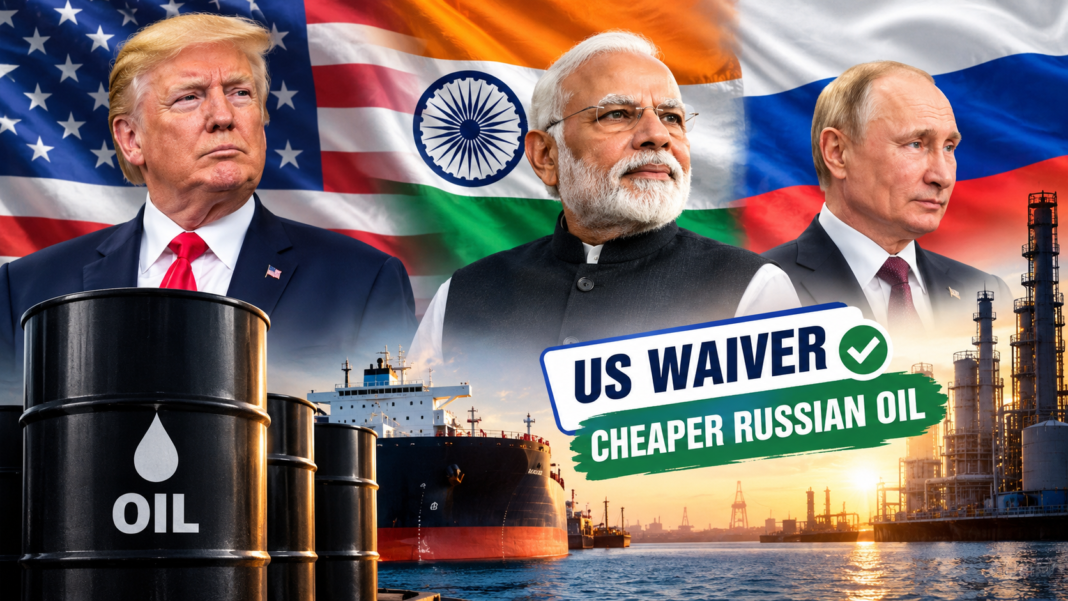
US President Donald Trump’s decision to waive key sanctions and tariff provisions targeting buyers of Russian oil has given India greater flexibility to continue sourcing competitively priced crude from Moscow. The move offers temporary relief to Indian refiners as elevated global oil prices and supply disruptions increase pressure on the country’s energy security.
The waiver, announced on October 16, 2026, suspends specified measures under the Lindsey O. Graham Sanctioning Russia and Iran Act of 2026. Although it eases the immediate threat of additional trade penalties, Washington retains the authority to reconsider the exemptions, leaving uncertainty over the longer-term outlook for India’s Russian oil imports.
US Waiver Eases Immediate Tariff Pressure on India
The US decision comes shortly before the October 18 deadline associated with provisions authorising additional duties on goods from major buyers of Russian-origin crude oil and natural gas.
The legislation created the possibility of tariffs of up to 100% on goods from qualifying countries that continued making specified purchases of Russian energy. It also provided for other sanctions and trade restrictions targeting Russia and countries involved in circumventing restrictions on its oil trade.
In his executive order, Trump waived specified duties, sanctions and restrictions under the legislation, citing US national interests. The exemptions remain in effect until the administration determines that further action is necessary.
For India, the move reduces the immediate risk of additional US trade penalties linked to its purchases of Russian energy. However, it does not amount to a permanent removal of all US sanctions on Russia or guarantee unrestricted access to Russian crude under every applicable restriction.
The White House has also directed officials to monitor international purchases of Russian oil and gas and report developments that could justify further action.
India Expected to Maintain Russian Oil Imports
India is expected to continue importing Russian crude at around current levels following the waiver, according to industry estimates reported on October 17.
India imported approximately 1.82 million barrels per day (bpd) of Russian crude in September. October imports are projected to remain in the range of 1.8 million to 1.9 million bpd, according to estimates cited by Business Standard.
These volumes make India one of the largest buyers of Russian seaborne crude, alongside China. Russian oil has become a major component of India’s energy supply since Moscow redirected exports towards Asian markets following Russia’s invasion of Ukraine in February 2022.
Before the conflict, Russian crude accounted for a relatively small share of India’s oil imports. Western restrictions and the withdrawal of several traditional buyers subsequently encouraged Russia to offer discounted supplies to alternative markets.
Indian refiners increased purchases because competitively priced crude improved their processing economics and offered an opportunity to manage import costs.
The latest US waiver gives refiners additional room to make purchasing decisions based on prices, availability, freight costs and commercial considerations rather than the immediate threat of the new tariff provisions.
Why Cheaper Russian Crude Matters for India’s Economy
India imports more than 88% of its crude oil requirements, making the country particularly vulnerable to fluctuations in international energy prices.
When crude prices rise, the impact can extend beyond oil companies and refineries. Higher import costs can put pressure on the country’s trade balance, increase inflationary risks and complicate decisions concerning domestic fuel prices.
Discounted Russian crude can help refiners reduce procurement costs compared with more expensive alternatives, although the actual savings depend on the grade of oil, transportation expenses, insurance, payment arrangements and refining requirements.
The advantage is not guaranteed to remain constant. Discounts on Russian Urals crude have narrowed at times, while freight costs and competition from other buyers have affected the economics of individual shipments.
The broader global oil market also remains exposed to geopolitical tensions and disruptions affecting supplies from West Asia. These conditions make access to multiple suppliers important for India’s energy security.
Maintaining purchases from Russia, alongside supplies from West Asia, the United States and other producers, allows Indian refiners to compare costs and adjust their sourcing strategies as market conditions change.
US Waiver Offers Relief, but Uncertainty Remains
Despite the immediate benefit, the waiver does not eliminate the geopolitical risks surrounding India’s Russian oil trade.
The US administration has retained the ability to reconsider the exemptions and has instructed officials to monitor countries’ purchases of Russian energy. Future changes in sanctions policy could therefore influence refiners’ decisions and the broader India-US trade relationship.
Russian oil purchases are also affected by factors beyond US policy, including global demand, shipping availability, payment mechanisms, insurance restrictions and competition from Chinese refiners.
For India, the central challenge is to balance affordable energy supplies with trade relations and changing international restrictions.
The waiver provides breathing room for now, allowing Indian refiners to continue evaluating Russian crude on commercial grounds. However, the durability of this advantage will depend on future US policy decisions, global oil prices and the availability of reliable supplies from alternative producers.
Ultimately, the US waiver strengthens India’s short-term flexibility in sourcing Russian oil, but it does not remove the uncertainty surrounding the country’s e