

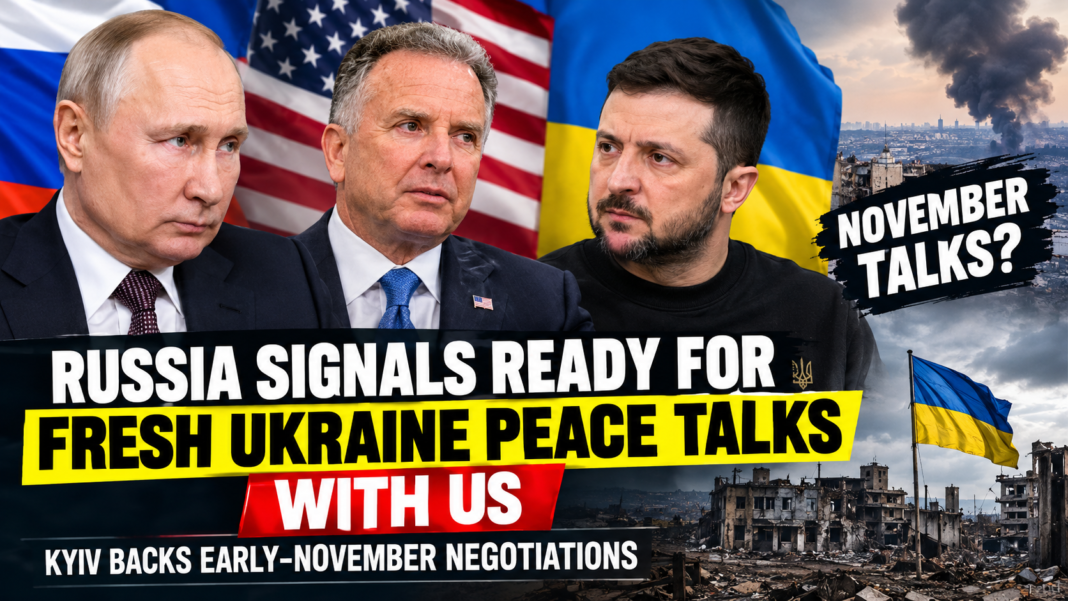
Russia Opens the Door to Renewed Ukraine Peace Negotiations
Russia has signalled its willingness to resume peace negotiations with Ukraine and the United States in November, creating a fresh diplomatic opening in a conflict that continues to affect European security and international relations.
On October 21, Russian President Vladimir Putin agreed in principle to restart trilateral talks following a meeting in St. Petersburg with US special envoy Steve Witkoff, according to the Kremlin. Russian foreign policy adviser Yuri Ushakov said the proposed negotiations could focus on establishing a post-war security framework for Russia and Ukraine.
The development comes as Washington intensifies its efforts to bring Moscow and Kyiv back to the negotiating table. However, the proposed talks do not yet represent a peace agreement, and important questions concerning territory, security guarantees and the terms of ending the war remain unresolved.
For now, the immediate challenge is to turn renewed diplomatic contact into substantive negotiations capable of producing measurable progress.
Ukraine Supports an Early-November Meeting
Ukrainian President Volodymyr Zelenskyy has expressed support for a new round of negotiations involving Ukraine, Russia and the United States.
Speaking to journalists on October 21 while returning from Norway, Zelenskyy said Kyiv supported the American proposal to hold trilateral discussions as soon as possible, preferably no later than early November.
According to Reuters, Zelenskyy said Ukraine had received indications that Russia was also supportive of a meeting at the level of negotiating teams. He added that Kyiv remained open to proposals involving a ceasefire, an end to the war, an energy-related ceasefire and humanitarian initiatives.
The Ukrainian position indicates a willingness to continue diplomatic engagement, although participation in negotiations does not necessarily mean that Kyiv has accepted Moscow’s demands or that the two sides have reached agreement on the conditions for peace.
The timing and format of the proposed meeting remain important. Negotiations between officials could help prepare the ground for further discussions, but a breakthrough would depend on whether the parties can narrow their differences on the central issues dividing them.
What Happened During Putin’s Meeting With the US Envoy?
Putin’s meeting with Witkoff in St. Petersburg lasted approximately three hours, according to the Kremlin.
The discussions followed Witkoff’s meetings in Oslo with Zelenskyy and European representatives. The diplomatic contacts focused on efforts to restart negotiations and explore the framework for a possible settlement.
According to reporting by the Associated Press, the discussions also covered post-war economic cooperation and European security. Jared Kushner, US President Donald Trump’s son-in-law, participated in part of the discussions by video, Ushakov said.
The meeting forms part of Washington’s continuing effort to facilitate direct negotiations between Moscow and Kyiv.
US President Donald Trump has pressed Ukraine to reach a settlement, while Russian officials have indicated that Moscow is prepared to consider renewed diplomatic engagement.
Nevertheless, the latest discussions have not established that either side is ready to abandon its principal demands. The extent to which the diplomatic initiative can address those differences remains uncertain.
Major Obstacles to a Peace Agreement Remain
Despite the renewed diplomatic activity, several significant obstacles stand in the way of a settlement.
Territorial disagreements: Russia and Ukraine continue to hold conflicting positions over occupied territories and the future status of disputed areas. These disagreements remain central to any negotiations.
Security guarantees: Ukraine wants assurances that its security will be protected against future Russian military action. The nature of any guarantees and the role of international partners remain important questions.
Ceasefire arrangements: A halt to fighting would require agreement on the conditions, implementation and monitoring of a ceasefire. The parties have yet to announce a comprehensive arrangement linked to the latest diplomatic initiative.
Post-war reconstruction: Rebuilding damaged infrastructure, restoring essential services and supporting displaced communities would require substantial resources and long-term planning.
Previous rounds of trilateral negotiations held earlier in 2026 produced limited publicly reported progress beyond prisoner exchanges, according to the Associated Press. The continuation of military operations also underscores the distance between diplomatic discussions and an enforceable peace settlement.
Fighting Continues Despite Diplomatic Efforts
The renewed push for negotiations is unfolding alongside continued attacks in Ukraine.
Ukrainian officials reported that overnight Russian attacks on October 21 killed five people and wounded at least 23 others in Kyiv and the Kharkiv area. The reported casualties included three deaths in Kyiv and two near Kharkiv.
Officials also reported damage to residential buildings and attacks affecting energy infrastructure. These figures reflect Ukrainian authorities’ accounts of the incidents; they should not be interpreted as independently verified casualty totals.
The continued violence highlights the immediate humanitarian stakes of the diplomatic process. Even if negotiations resume in November, civilians will remain exposed to the consequences of military operations unless the parties agree on effective measures to reduce or stop the fighting.
For Ukraine, protecting infrastructure and maintaining essential services are also important concerns as the country approaches the colder months.
Why the Talks Matter for the International Community
The Russia–Ukraine war has consequences that extend beyond the two countries.
The conflict has shaped European defence planning, relations between Russia and Western governments, international sanctions policy and debates over regional security.
A credible diplomatic process could create opportunities to reduce military escalation and improve humanitarian conditions. However, the announcement of proposed talks alone does not establish that a ceasefire or lasting settlement is imminent.
For governments and international organisations, the next stage will involve determining whether negotiations can produce concrete commitments rather than another round of discussions without a substantial outcome.
The response of European governments will also matter, particularly on questions concerning Ukraine’s future security and the broader European security framework.
What the Latest Development Means for India
For India, the diplomatic initiative is relevant because the conflict intersects with energy markets, international trade, defence relationships and relations with major global powers.
Any sustained reduction in hostilities could influence market expectations and international economic conditions. However, it would be premature to predict lower energy prices or immediate economic benefits solely on the basis of the latest announcement.
India has maintained diplomatic engagement with both Russia and Western countries while repeatedly emphasising dialogue and diplomacy as ways to address international conflicts.
New negotiations could therefore be significant for New Delhi’s broader diplomatic environment, particularly if they lead to measurable progress towards de-escalation.
At this stage, however, the practical implications for India’s economy and foreign policy will depend on what the parties actually agree to and whether those commitments are implemented.
What Happens Next?
The immediate focus is on whether Russia, Ukraine and the United States can arrange the proposed negotiations in early or mid-November.
The Kremlin has indicated that Russia is willing in principle to resume talks after November 10, while Zelenskyy has called for a meeting as early as possible in November. The difference in the publicly stated timelines means the precise date and format require further confirmation.
Attention will also turn to the agenda, the level of representation and whether the parties can identify areas of agreement on ceasefire arrangements, security guarantees and humanitarian measures.
Until those details become clearer, the announcement should be viewed as a renewed diplomatic opportunity rather than evidence that the war is approaching a definitive end.
Conclusion
Russia’s willingness to resume trilateral negotiations with Ukraine and the United States has reopened a diplomatic channel at a time when military operations continue.
Ukraine has also expressed support for renewed talks, but major disagreements over territory, security and the conditions for ending the conflict remain.
The significance of the proposed November meeting will ultimately depend on whether the diplomatic initiative produces concrete steps towards reducing violence and establishing a credible path to peace.
For the international community, the central question is no longer simply whether the parties will meet, but whether those discussions can deliver progress that extends beyond the negotiating table.


