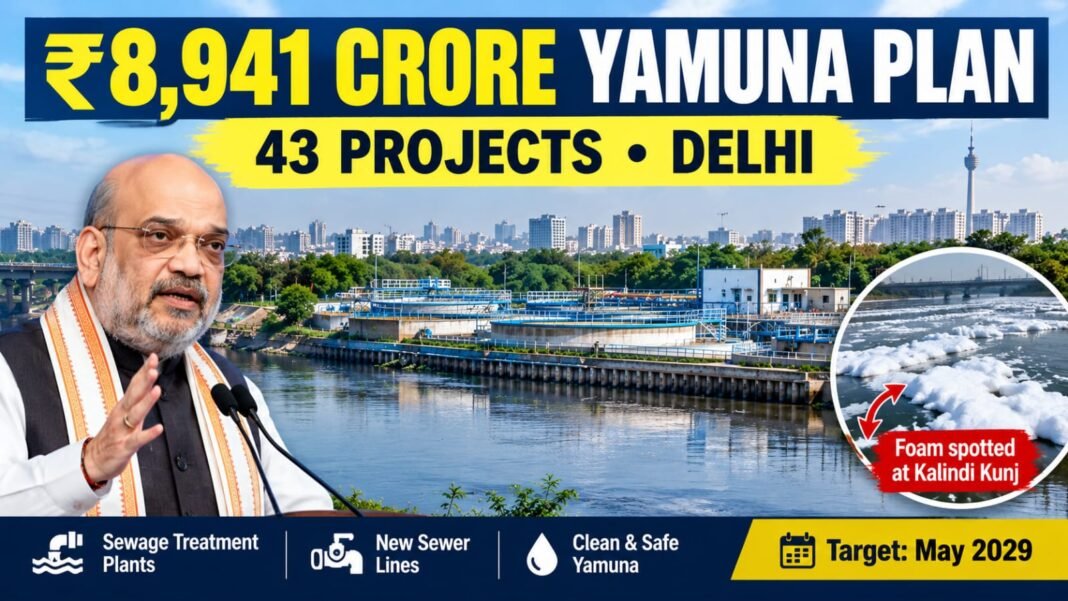
The Centre and Delhi government have launched a major water and sewerage infrastructure initiative to reduce pollution in the Yamuna. However, reports of foam on the river at Kalindi Kunj have renewed attention on the challenge of cleaning the river.
New Delhi, October 23, 2026: The Yamuna River’s pollution problem is back in focus after the launch of 43 water and sewerage projects worth ₹8,941.22 crore in Delhi. Union Home Minister Amit Shah inaugurated 10 completed projects and laid the foundation stones for 33 more on October 22. The initiative aims to improve sewage treatment, expand sewer connections and prevent untreated wastewater from entering the river.
The announcement comes at an important time for Delhi, where the Yamuna’s water quality remains a major environmental concern. On October 23, a report by The News Mill, citing ANI inputs, said foam was visible on the river’s surface at Kalindi Kunj. The development has drawn attention to the gap between infrastructure plans and the challenge of improving the river’s actual condition.
What Is the ₹8,941 Crore Yamuna Project?
The 43 projects fall under the Delhi Jal Board’s water and sewerage infrastructure programme. According to reports, 10 projects worth ₹2,827.11 crore were inaugurated, while foundation stones were laid for 33 projects costing ₹6,114.11 crore.
The projects focus on collecting and treating wastewater before it reaches the Yamuna. They include sewage treatment plants (STPs), sewer-line expansion, pumping stations, sewer rehabilitation and improvements to drinking-water infrastructure.
A major part of the plan is a proposed sewage treatment plant at Okhla with a capacity of 124 million gallons per day (MGD). The project is estimated to cost ₹1,161 crore.
The plan also includes upgrades to eight existing sewage treatment plants and the development of decentralised sewage treatment facilities in areas where a large centralised plant may not be practical.
New Sewer Lines and Treatment Facilities
The initiative includes plans to lay around 1,034 kilometres of sewer lines. The expansion is intended to improve connections for homes in unauthorised colonies and villages, where gaps in sewage infrastructure can allow wastewater to enter drains without adequate treatment.
The programme also includes 29 decentralised sewage treatment plants and pumping stations. These facilities are expected to help manage wastewater closer to the areas where it is generated.
Another component is the proposed 477 MLD Chandrawal water treatment plant, aimed at strengthening Delhi’s drinking-water infrastructure.
Together, these measures are designed to improve wastewater management and reduce the amount of untreated sewage reaching the river.
Foam Seen at Kalindi Kunj Raises Questions
Despite the announcement of the projects, foam was reportedly observed on the Yamuna at Kalindi Kunj on October 23.
The sighting highlights the continuing challenge of river pollution. However, the appearance of foam alone does not establish its precise chemical composition or source. Water testing and environmental assessments are needed to determine the causes and possible risks.
The latest report also underlines why cleaning riverbanks alone cannot solve the problem. Effective pollution control requires sewage collection, proper treatment, regular monitoring and action against sources of contamination.
When Is the Yamuna Expected to Improve?
According to reports on the project, the work is expected to take around two to two-and-a-half years to complete. The government has set a target of May 2029 for cleaning and rejuvenating the Yamuna.
The results will depend on the timely completion of infrastructure, the performance of treatment plants, household sewer connections and the prevention of untreated wastewater entering the river.
The impact will need to be assessed through water-quality monitoring and progress reports as the projects advance.
What Happens Next?
The ₹8,941.22 crore programme represents a major investment in Delhi’s water and sewage infrastructure. Its long-term success will depend on implementation, maintenance and measurable improvements in water quality.
For residents, the key question is whether these projects will lead to a sustained reduction in pollution rather than temporary improvements.
As construction progresses, the completion of treatment facilities and independent monitoring of the Yamuna’s water quality will be important indicators of progress.
Sources: The Indian Express, DD News and The News Mill, with ANI inputs. This report distinguishes announced project plans from outcomes that have yet to be demonstrated.