

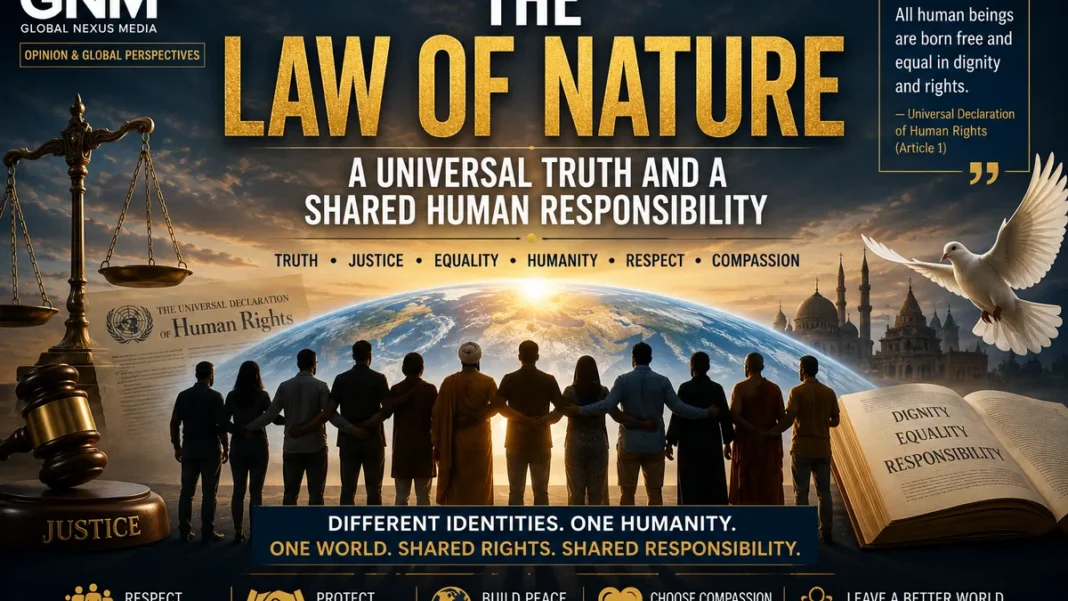
A Call for Justice, Equality, Human Dignity and Shared Human Responsibility
Introduction: Beyond Religion, Borders and Identity
Humanity has never lacked differences. We speak different languages, follow different religions, belong to different nations and inherit different cultural traditions. Yet beneath these differences lies something fundamental that connects us all: our shared humanity.
Across generations, civilizations have debated morality, justice, truth and the meaning of a good society. Although their beliefs and interpretations may differ, certain ethical principles repeatedly emerge: honesty, fairness, compassion, equality, respect, responsibility and the protection of human dignity.
These principles may be understood collectively as the Law of Nature — not as a formal legal code or a universally agreed scientific law, but as a moral framework rooted in the fundamental responsibilities human beings owe to one another.
It does not belong exclusively to any religion, nation, political ideology or civilization. It transcends geographical boundaries and reminds us that human dignity cannot be determined by wealth, power, colour, language, religion or social status.A NEW INDIA!
Truth has no nationality. Justice has no religion. Humanity has no borders.
And respect should never depend on whether someone agrees with us.
1. The Fundamental Principles That Belong to All Humanity
Consider the basic principles upon which a peaceful and just society should stand.
Truth: Honesty and integrity must guide our words, actions and decisions.
Justice: Every individual deserves fairness, without discrimination or favouritism.
Equality: Wealth, status, religion, colour and nationality cannot determine a person’s inherent human worth.
Humanity: Compassion and concern for others must remain central to human behaviour.
Respect: Every person deserves dignity, even when their beliefs and opinions differ from ours.
Mutual Responsibility: Individual freedom must coexist with responsibility towards society.
Peaceful Coexistence: Differences should encourage understanding, not hatred or violence.
Love for One’s Homeland: Patriotism should inspire service, responsibility and the welfare of one’s people, without becoming hostility towards other nations.
These principles do not require every human being to follow an identical way of life.
They require something much more meaningful: that we recognise one another’s equal dignity despite our differences.
A wealthy individual is not inherently more valuable than a poor individual. A powerful person does not possess greater human dignity than an ordinary citizen. A person’s religion, language or nationality cannot become a justification for denying them justice.
The real measure of a society is not how respectfully it treats the powerful, but how fairly it treats those who have the least power.
2. Different Religions, Different Civilizations — A Shared Ethical Foundation
Human civilization has developed through different religious, philosophical and cultural traditions. Each has contributed to humanity’s understanding of moral responsibility, social conduct and the importance of justice.
Their teachings and interpretations are not identical. Nor do all societies agree on every ethical question.
However, across many traditions, we repeatedly encounter the importance of truthfulness, compassion, fairness, self-restraint and respect for human life.
The significance of these shared principles is not that they eliminate differences between civilizations. It is that they create opportunities for cooperation despite those differences.
We should not ask humanity to abandon its identities in order to live peacefully.
Instead, we should encourage every individual and community to recognise that their identity carries responsibilities towards others.
A person can remain deeply connected to their religion while respecting another person’s freedom of belief. A citizen can love their country while respecting the sovereignty and dignity of other nations. A community can preserve its traditions without denying others the right to preserve theirs.
The Law of Nature does not demand uniformity. It demands fairness in the presence of diversity.
3. The Family: A Small Example of How the World Should Function
Consider a simple family.
Four people live under the same roof. Each has a different personality, different preferences, different opinions and perhaps different beliefs.
One may prefer one lifestyle, another may choose something entirely different. They may disagree about decisions, priorities and the direction of their lives.
Does that mean they must fight every day?
Of course not.
A healthy family survives not because everyone thinks alike, but because its members recognise mutual respect, responsibilities and the importance of coexistence.
They can disagree without humiliating one another. They can express different opinions without denying one another’s dignity. They can maintain individual identities while contributing to a shared home.
Now consider the world.
Billions of people belong to different nations, religions, cultures and communities. If a family can function despite differences, why should humanity consider peaceful coexistence impossible?
The world is not required to become one family in its beliefs.
It must learn to behave like a responsible human community in its treatment of others.
The family is a simple example, but the principle has global significance: disagreement does not have to become hostility.
4. The United Nations and the International Recognition of Human Dignity
The idea of shared human dignity is not merely a philosophical discussion. It also has an important foundation in modern international institutions and human rights principles.
On 10 December 1948, the United Nations General Assembly adopted the Universal Declaration of Human Rights (UDHR) as a common standard of achievement for all peoples and nations.
Its Article 1 states:
“All human beings are born free and equal in dignity and rights.”
Article 2 further establishes that everyone is entitled to the rights and freedoms in the Declaration without discrimination based on factors including race, colour, sex, language, religion, political opinion, national origin or social status.
These provisions express an important international commitment: human dignity should not depend on an individual’s identity.
The United Nations Charter also identifies international cooperation, peaceful relations between nations and respect for fundamental human rights as central purposes of the international community.
Yet recognising a principle is not the same as implementing it.
The existence of international declarations, national constitutions, courts and legal institutions does not automatically guarantee justice in everyday life.
Their true value depends on how consistently their principles are respected and implemented.
Sources:
Universal Declaration of Human Rights: https://www.un.org/en/about-us/universal-declaration-of-human-rights/
United Nations Charter: https://www.un.org/en/about-us/un-charter/
5. The Greatest Contradiction: We Demand Justice for Ourselves but Forget Others
One of humanity’s greatest challenges is the contradiction between the values we proclaim and the behaviour we practise.
We demand justice, but sometimes only when injustice affects our own community.
We demand freedom, but may hesitate to respect the freedom of those whose opinions we dislike.
We expect others to respect our religion, culture and identity, yet sometimes fail to extend the same courtesy to them.
We speak about equality while allowing wealth, influence and political power to shape how people are treated.
This contradiction exists at different levels of society.
An individual may demand honesty from others while compromising their own integrity. A community may demand equal rights while discriminating against another community. An institution may promote fairness in its public statements but fail to apply it consistently.
Governments, too, must be judged by the gap between their declared principles and their actual decisions.
The problem is not necessarily the absence of moral principles. The problem is our unwillingness to apply those principles consistently, particularly when doing so challenges our personal interests.
A principle has little meaning if we defend it only when it benefits us.
Justice cannot be selective. Human dignity cannot be conditional. Equality cannot depend on political convenience.
If we expect others to respect our rights, we must be prepared to respect theirs as well.
6. Laws Alone Cannot Build a Just Society
Every organised society requires laws, institutions and systems of accountability.
Constitutions establish rights. Courts interpret laws. Governments administer public institutions. International agreements provide frameworks for cooperation between nations.
These structures are essential.
But a legal system cannot independently create a morally responsible society.
A law may prohibit discrimination, but individuals must choose not to discriminate. A constitution may guarantee equality, but institutions must implement it fairly. A court may deliver justice, but society must respect the principles that make justice possible.
This is where individual character becomes important.
The Law of Nature, understood as an ethical responsibility, must operate at three interconnected levels:
Individual responsibility: Every person must practise honesty, fairness, compassion and respect in daily life.
Social responsibility: Families, communities, educational institutions and organisations must encourage peaceful coexistence and reject discrimination.
Institutional responsibility: Governments, courts and international organisations must uphold rights, apply laws fairly and remain accountable for their decisions.
A just society emerges when moral responsibility and institutional accountability work together.
Neither can completely replace the other.
7. Freedom Must Come with Responsibility
Human freedom is essential, but freedom should not be confused with the unrestricted right to harm others.
Every individual should have the freedom to express opinions, follow their beliefs, pursue opportunities and make personal choices, subject to lawful protections for the rights of others.
However, these freedoms exist within a shared society.
My freedom cannot become an excuse to destroy another person’s dignity. My beliefs cannot justify denying someone else’s basic rights. My national identity cannot become a licence to hate another nation or its people.
The same principle applies to communities and governments.
Power should be exercised with responsibility. Authority should be accompanied by accountability. National interests should be pursued without abandoning respect for international law and human dignity.
The purpose of responsibility is not to suppress freedom. It is to make freedom sustainable for everyone.
8. A Message to the Global Community: Put Humanity into Practice
The world does not need a single religion, a single culture or one identity imposed upon all humanity.
It needs a stronger commitment to the ethical principles that make coexistence possible.
We need a world in which disagreement does not automatically become hatred, wealth does not determine human worth, power does not replace justice and identity does not become an excuse for discrimination.
We must teach children not only to be proud of their own identity but also to respect the dignity of people who are different from them.
We must encourage leaders to understand that the strength of a nation is not measured only by its economic or military power, but also by the fairness of its institutions and the dignity it guarantees to its people.
We must remind communities that protecting their own rights and respecting the rights of others are complementary responsibilities.
And we must remind individuals that a better world cannot be built by governments alone. It begins with the everyday choices of ordinary human beings.
9. Questions Every Human Being Should Ask
Before demanding justice, can we ensure that we treat others fairly?
Before asking for respect, can we demonstrate respect towards those who disagree with us?
Before defending our own freedom, can we recognise the freedom of others?
Before judging another person’s identity, can we recognise their humanity?
Before expecting governments and institutions to act responsibly, are we willing to practise responsibility ourselves?
These are not questions directed at any single religion, country or community.
They are questions for all of humanity.Omar Abdullah and Nidhi Razdan Wedding Claim Draws Attention in Kashmir
The answers will determine whether our declared values remain words on paper or become principles that shape our everyday lives.
Conclusion: One Humanity, Shared Responsibility
Humanity does not need to eliminate every difference to achieve peace.
Different languages can coexist. Different religions can coexist. Different political opinions can coexist. Different cultures and civilizations can preserve their identities while contributing to a common future.
The real achievement of civilization will not be a world where everyone thinks alike.
It will be a world where people can think differently without denying one another’s dignity, live differently without discriminating against one another, and pursue their interests without abandoning justice.
The Law of Nature, as a shared ethical vision, reminds us that humanity’s greatest strength lies not in uniformity but in the ability to recognise common responsibilities despite our differences.
Its principles must be practised by individuals, protected by institutions, encouraged by communities and respected by governments.
The responsibility begins with each of us.
It extends to our families, our communities and our nations. Ultimately, it reaches the entire global community.
We may have different identities, but we share one human future.
One Humanity. One World. Shared Rights. Shared Responsibility.
The Law of Nature is not merely an idea to discuss. It is a responsibility to practise.
Author: Abu Parvez
Opinion & Global Perspectives | GNM — Global Nexus Media


Assalamu alaikum good job ana God bless you
Shukriya bhai 🌹
Bhai filhal itna hi kahna hai ki aapne samaj aur samaj ke liye zimmedaron ko jo aayina dikhane ko koshish ki hai woh lajawab hai aur sach chai se roo baroo hai baqi main aapse bad mein bat karta hoon