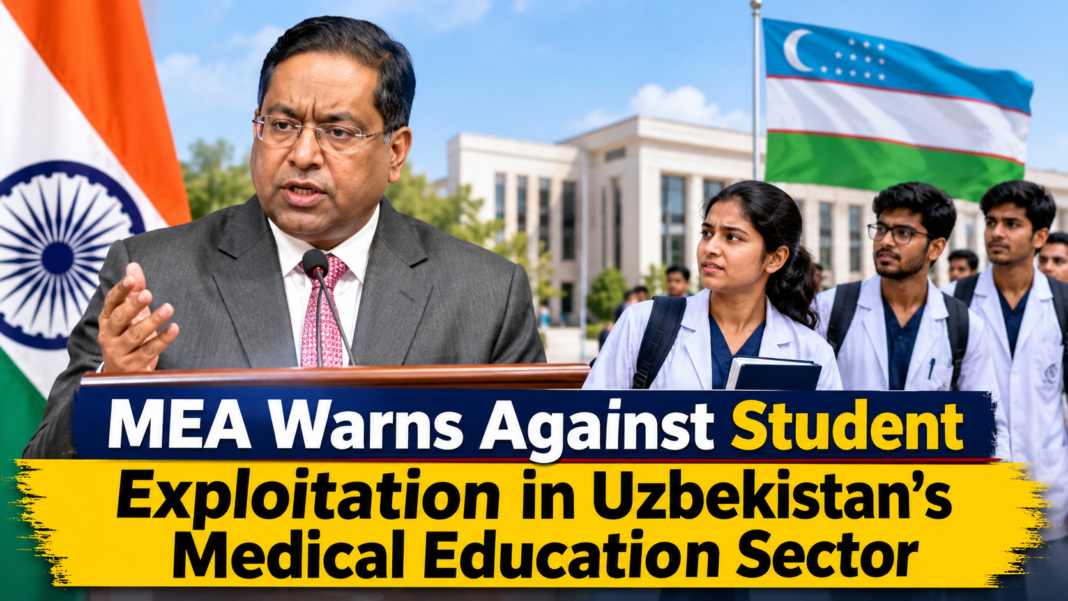
November 3, 202: The Indian government has raised concerns over the possible exploitation of Indian students pursuing medical and other higher education courses in Uzbekistan. The Ministry of External Affairs (MEA) has stressed that students travelling abroad must receive quality education and should not be misled or exploited by individuals or organisations involved in the admission process.
MEA spokesperson Randhir Jaiswal addressed the issue during the ministry’s bi-weekly press briefing on Tuesday. He said India continues to engage with the Uzbek authorities to address concerns related to Indian students studying in the country. The government wants to ensure that students receive proper educational opportunities and are protected from unscrupulous elements in both India and Uzbekistan.
The statement comes amid concerns about the number of Indian students travelling to Uzbekistan for medical education. During the briefing, Jaiswal was asked about reports suggesting a decline in the number of Indian students and medical aspirants going to the country, from around 2,000 to approximately 200.
Responding to the question, he said the Indian government remains in contact with the Uzbek side regarding issues affecting Indian students.
MEA Warns Against Misleading Admission Practices
Jaiswal emphasised that Indian students planning to pursue medical or other courses in Uzbekistan should not fall victim to misleading promises or exploitation by unscrupulous individuals.
He said it was important to ensure that students travelling from India for higher education are not exploited either in India or in Uzbekistan. The government is particularly concerned about students making major financial and academic decisions based on incomplete or misleading information.
The MEA spokesperson also highlighted advisories issued by the Indian Embassy in Tashkent and the National Medical Commission (NMC). These advisories provide important guidelines and precautions for students considering admission to foreign medical institutions.
He encouraged students and parents to carefully read the official guidance before deciding on a university or medical programme abroad.
NMC Flags Concerns Over Medical Colleges
The National Medical Commission had earlier issued an advisory on April 1, cautioning Indian students about certain medical institutions in Uzbekistan.
The advisory referred to concerns raised by the Indian Embassy in Tashkent regarding the quality of education and alleged malpractices by agents involved in facilitating admissions.
Four institutions were specifically named in the advisory:
- Bukhara State Medical Institute
- Samarkand State Medical University
- Tashkent State Medical University
- TIT Institute of Medical Sciences in Bangalore, an offshore campus linked to Tashkent State Medical University’s Termez Branch.
The NMC highlighted concerns that some colleges were reportedly admitting more students than their permitted capacity. Such practices could affect the standard of education, classroom facilities and the availability of proper academic resources.
The Commission also flagged difficulties faced by Indian students in receiving practical medical training. Language barriers were among the major concerns, as the medium of instruction was reportedly not English in some cases.
These issues are important for medical students because their education requires not only classroom learning but also regular practical sessions, hospital exposure and clinical training.
Important Rules for Indian Students Studying Medicine Abroad
The NMC has advised students to carefully check the university, course structure and admission conditions before enrolling in a foreign medical institution.
Under the requirements highlighted in the advisory, students pursuing medical education abroad must ensure that their course includes at least 54 months of study at one institution. This must be followed by a 12-month internship at the same university.
The medical programme must also be taught in English and include the required subjects and clinical training.
These conditions are important for Indian students who plan to return to India after completing their medical degrees. Students must ensure that their foreign qualifications meet the applicable NMC requirements to avoid difficulties with registration and eligibility to practise medicine in India.
The Commission has warned that students who fail to meet the prescribed requirements may face problems obtaining registration in India.
What Students and Parents Should Check Before Admission
The latest warning highlights the importance of proper research before choosing a foreign medical university. Students should not depend only on education agents, advertisements or promises of guaranteed admission.
Before paying admission fees, students and parents should:
- Check the university’s recognition and official status.
- Read the latest NMC guidelines for foreign medical education.
- Confirm that the course meets the required duration and internship conditions.
- Verify that English is the medium of instruction.
- Check whether the university provides adequate clinical and practical training.
- Understand the complete fee structure and admission conditions.
- Read advisories issued by the Indian Embassy in the destination country.
Students should also seek clarification from the relevant Indian authorities if they have doubts about a university or its medical programme.
India Continues Engagement With Uzbekistan
India’s latest statement indicates that the government is continuing discussions with Uzbekistan to address issues affecting Indian students.
The focus remains on protecting students from misleading admission practices and ensuring that they receive education that meets the required standards.
For students planning to study medicine abroad, the concerns surrounding Uzbekistan serve as an important reminder that choosing a university requires careful attention to academic quality, course requirements and future professional eligibility.
The government’s message is clear: Indian students must have access to quality education and must not be exploited by unscrupulous elements while pursuing their academic goals overseas.