

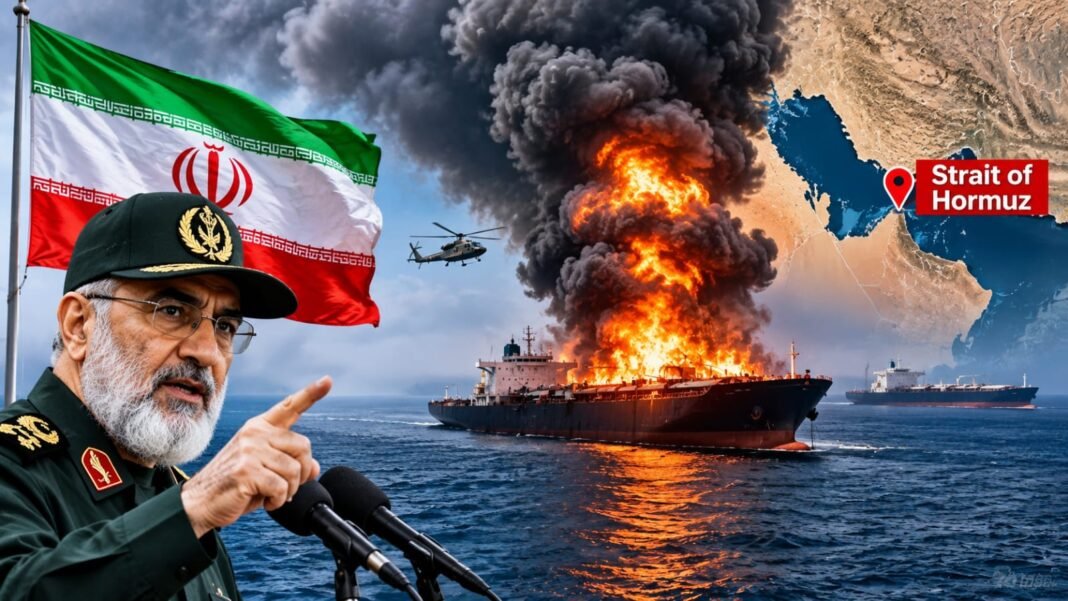
TEHRAN/NEW DELHI: Tensions in the strategically important Strait of Hormuz have intensified after Iran’s Islamic Revolutionary Guard Corps (IRGC) Navy claimed that two oil tankers exploded after striking naval mines while attempting to navigate an unauthorised route through the waterway.
The announcement, reported by Iranian state media on Sunday, November 1, comes amid escalating maritime security concerns in the Persian Gulf, where commercial vessels have increasingly faced attacks and restrictions on navigation.
According to Reuters, the IRGC Navy alleged that the two tankers were travelling through a route that Iran had not authorised. Tehran has imposed restrictions on shipping movements through the strait as it seeks to strengthen its control over the strategic passage and increase pressure on the United States.
Iran Claims Tankers Ignored Warnings
Iranian state broadcaster Press TV, citing the IRGC Navy’s public relations office, reported that both vessels struck naval mines while attempting to pass through a restricted southern route.
The Iranian military claimed that one of the vessels was a supertanker that caught fire following a powerful explosion. It also alleged that both ships had switched off their navigation and identification systems to pass through the restricted area.
The IRGC further claimed that the vessels had ignored repeated warnings issued by Iranian forces.
However, the identities of the two tankers, their flags, cargo details, crew conditions and the extent of the damage have not been independently established in the available reporting. The allegations about their route and actions also remain claims made by the Iranian military.
India Angle: 29 Indian Seafarers Reportedly Safe After Separate Tanker Attacks
The latest development is particularly significant for India because Indian nationals are working aboard commercial vessels operating in the Gulf region.
On October 30, Union Minister for Ports, Shipping and Waterways Sarbananda Sonowal confirmed that two oil tankers carrying a total of 29 Indian seafarers had been targeted in separate incidents in the Strait of Hormuz.
The vessels were:
MT Louise 1: A Panama-flagged crude oil tanker carrying 27 Indian seafarers, reportedly targeted with limpet mines.
MT Arzanah: A Liberia-flagged very large crude carrier (VLCC) carrying two Indian nationals, which was also targeted in a separate projectile attack.
The minister said all 29 Indian seafarers were safe and had sustained no injuries. He added that the government was monitoring the situation and coordinating with the ship management companies to ensure their safety.
The October 30 incident involving MT Louise 1 occurred approximately 25 nautical miles northeast of Khasab, Oman. The United Kingdom Maritime Trade Operations (UKMTO) reported that the vessel had been damaged and experienced an engine-room fire, which was subsequently extinguished. The crew remained safe, with no environmental impact reported.
These incidents underline the growing risks faced by Indian merchant navy personnel navigating one of the world’s most sensitive maritime corridors.
Why the Strait of Hormuz Matters to India
The Strait of Hormuz is a narrow but strategically vital maritime passage connecting the Persian Gulf with the Gulf of Oman and the Arabian Sea.
It is one of the world’s most important routes for international oil and liquefied natural gas shipments. Any prolonged disruption to commercial shipping through this corridor could affect global energy supplies, transportation costs and international oil markets.
For India, which relies heavily on imported crude oil to meet its energy requirements, instability in the region carries significant economic implications.
A sustained disruption could increase shipping insurance premiums, freight costs and crude oil prices, potentially adding pressure to India’s fuel-import bill and domestic inflation.
The security of the waterway is therefore not just a regional concern but also an important economic and energy-security issue for New Delhi.
International Maritime Security Under Pressure
The latest Iranian announcement comes amid a series of reported attacks on commercial shipping in and around the Gulf.
The UKMTO has repeatedly advised vessels operating in the region to exercise caution and report suspicious activity.
Meanwhile, maritime security experts have raised concerns about the vulnerability of commercial vessels to naval mines, explosive devices attached to ship hulls and attacks involving small boats.
India’s Directorate General of Shipping has also issued security advisories for Indian seafarers and shipping stakeholders operating in the Persian Gulf, Strait of Hormuz and adjoining waters.
As tensions continue, the safety of commercial shipping, protection of seafarers and uninterrupted energy transportation are emerging as major challenges for countries dependent on the Gulf’s maritime routes.
For India, the immediate priority remains the protection of its nationals working aboard merchant vessels and maintaining the stability of energy supplies.