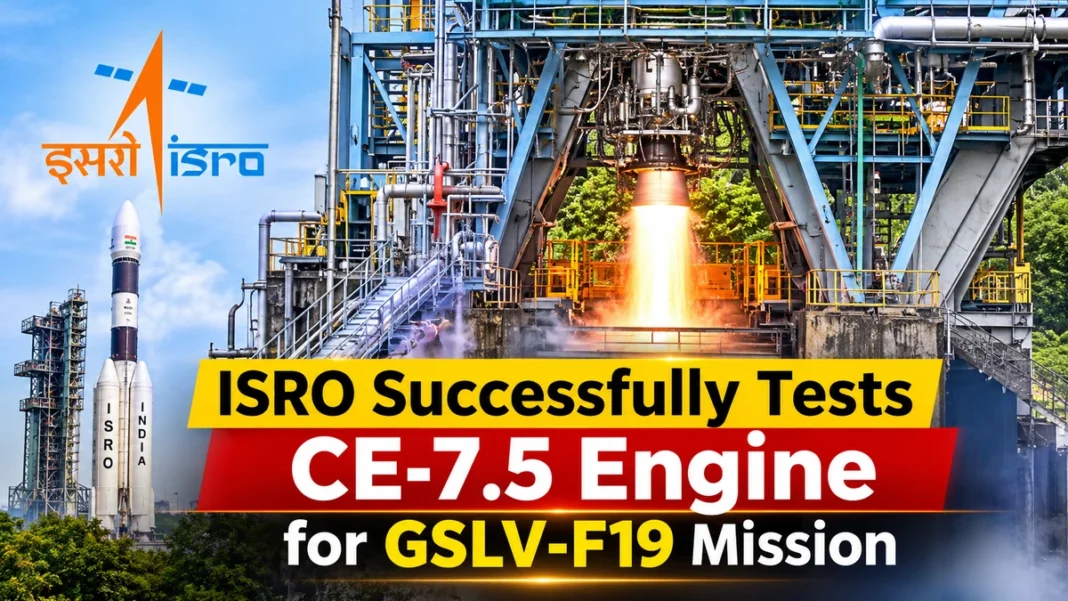
The 200-second flight acceptance test of the CE-7.5 cryogenic engine was successfully completed at ISRO’s IPRC facility in Mahendragiri, Tamil Nadu, marking another step towards the upcoming GSLV-F19 mission.
India’s space programme has achieved another important milestone as the Indian Space Research Organisation (ISRO) successfully completed the flight acceptance test of its CE-7.5 cryogenic engine for the GSLV-F19 mission.
According to an update shared by ISRO Spaceflight on November 10, 2026, the engine underwent a hot-fire test lasting 200 seconds at ISRO’s Propulsion Complex (IPRC) in Mahendragiri, Tamil Nadu. The engine’s performance remained nominal throughout the test, indicating that it met the required performance parameters during the testing period.
The CE-7.5 engine is intended for use in the third stage of the GSLV-F19 launch vehicle, which will play a crucial role in the rocket’s flight.
Main Engine and Gas Generator Perform as Expected
ISRO’s official update stated that the test was conducted on November 5, 2026. Both the Main Engine (ME) and Gas Generator (GG) ignited as expected during the test.
The engine’s performance during steady-state operation was found to be normal and consistent with the expected predictions. The successful 200-second firing also confirmed that the engine performed satisfactorily under the test conditions.
The flight acceptance test is an important stage in preparing an engine for its actual use in a launch vehicle. It helps establish that the engine meets the necessary performance requirements before being integrated into the rocket’s cryogenic stage.
What Is the CE-7.5 Cryogenic Engine?
The CE-7.5 is an indigenous cryogenic engine developed for the upper stage of India’s Geosynchronous Satellite Launch Vehicle (GSLV).
Unlike conventional rocket engines that use solid or storable liquid propellants, cryogenic engines use propellants stored at extremely low temperatures. The CE-7.5 uses liquid oxygen (LOX) as an oxidiser and liquid hydrogen (LH2) as fuel.
According to ISRO’s technical information, the engine operates on a staged-combustion cycle and produces a nominal thrust of 75 kilonewtons.
Cryogenic propulsion is particularly important for launching heavier satellites into higher orbits because it offers greater efficiency than conventional solid and earth-storable liquid propulsion systems.
The technology also involves significant engineering challenges, including handling extremely cold propellants, maintaining insulation and ensuring reliable engine operation.
GSLV-F19 Mission to Carry NVS-04 Navigation Satellite
The successfully tested engine will be inducted into the cryogenic stage of the upcoming GSLV-F19 mission. The mission is expected to launch the NVS-04 navigation satellite, which will become part of India’s Navigation with Indian Constellation (NavIC) system.
NavIC is India’s independent regional satellite navigation system, developed by ISRO to provide positioning, navigation and timing services across the country and beyond its geographical boundaries.
The system is designed to provide services over the Indian mainland and a region extending approximately 1,500 kilometres beyond the country’s borders. It supports a range of applications, including transportation, maritime navigation, disaster management and location-based services.
The launch of NVS-04 will contribute to the expansion of India’s indigenous satellite navigation capabilities and strengthen the country’s ability to provide navigation services without depending entirely on foreign systems such as the United States’ Global Positioning System (GPS).
Why Is the Test Important for India’s Space Programme?
The successful test represents progress in India’s efforts to strengthen its indigenous launch vehicle technology. Cryogenic propulsion is among the most technically challenging areas of rocket development, and its successful operation is essential for missions involving satellites that need to reach higher orbits.
The GSLV programme has played an important role in India’s ability to launch heavier communication and navigation satellites. The development and operational use of indigenous cryogenic technology have also reduced the country’s dependence on foreign propulsion systems.
With the CE-7.5 engine successfully completing its flight acceptance test, ISRO has moved another step closer to preparing the GSLV-F19 launch vehicle for its upcoming mission.
The performance of the engine during the test is an encouraging development for India’s satellite navigation programme and its broader ambitions in space technology.