
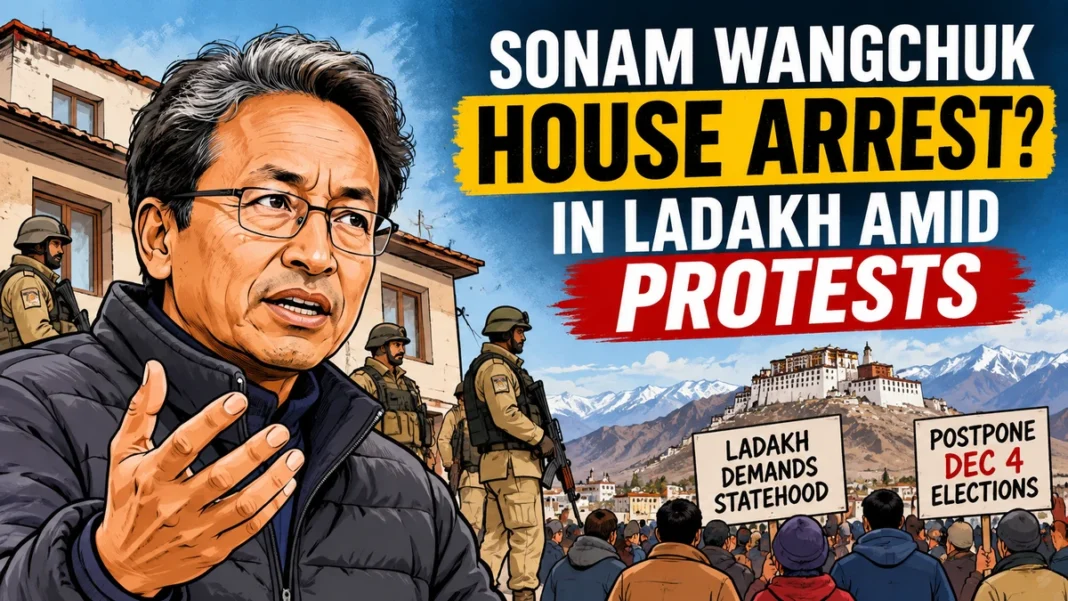
LEH: Climate activist and education reformer Sonam Wangchuk has alleged that he has effectively been placed under house arrest at his residence in Leh, Ladakh, after security personnel were deployed around his home. The development has intensified tensions in the Union Territory, where regional organisations are protesting against the upcoming Ladakh Autonomous Hill Development Council (LAHDC) elections and demanding greater democratic representation.
In a video message shared on social media on Thursday, November 12, Wangchuk claimed that around 20–25 armed police and paramilitary personnel had been stationed outside his residence, restricting his freedom of movement.
The activist questioned the administration’s explanation that he had merely been advised to remain at home. He argued that the presence of armed personnel around his residence effectively amounted to house arrest, even though he had not been formally arrested.
According to a report by Moneycontrol, Wangchuk also submitted a representation to the Ladakh administration on November 12, seeking written clarification about the restrictions imposed on him. He questioned whether he was legally permitted to leave his residence and demanded access to the grounds on which the restrictions were imposed.
Why was Sonam Wangchuk removed from the protest site?
The controversy began on Wednesday, November 11, when Ladakh Police removed Wangchuk from the proposed protest site at NDS Memorial Park in Leh and escorted him to his residence.
According to the police, the action was preventive and carried out in compliance with prohibitory orders issued by the Chief Electoral Officer of Ladakh and the District Magistrate of Leh.
The administration had imposed restrictions on public rallies, protests and other gatherings within Leh Municipality in view of the ongoing Panchayat, Municipal and LAHDC election process.
Police maintained that Wangchuk had been advised to stay at his residence to prevent any potential breach of public order and maintain peace in the region.
However, Wangchuk questioned the legal basis and scope of the restrictions. He claimed that the order issued under Section 163 of the Bharatiya Nagarik Suraksha Sanhita (BNSS) did not explicitly mention house arrest or detention.
He also alleged that four masked men forcibly took him from the protest site to his residence and that he was initially prevented from contacting his family or consulting a lawyer. These allegations have not been independently established.
December 4 elections become another point of conflict
The latest confrontation comes amid growing opposition to the scheduling of the Ladakh Autonomous Hill Development Council elections for December 4.
Wangchuk and other regional leaders have criticised the administration for holding the elections during the harsh winter months, arguing that snowfall, difficult road conditions and seasonal migration could affect voter participation.
According to reports, Ladakh MP Haneefa Jan has also approached Union Home Minister Amit Shah, requesting that the elections be postponed.
Regional representatives have expressed concern that senior citizens, students and other residents may leave Ladakh during the winter season, potentially affecting their ability to participate in the electoral process.
The Leh Apex Body (LAB) and the Kargil Democratic Alliance (KDA), which have been involved in discussions with the Centre over Ladakh’s political demands, have also raised concerns about the election process.
Their broader demands include statehood for Ladakh, constitutional safeguards under the Sixth Schedule and greater democratic representation for the region.
Demand for judicial inquiry report into September 2025 violence
Another major issue behind the renewed protests is the delay in releasing the judicial inquiry report into the September 24, 2025 violence in Leh.
The violence erupted during protests over demands for statehood and constitutional safeguards for Ladakh. Four people were killed following police action, while several others were injured.
The Union Government subsequently ordered a judicial inquiry headed by former Supreme Court judge Justice B.S. Chauhan to examine the circumstances leading to the violence, the police action and the deaths.
According to an official notice issued by the Ladakh administration on November 3, 2025, the inquiry proceedings commenced on October 27, 2025. The commission invited statements and supporting documents from individuals familiar with the incident.
Wangchuk has criticised the delay in making the findings public, arguing that accountability for the violence remains an important concern for the people of Ladakh.
Wangchuk’s previous detention and the Centre’s position
The latest developments also bring renewed attention to Wangchuk’s earlier detention under the National Security Act (NSA).
He was detained on September 26, 2025, following the violence in Leh. The detention was revoked by the Union Ministry of Home Affairs on March 14, 2026.
In its official statement, the Ministry said the decision was taken to promote peace, stability and mutual trust in Ladakh and facilitate constructive dialogue with regional stakeholders.
The Centre also maintained that continued protests and disruptions had affected students, job aspirants, businesses and the region’s tourism economy. It reiterated its commitment to addressing Ladakh’s concerns through dialogue, including the High-Powered Committee mechanism.
What happens next?
Wangchuk has indicated that he intends to challenge the restrictions on his movement before the appropriate legal authorities, including the Magistrate and higher courts.
He has also demanded that the administration clarify the legal provisions under which his movement is being restricted and withdraw the police deployment outside his residence.
Meanwhile, the disagreement over the December 4 council elections, the judicial inquiry report and Ladakh’s long-standing demands for constitutional safeguards continues to create political tension in the region.
The administration’s position on the latest allegations and the legal challenge remains important to the unfolding situation. Whether the restrictions will be withdrawn and whether the election schedule will be reconsidered are questions that remain unresolved.