

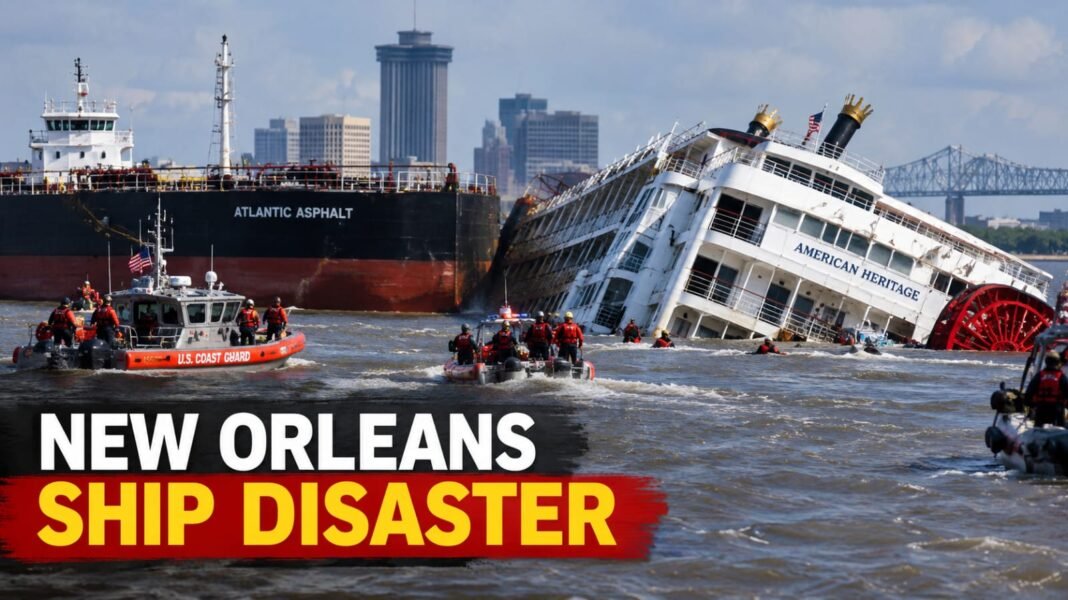
The Atlantic Asphalt tanker struck the American Heritage passenger vessel on the Mississippi River in the United States. Around 180–190 people were reportedly aboard, and all were accounted for after a major rescue operation.
NEW ORLEANS, USA | November 14, 2026
A major maritime accident in New Orleans, United States, has raised fresh concerns about passenger safety and navigation on busy inland waterways. An asphalt-carrying tanker collided with a passenger cruise ship on the Mississippi River on Friday, November 13, causing the cruise vessel to overturn and partially sink. Although 32 people were hospitalised with non-critical injuries, all passengers and crew members were safely accounted for.
The incident is particularly relevant for India as the country continues to expand its inland water transport network. With passenger services, river tourism and cargo transportation gaining importance, the accident highlights why navigation systems, vessel inspections and emergency preparedness must remain central to waterway development.
How Did the New Orleans Accident Happen?
According to reports, the incident occurred at approximately 12:30 p.m. local time near the Port of New Orleans. The Atlantic Asphalt tanker struck the American Heritage, a paddle-wheel river cruise ship operated by American Cruise Lines.
The passenger vessel had docked around two hours earlier and was preparing for passengers to disembark when the collision took place.
Initial information from officials indicated that approximately 129 passengers, along with crew members, were aboard the cruise ship. Later estimates reported by Reuters placed the total number of passengers and crew at around 180–190.
The impact caused the American Heritage to tilt sharply before rolling onto its side. Several people were thrown into the Mississippi River, while others attempted to escape using life jackets and available flotation equipment.
32 People Hospitalised, No Fatalities Reported
The collision immediately triggered a large-scale rescue operation involving the United States Coast Guard, New Orleans Fire Department, local police, harbour authorities and emergency medical teams.
Rescue personnel, harbour workers and people aboard nearby vessels helped bring passengers out of the water. Emergency teams also arranged medical assistance and temporary support for those affected.
New Orleans Mayor Helena Moreno confirmed that everyone aboard had been accounted for. Around 32 people were taken to hospitals with non-critical injuries. Two harbour police officers were also among those reported injured in initial accounts.
The mayor described the successful rescue as a ‘miracle on the Mississippi’, considering the scale of the collision and the number of people involved.
Steering Failure Suspected, Investigation Underway
Initial statements indicated that the tanker had lost control before hitting the passenger vessel. A possible steering-system failure has been discussed, but authorities have not established the final cause.
The US Coast Guard and the National Transportation Safety Board are involved in examining the circumstances surrounding the accident.
Investigators are expected to examine the tanker’s steering equipment, operational records, navigation procedures and other relevant evidence. The findings will help establish whether a mechanical problem or another operational factor contributed to the collision.
The accident also led authorities to restrict vessel movement in the affected section of the Mississippi River during rescue and response operations.
Why the Accident Matters for India
For India, the incident carries an important lesson as inland waterways become a growing part of the country’s transport and tourism infrastructure.
The Inland Waterways Authority of India (IWAI) is developing National Waterway-1 along the Ganga-Bhagirathi-Hooghly river system. Under the Jal Marg Vikas Project, infrastructure is being strengthened along the 1,390-kilometre Varanasi–Haldia stretch.
The project includes multimodal terminals, navigation facilities and community jetties to improve cargo and passenger movement.
India has also established a regulatory framework under the Inland Vessels Act, 2021, supported by rules covering vessel surveys, safe navigation, communication, fire-fighting equipment and life-saving appliances.
As river transport expands, the New Orleans accident underlines the importance of implementing these safety measures effectively. Regular technical inspections, trained crews, reliable communication systems, life jackets and quick emergency-response arrangements are essential for protecting passengers.
Safety Must Grow Alongside Waterway Development
The New Orleans collision is a reminder that modern vessels and developed ports cannot completely eliminate maritime risks. Even a single navigation or mechanical failure can turn a routine passenger journey into a serious emergency.
For India, the priority should be to ensure that infrastructure expansion goes hand in hand with strong safety enforcement. The success of inland water transport will depend not only on connectivity and economic growth but also on the confidence of passengers using these services.
Meanwhile, the investigation into the Mississippi River collision continues. The safe recovery of everyone aboard is a positive outcome, but the final findings will be important for understanding the cause and preventing similar accidents in the future.


