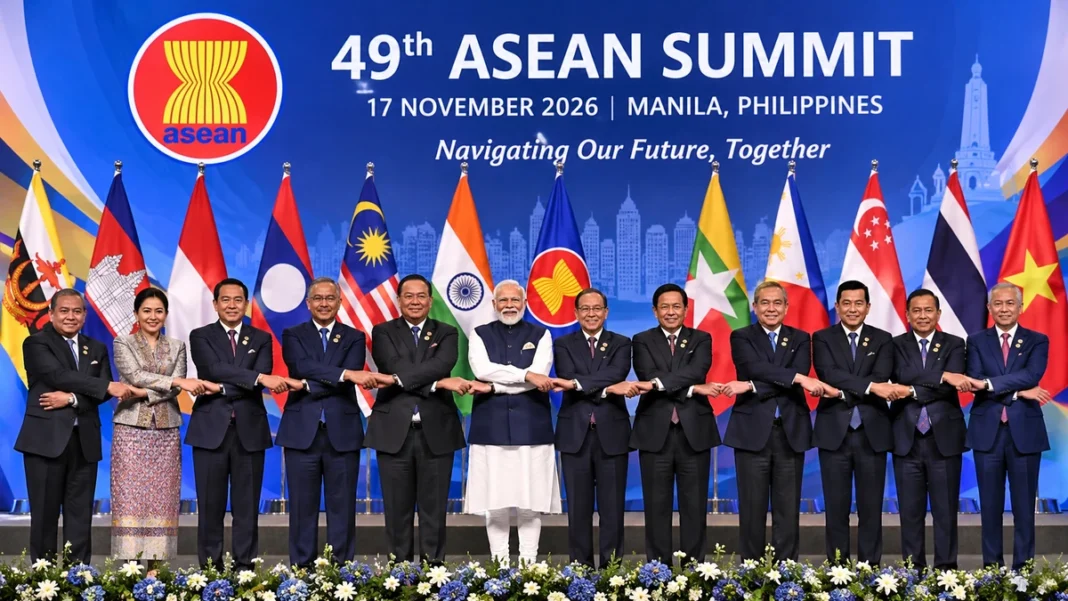
Manila: The 49th ASEAN Summit and related meetings concluded in the Philippines on November 17, 2026, with regional leaders focusing on economic cooperation, maritime security, disaster preparedness, energy resilience and regional stability. The meetings also marked an important development in India’s engagement with Southeast Asia, as Prime Minister Narendra Modi participated in the 23rd ASEAN-India Summit in Manila.
The Philippines, under President Ferdinand Marcos Jr., hosted the 2026 ASEAN chairmanship under the theme “Navigating Our Future, Together.” The summit brought together leaders from ASEAN member countries and dialogue partners to discuss shared regional challenges and strengthen cooperation amid changing geopolitical and economic conditions.
One of the major outcomes was the adoption of the ASEAN-India Joint Statement on Cooperation in Disaster Management. The agreement seeks to improve regional preparedness, strengthen emergency response mechanisms and build resilience against natural disasters.
The summit also witnessed discussions on maritime security, trade, digital technology, cybersecurity, energy cooperation and the future of the Indo-Pacific region.
India and ASEAN strengthen strategic partnership
At the 23rd ASEAN-India Summit, Prime Minister Narendra Modi reaffirmed India’s commitment to ASEAN unity, regional stability and an open, inclusive and rules-based Indo-Pacific.
Modi emphasised that cooperation, rather than competition, should shape the region’s future. He also highlighted the importance of India’s Act East Policy in strengthening economic, cultural and strategic relations with Southeast Asian countries.
The Prime Minister connected ASEAN Community Vision 2045 with India’s Viksit Bharat 2047 vision, highlighting opportunities for both sides to work towards shared development goals.
The year 2027 will mark 35 years of ASEAN-India dialogue relations and five years of their Comprehensive Strategic Partnership, making the upcoming year particularly significant for bilateral engagement.
Major announcements from India at the summit
India announced several initiatives aimed at expanding cooperation with ASEAN across maritime affairs, technology, education and economic development.
According to the Prime Minister’s Office, the proposed initiatives include:
A long-term maritime cooperation plan covering maritime connectivity, scientific research, Coast Guard cooperation and seafarers’ security.
A joint cyber forensics training programme.
Technical exchanges on nuclear energy.
An ASEAN-India Space Hackathon.
Cooperation in mining and critical minerals.
Youth exchanges, start-up hackathons and young parliamentarian programmes.
Increased scholarship opportunities for ASEAN students at Nalanda University.
A creative partnership pavilion at WAVES 2027.
Free e-visas for tourists from ASEAN countries.
The initiatives are intended to expand people-to-people connections while creating opportunities in emerging technologies, education and strategic industries.
Disaster management becomes a key area of cooperation
Disaster preparedness emerged as one of the most significant areas of agreement between India and ASEAN.
The joint statement adopted in Manila focuses on improving early-warning systems, emergency response, humanitarian assistance and post-disaster recovery. Both sides recognised their shared vulnerability to earthquakes, tsunamis, floods, cyclones, extreme heat and landslides.
The agreement also envisages stronger coordination between ASEAN’s disaster management institutions, including the ASEAN Coordinating Centre for Humanitarian Assistance (AHA Centre), and India’s National Disaster Management Authority (NDMA).
Cooperation could also extend to satellite data, meteorological information, artificial intelligence and machine learning for disaster-risk assessment. Joint training programmes and simulation exercises are expected to strengthen the preparedness of emergency response agencies.
ASEAN Plus Three focuses on energy and food security
Another important development came from the 29th ASEAN Plus Three Summit, attended by leaders from ASEAN, China, Japan and South Korea.
The leaders adopted two significant statements addressing maritime trade and logistics connectivity, and strengthening energy and food security amid external shocks and supply-chain disruptions.
The discussions reflected growing concerns about international conflicts, rising energy costs and disruptions to global trade routes. Leaders stressed the importance of stronger regional coordination to protect economic stability and ensure reliable access to essential supplies.
The issue gained particular importance amid the economic consequences of the conflict in the Middle East.
East Asia Summit addresses online scams and regional stability
The 21st East Asia Summit (EAS) also took place in Manila on November 17. Participating leaders adopted the East Asia Summit Declaration on Navigating Our Future, Together: Stability and Renewal.
They also adopted a separate statement on strengthening cooperation against online scams and related offences.
The initiative seeks to improve international law-enforcement cooperation, information sharing and coordination against cross-border online fraud and other digital crimes.
India additionally announced plans for an East Asia Summit cybercrime conference at the National Forensic Science University, alongside initiatives on seafarers’ safety, maritime heritage and university-level cooperation.
South China Sea dispute remains unresolved
Despite progress in regional cooperation, maritime tensions remained a major challenge for ASEAN.
Negotiations between ASEAN and China on the long-awaited South China Sea Code of Conduct made progress, with Philippine President Ferdinand Marcos Jr. saying that discussions were approximately 85–90 per cent complete.
However, the agreement remained unfinished as differences over key provisions continued, including whether the proposed code would be legally binding.
The South China Sea remains strategically important because of its international shipping routes, fishing resources and potential energy reserves. The dispute involves competing territorial claims and wider concerns about maritime security and freedom of navigation.
Myanmar crisis continues to challenge ASEAN unity
The political and humanitarian crisis in Myanmar remained another important concern during the summit.
ASEAN leaders reviewed the implementation of the Five-Point Consensus, the bloc’s framework for addressing the crisis. They expressed concern over continuing violence against civilians and called for an immediate halt to indiscriminate attacks.
The leaders also emphasised humanitarian assistance and inclusive political dialogue. ASEAN’s position on Myanmar’s military leadership remained conditional, with full political representation dependent on sustained and concrete progress towards implementing the peace plan.
The bloc also highlighted humanitarian assistance reaching more than 11,000 households in Myanmar through an ASEAN-led initiative.
Philippines hands over ASEAN chairmanship to Singapore
The 2026 ASEAN chairmanship officially concluded with the Philippines handing over leadership of the regional organisation to Singapore on November 17.
President Marcos described the Philippines’ chairmanship as successful, citing more than 100 outcome documents covering maritime cooperation, digital integration, energy connectivity, disaster management and child protection.
Among the significant achievements was progress on the ASEAN Digital Economy Framework Agreement (DEFA), designed to facilitate cross-border digital trade and strengthen cooperation in areas such as data governance and digital payments.
The Philippines also advanced plans for an ASEAN Maritime Centre, which is expected to support research, policy development and regional cooperation on maritime issues.
Timor-Leste’s participation as ASEAN’s 11th member was another important development during the Philippine chairmanship.
What lies ahead for ASEAN?
The Manila summit highlighted ASEAN’s efforts to strengthen regional cooperation at a time of geopolitical uncertainty, economic disruption and growing technological challenges.
India’s expanding engagement with Southeast Asia, particularly in maritime security, digital technology, disaster management and education, adds another dimension to the region’s strategic partnerships.
For Singapore, which takes over the ASEAN chairmanship in 2027, the challenge will be to translate the agreements and commitments made in Manila into practical outcomes.
With the 35th anniversary of ASEAN-India dialogue relations approaching in 2027, both sides will also have an opportunity to deepen their strategic partnership.
The outcomes of the 2026 summit suggest that regional stability, economic resilience, technological cooperation and maritime security will remain central to ASEAN’s priorities in the coming year.