

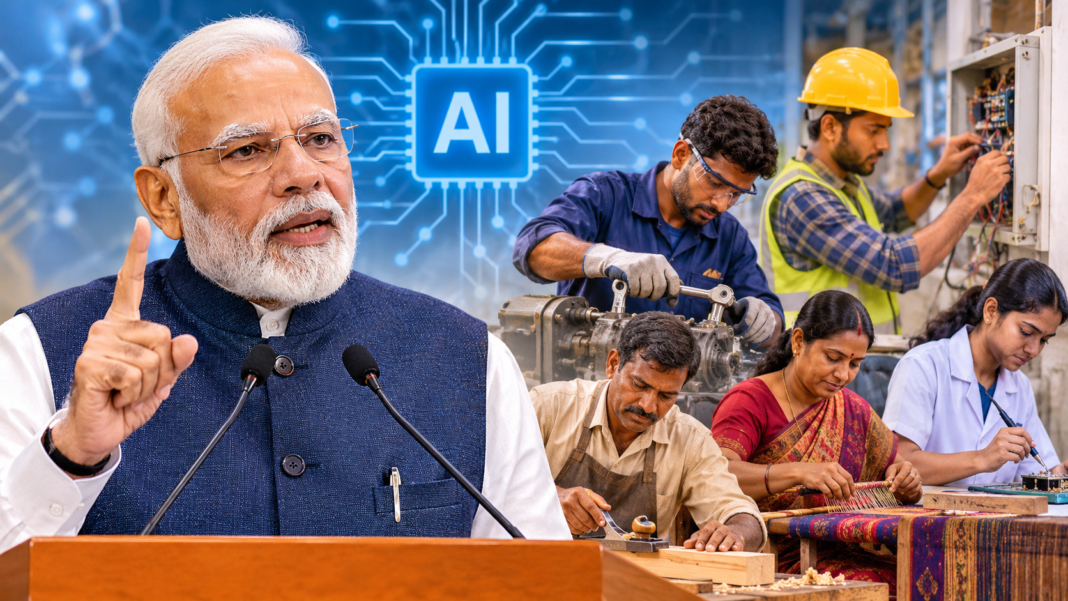
Prime Minister Narendra Modi has said that artificial intelligence (AI) cannot take away the jobs of skilled workers, highlighting the importance of practical knowledge, technical expertise and traditional craftsmanship in India’s changing employment landscape.
His remarks come amid growing concerns about the impact of artificial intelligence on jobs, as businesses and industries increasingly adopt advanced technologies to automate tasks and improve productivity.
Modi stressed that skilled workers would continue to play an important role despite the rapid development of AI. His message highlighted the need to recognise the value of people who possess specialised abilities and practical experience.
PM Modi Questions India’s Preference for Clerical Jobs
Speaking about India’s approach to employment and education, the Prime Minister pointed out that even after independence, the country continued to give greater importance to clerical jobs.
He said that skill development and traditional craftsmanship did not receive the attention they deserved. This approach, according to his remarks, affected the recognition of vocational professions and practical skills.
India has a long tradition of craftsmanship, with workers engaged in weaving, carpentry, pottery, metalwork, construction and several other occupations. However, conventional academic qualifications and office-based employment have often received greater social recognition than vocational professions.
The Prime Minister’s comments underline the importance of changing this mindset and giving skilled occupations greater respect and recognition.
Why AI Cannot Easily Replace Skilled Workers
Artificial intelligence has transformed several industries by making it possible to automate tasks that previously required human involvement. AI tools are increasingly being used in areas such as writing, data analysis, customer service, software development, banking and manufacturing.
However, many professions require practical experience, physical abilities, technical understanding and human judgement.
Electricians, plumbers, mechanics, construction workers, machine operators and technicians often deal with real-world problems that require direct intervention. Their work involves handling equipment, identifying faults, understanding physical conditions and making decisions that cannot always be managed by automated systems.
This makes specialised skills and hands-on experience important in the modern employment market.
AI can also support skilled workers by helping them complete certain tasks more efficiently. It can assist with technical planning, information gathering, identifying problems and managing repetitive activities.
Therefore, the growing use of AI does not necessarily mean that every profession will disappear. Instead, many jobs may change, requiring workers to learn new technologies and upgrade their existing abilities.
Focus on Skill Development and Vocational Education
Modi’s remarks also bring attention to the importance of vocational education and professional training in India.
The country has a large young population entering the workforce every year. Providing young people with practical skills is essential to improve their employment opportunities and meet the changing requirements of industries.
Training in electronics, automobile technology, manufacturing, construction, healthcare support and information technology can help students prepare for different career opportunities.
The government has introduced initiatives such as the Skill India Mission and Pradhan Mantri Kaushal Vikas Yojana (PMKVY) to strengthen vocational training and improve the employability of young people.
Greater cooperation between educational institutions and industries can also help students acquire skills that match actual workplace requirements.
Traditional Craftsmanship Still Has a Role
Traditional craftsmanship is another important aspect of the Prime Minister’s message.
India’s artisans and craft workers contribute to the country’s economy while preserving its cultural heritage. Handloom weaving, handicrafts, pottery, metalwork and other traditional professions continue to provide livelihoods to many families.
Combining traditional knowledge with modern tools can create new opportunities for artisans and small businesses.
India’s Employment Landscape Is Changing
The growing use of artificial intelligence is expected to change the nature of employment across the world. Workers may need to develop new abilities and adapt to technological changes to remain competitive.
Modi’s remarks highlight the need for India to move beyond the traditional preference for clerical and office-based employment and recognise the importance of practical knowledge.
The challenge ahead will be to prepare young people for emerging technologies while ensuring that vocational professions and traditional skills receive adequate attention.
As AI continues to develop, technical expertise, practical experience and the ability to work with new technologies will remain important factors in the employment market.
The Prime Minister’s message places the focus on a broader question for India’s future: how the country can combine technological progress with stronger skill development and greater recognition for skilled workers.