

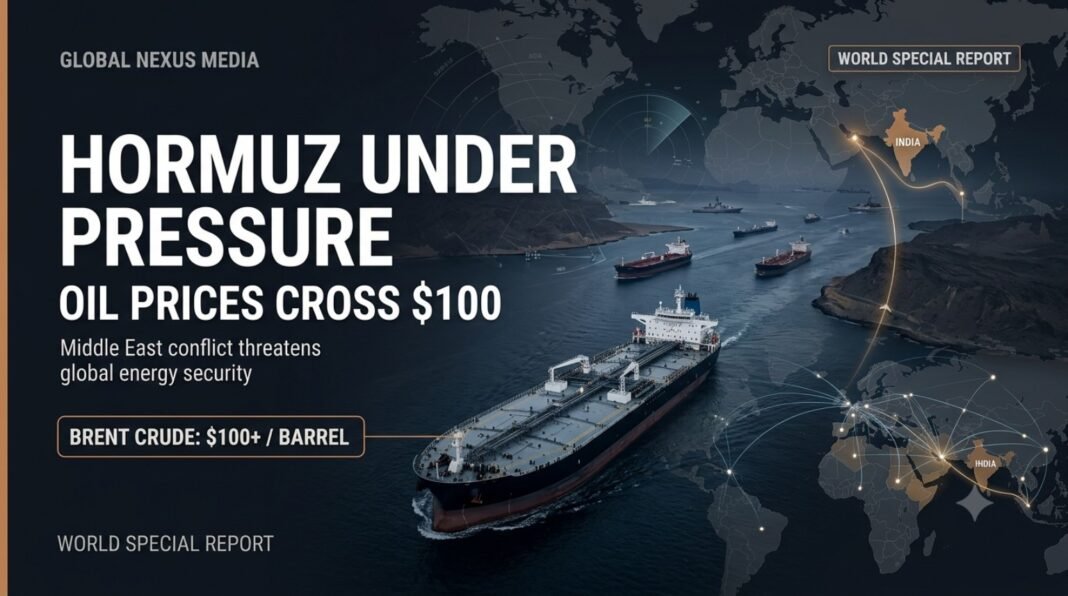
From India to the Global South, rising risks around the Strait of Hormuz are turning a regional conflict into a global energy and economic challenge.
By Global Nexus Media | World Special Report
8 October 2026
Hormuz Under Pressure: Oil Prices Cross $100 as Middle East Conflict Threatens Global Energy Security
Global oil markets are facing renewed pressure as attacks on commercial shipping around the Strait of Hormuz increase concerns over the movement of crude oil and other energy supplies.
Brent crude rose above $102 a barrel on Thursday as investors assessed the risk of further disruption to Middle Eastern energy flows. Reuters reported that intensifying attacks on oil tankers have pushed shipping risks higher, while the Strait previously carried roughly one-fifth of global oil shipments. Reuters
The immediate concern is not simply the price of oil.
It is the growing risk surrounding one of the world’s most important energy corridors.
For India and much of the Global South, that raises a bigger question:
How much will a prolonged energy shock cost economies that depend on imported fuel to keep their growth engines running?
Why the Strait of Hormuz Matters
The Strait of Hormuz connects the Persian Gulf with the Gulf of Oman and the wider Arabian Sea.
Before the current conflict, around 125 large commercial vessels a day used the waterway, carrying roughly one-fifth of global crude oil and LNG supplies. Reuters
But shipping activity has fallen sharply.
Reuters reported that only seven commodity vessels crossed the strait on October 6, the lowest level since July 23. Crude flows through Hormuz had fallen to about 10.1 million barrels per day, approximately 74% of the pre-war level. Reuters
That does not mean the world has suddenly run out of oil.
It means that moving energy has become more difficult, more expensive and more vulnerable to geopolitical disruption.
The $100 Oil Warning
Oil prices above $100 a barrel are important because crude is connected to almost every major part of the modern economy.
Higher oil prices can affect:
- Petrol and diesel
- Aviation fuel
- Transport and logistics
- Manufacturing
- Fertiliser production
- Food prices
- Inflation
- Trade balances
- Currency markets
The longer the disruption continues, the greater the possibility that higher energy costs will move from financial markets into the real economy.
The IMF chief has already warned that elevated energy prices linked to Middle East conflicts represent a negative supply shock for the global economy. Reuters
India: Why Hormuz Matters to New Delhi
India is one of the world’s largest energy consumers and remains heavily dependent on imported crude.
The country’s crude-import exposure makes international oil prices an important part of its economic calculations.
According to Indian Express analysis based on petroleum-sector data, India imports around 1.8–2 billion barrels of crude oil annually. It estimated that every $1 increase in the price of crude can add up to $2 billion to India’s annualised oil import bill. The Indian Express
That makes the current oil shock particularly important for India.
Higher crude prices can increase the import bill, put pressure on the rupee and contribute to inflation.
India Faces a Double Challenge: Oil and the Rupee
Oil is traded internationally in U.S. dollars.
Therefore, India can face additional pressure when crude prices rise at the same time that the rupee weakens.
On October 8, Reuters reported that the rupee weakened to around ₹96.78 per dollar, while Brent crude moved above $102. The combination is particularly important for an economy that imports a large share of its crude requirement. Reuters
This creates a potentially difficult equation:
Higher oil prices + weaker rupee = greater import pressure.
That makes the Hormuz crisis more than a Middle East story.
It is also an Indian macroeconomic story.
India Is Not Starting From Zero
India has spent years diversifying its energy sources and supply arrangements.
Recent Indian oil-import data shows that Gulf suppliers have used ship-to-ship transfers to help maintain crude flows despite difficult shipping conditions around Hormuz. The Indian Express
India’s large refining capacity and diversified supplier base provide additional flexibility.
The country is also expanding renewable energy, electric mobility, green hydrogen and other alternatives.
None of this makes India immune to a global oil shock.
But it can reduce the country’s vulnerability to any single supply route.
A New Global South Energy Question
The Hormuz crisis exposes a much larger problem for developing economies.
For many countries in the Global South, energy is not simply a commodity.
It is an input into almost everything.
When oil prices rise:
higher fuel costs → higher transport costs → higher production costs → higher food prices → higher inflation.
Governments may then face pressure to subsidise fuel, increase public spending or tolerate higher inflation.
For countries with weaker currencies and high import dependence, the impact can be even greater.
That makes energy security a development issue, not merely a geopolitical issue.
The Global Energy System Is Adapting
Despite the disruption around Hormuz, oil has continued to move through alternative routes.
Reuters reported that Gulf of Oman and Red Sea exports had risen to around 6.7 million barrels per day, more than twice their pre-war level, helping offset lower flows through Hormuz. Reuters
This is an important distinction.
The current crisis is not simply a story of:
“No oil is moving.”
It is a story of:
“Energy is moving through a more complicated, expensive and risky system.”
That difference matters for both governments and markets.
The Cost of Keeping Energy Moving
Global energy markets are adaptable.
Producers can redirect cargoes.
Shipping companies can change routes.
Traders can use alternative arrangements.
Governments can release strategic reserves.
But every workaround has a cost.
Longer routes increase freight expenses.
Higher maritime risks increase insurance premiums.
Security operations add additional costs.
And eventually, part of that additional cost can reach businesses and consumers.
Asia at the Centre of the Energy Challenge
India and China are among the world’s largest energy consumers.
Their continued economic growth depends on reliable and affordable energy supplies.
That gives the Hormuz crisis an important Asian dimension.
For major Asian economies, the lesson is increasingly clear:
Energy security is becoming inseparable from foreign policy.
Countries are therefore looking beyond simply securing oil.
They are seeking diversified suppliers, alternative shipping routes, strategic reserves and new energy technologies.
India’s Strategic Opportunity
A geopolitical shock can also become a catalyst for long-term change.
For India, the current crisis reinforces the importance of moving from energy dependence to energy resilience.
That means building a system where economic growth is less vulnerable to sudden changes in global crude prices.
India’s long-term strategy can increasingly combine:
Renewable Energy
Solar and wind power can gradually reduce dependence on imported fossil fuels.
Strategic Petroleum Reserves
Greater storage capacity can provide additional protection against temporary supply disruptions.
Supplier Diversification
India can continue building energy relationships across West Asia, Africa, Russia and other producing regions.
Cleaner Transport
Electric vehicles, railways and public transport can gradually reduce petroleum demand.
New Energy Technologies
Battery storage, green hydrogen, biofuels and modern power infrastructure can strengthen long-term energy security.
What Happens Next?
The future of oil prices will depend heavily on developments around the Strait of Hormuz.
Scenario 1: Shipping Normalises
If attacks decline and commercial shipping returns to normal, the geopolitical risk premium could fall.
Oil prices could ease.
Scenario 2: Disruption Continues
If shipping remains difficult while alternative routes continue functioning, prices could remain elevated without creating an immediate global physical shortage.
The world could enter a prolonged period of high-cost energy.
Scenario 3: The Crisis Expands
If attacks increase substantially or major production and export infrastructure is damaged, the market could face a much more serious supply shock.
For oil-importing economies, this would be the most dangerous scenario.
GNM Analysis: The Real Battle Is Energy Security
The most important lesson from the Hormuz crisis is not simply that oil has crossed $100.
It is that geography still controls a significant part of the global economy.
A narrow maritime corridor can influence inflation in India, fuel costs in Africa, manufacturing costs in Asia and monetary policy across emerging markets.
That is the vulnerability.
But it is also an opportunity.
Countries will increasingly compete not only for oil and gas, but for:
secure supply chains, alternative energy routes, strategic reserves, renewable capacity and technological independence.
For India, this creates a strategic opening.
India cannot control what happens inside the Strait of Hormuz.
But it can increasingly control how vulnerable its economy is to what happens there.
GNM Global South Perspective
From the Global South perspective, energy security should not mean simply securing more oil.
It should mean securing affordable, diversified and sustainable energy.
The countries that succeed in the coming decade may not necessarily be those with the largest oil reserves.
They may be the countries that can continue growing even when oil prices rise.
For India, that means turning today’s geopolitical pressure into tomorrow’s energy resilience.
GNM Bottom Line
Hormuz is under pressure. Oil has crossed $100. But the bigger story is not today’s price—it is tomorrow’s energy architecture.
For India, the immediate priority is maintaining adequate energy supplies, protecting economic stability and managing inflation.
For the Global South, the lesson is broader: dependence on vulnerable energy corridors carries an economic cost.
And for the world, the crisis is another reminder that:
Energy security is national security, economic security and increasingly development security.
The next phase of global energy competition may therefore be decided not only by who produces oil—but by who can live with less of it.