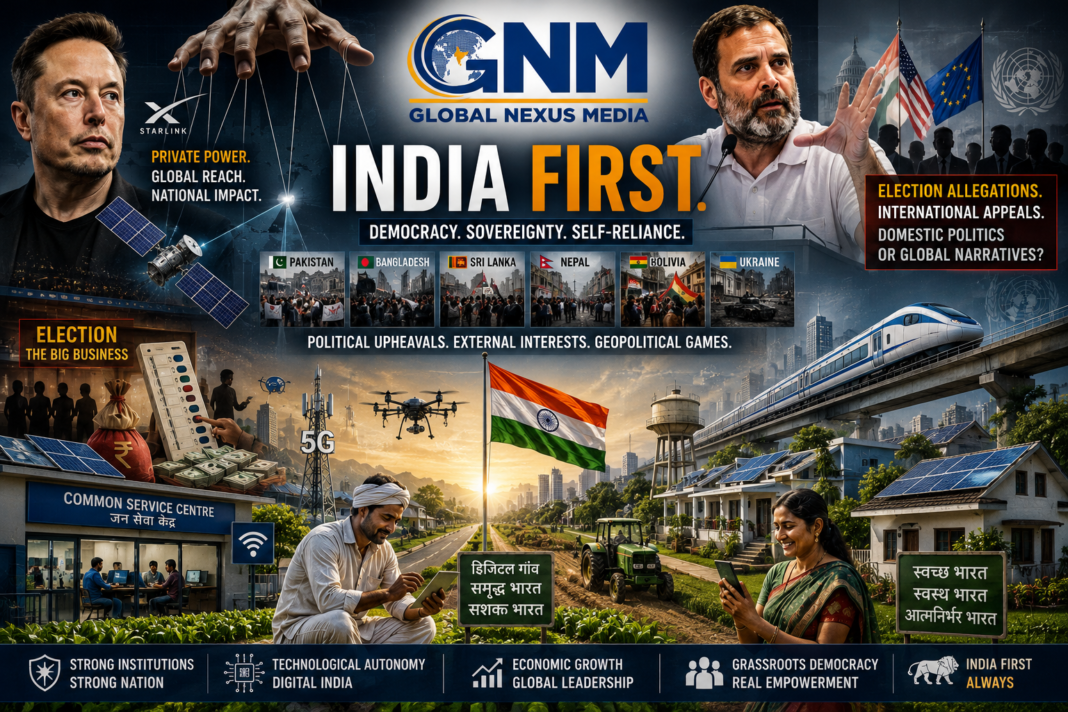
From Pakistan and Bangladesh to Ukraine and Bolivia, political upheavals and the growing power of technology companies raise urgent questions about national sovereignty. For India, the answer lies in strategic independence, strong institutions and public trust.
By GNM Editorial Desk | Opinion & Geopolitics
The global struggle for influence is changing. Governments still exercise political and military power, but technology companies, digital platforms, satellite communications and international narratives increasingly shape the environment in which nations make decisions.
For India, this presents a strategic question: how can the country protect its national interests while remaining an open, confident democracy?
The answer begins with a distinction that often gets lost in political debate: foreign influence is a legitimate subject of scrutiny, but not every domestic crisis is evidence of a foreign conspiracy.
South Asia’s political upheavals: A warning for the region
Pakistan’s political crisis culminated in Imran Khan’s removal as prime minister through a parliamentary no-confidence vote in April 2022. Khan alleged American interference, which Washington denied. Bangladesh experienced a different upheaval in 2024, when mass protests and a violent confrontation led to Sheikh Hasina’s departure from power. Sri Lanka’s 2022 crisis was driven by economic collapse and public anger, while Nepal has repeatedly faced political instability.
These events have different causes and histories. There is no established evidence that they were all orchestrated through a single foreign operation.
Yet they reveal an important geopolitical reality: when domestic institutions lose public confidence, economic pressures deepen or political divisions become unmanageable, outside actors may find greater opportunities to influence events and their international interpretation.
For India, developments in neighbouring countries have direct implications for regional security, trade, connectivity and strategic competition. New Delhi must remain alert to external pressure while respecting the sovereignty and democratic choices of neighbouring populations.
India First means assessing every regional crisis through evidence, national interest and strategic foresight—not through assumptions.
Elon Musk, Starlink and the power of private technology
The war in Ukraine has demonstrated the strategic importance of satellite communications. Starlink’s role in maintaining connectivity during the conflict has shown how a private technology company can become relevant to decisions involving security and military operations.Reuters
This raises a fundamental question: what happens when technology essential to a country’s communications or security depends on decisions made by a private corporation?
Musk’s controversial 2020 statement—“We will coup whoever we want! Deal with it”—during debate over Bolivia’s political crisis intensified concerns about the relationship between corporate power and national sovereignty. However, the statement does not establish that Musk organised a coup in Bolivia or that lithium was the decisive cause of the country’s political upheaval.
The broader lesson is more important than the controversy surrounding one individual. Countries must consider who controls critical technologies, how those technologies can be used and what safeguards exist when commercial decisions have national-security consequences.
India’s long-term response must include domestic technological capability, resilient communications infrastructure, diversified strategic partnerships and reduced vulnerability to external dependencies.
Rahul Gandhi, electoral allegations and international scrutiny
Rahul Gandhi has taken concerns about Indian democracy and electoral integrity to international audiences. Supporters describe such interventions as legitimate political advocacy; critics argue that taking domestic disputes abroad can undermine confidence in Indian institutions.Election Commission of India
The central issue should be evidence.
Allegations of electoral irregularities deserve transparent examination through constitutional institutions. Equally, an allegation, a political speech or a court issuing notice on a petition must not be presented as a final judicial finding.
The Election Commission has contested Rahul Gandhi’s allegations. Any legal proceedings must be assessed according to their actual findings and outcomes.
International human-rights institutions and foreign governments should face the same standard of scrutiny. If similar incidents receive different treatment depending on the country involved, that inconsistency deserves investigation through specific, comparable evidence.
India should neither dismiss every criticism as foreign interference nor accept every international judgment uncritically. Its interests are best served by credible institutions, transparent processes and consistent standards.
The politics of the ground, not just the screen
A major weakness in contemporary political analysis is the assumption that the loudest voices online necessarily represent the wider electorate.Rahul Gandhi’s ‘Vote Chori’ Charge Meets BJP’s Counterattack: What the Supreme Court Petition Really Means
India’s democracy is far larger and more diverse than its metropolitan debates. In villages and small towns, political choices are shaped by livelihoods, public services, social mobility, local leadership and the everyday experience of governance.
Food security, housing, sanitation, cooking fuel, agricultural support and digital access have become important parts of this experience. Government programmes such as free foodgrain distribution, PM-KISAN, PMAY-G, Ujjwala and crop insurance feature prominently in debates about welfare delivery.
These schemes do not guarantee support for any particular party. Voters also consider employment, inflation, education, healthcare and the quality of implementation. Nevertheless, welfare delivery and access to public services can materially influence how citizens assess governments.
For the Congress and other opposition parties, the challenge is therefore larger than communicating allegations through speeches or social media. They must build durable local organisations, develop credible leadership and understand the priorities of voters in states such as Uttar Pradesh and West Bengal.
The ruling party faces its own obligation: public trust must be continually earned through performance, accountability and responsiveness.
A political narrative that travels internationally but fails to connect with citizens at home cannot, by itself, build a durable democratic mandate.Evidence, Not Allegations
National credibility and India’s economic ambitions
India’s ambitions in manufacturing, infrastructure, technology and global investment depend partly on confidence in the country’s economic direction and institutional reliability.
Investors assess market opportunities, infrastructure, policy predictability, regulatory processes and political risk. Persistent instability or serious doubts about institutional functioning can affect confidence. But political criticism alone does not automatically undermine investment, and democratic scrutiny is not inherently damaging to a country’s reputation.
The objective should be to strengthen the foundations of confidence: predictable policies, credible institutions, effective governance and peaceful democratic competition.
Governments must deliver. Opposition parties must offer workable alternatives. Institutions must act impartially. And public debate must distinguish evidence from allegation.
India First: Strength through sovereignty and democracy
The changing relationship between geopolitics, private technology and domestic politics presents India with both risks and opportunities.
The country must guard against undue external pressure, strengthen technological self-reliance, insist on consistent international standards and improve public confidence in its institutions. At the same time, it must avoid treating every political upheaval abroad as proof of a coordinated plot or every domestic criticism as an attack on the nation.
India’s greatest strategic asset is not merely its size, economy or technological progress. It is the capacity of its democratic institutions and citizens to make independent choices.
The future will not be determined solely by billionaire-owned platforms, international commentary or narratives circulating in global capitals. It will also depend on the strength of India’s institutions, the resilience of its economy and the confidence of its people.
India First is not isolation from the world. It is engagement with the world from a position of sovereignty, technological capability and democratic confidence.