

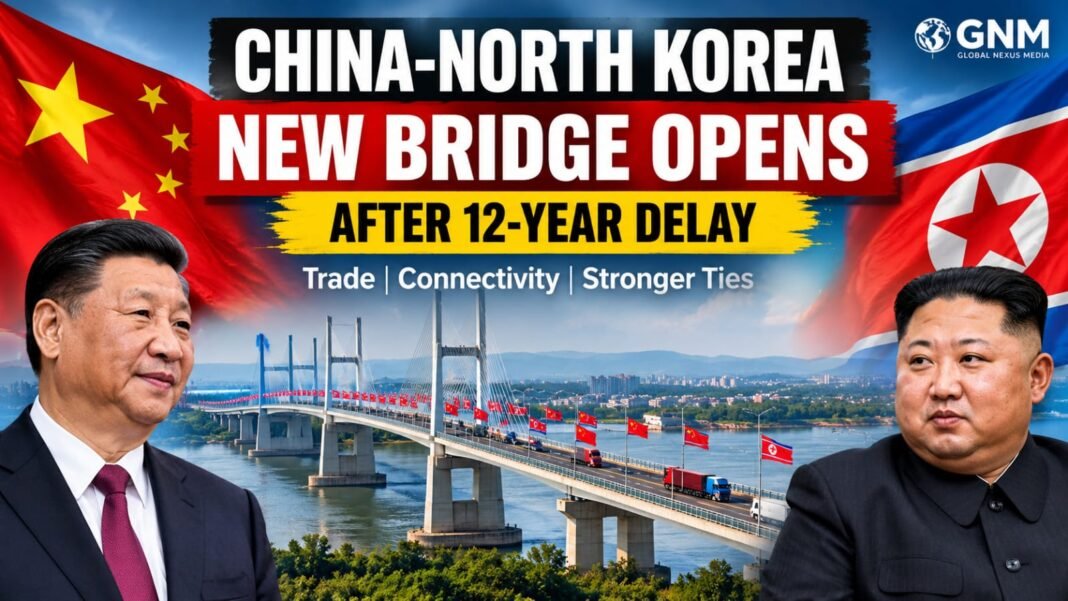
DANDONG/SEOUL: China and North Korea have officially opened a major road bridge connecting their border cities, ending more than a decade of delays and creating new possibilities for cross-border trade and economic cooperation.
The New Yalu River Bridge, also known as the Amnok River Bridge in North Korea, was officially opened on October 15, 2026. The approximately 3-kilometre-long, four-lane crossing connects Dandong in China’s northeastern Liaoning Province with Sinuiju in North Korea.
The opening was reported by China’s state-run Xinhua News Agency and North Korea’s state media, KCNA. The development represents an important step in improving transport infrastructure between the two neighbouring countries. However, the extent of its economic impact will depend on how effectively the crossing is used for regular commercial traffic.
A Bridge That Waited More Than a Decade to Open
The bridge’s history makes its opening particularly significant.
Construction on the Chinese side was completed in 2014, and the project was initially expected to begin operating that year. However, the bridge remained unused for more than a decade as the necessary approach roads and customs facilities on the North Korean side were not completed.
The delay also coincided with periods of strained relations between Beijing and Pyongyang, including disagreements linked to China’s support for United Nations sanctions against North Korea over its nuclear and missile programmes.
The bridge’s opening therefore marks more than the completion of a transport project. It also signals renewed efforts to improve practical cooperation between the two countries.
The crossing is expected to provide an additional route for vehicles and freight travelling between the two sides of the border.
What Makes the New Yalu River Bridge Important?
The bridge crosses the Yalu River, known as the Amnok River in North Korea. The river forms a substantial section of the border between the two countries.
Its location is strategically important because Dandong is a major Chinese border city, while Sinuiju is one of North Korea’s principal gateways for trade with China.
The new crossing could improve the movement of commercial goods and provide additional transport capacity alongside the existing China-Korea Friendship Bridge.
The older bridge, which dates back to 1937, has long played a central role in cross-border transport. Its limitations have made additional infrastructure particularly valuable as both countries seek to improve connectivity.
Nevertheless, the opening of a new bridge does not automatically mean that all freight traffic will shift to the new route. Actual usage will depend on border procedures, road connections, customs arrangements and the operating policies of both government.
China and North Korea Signal Stronger Economic Cooperation
The opening ceremony featured video addresses by Chinese Premier Li Qiang and North Korean Premier Pak Thae Song.
According to China’s official government news portal, Li described the bridge as a new symbol of the traditional friendship between the two countries.
He called for improvements in border-clearance procedures, stronger transport connectivity and greater cooperation in border regions. He also said the project could support economic and trade exchanges while strengthening people-to-people contacts.
Pak Thae Song similarly presented the bridge as an opportunity to promote prosperity and improve the well-being of people in both countries.
The statements indicate that both governments want the project to contribute to closer economic relations. However, neither leader announced a specific trade target or provided an estimate of the additional economic activity the bridge might generate.
Trade Figures Explain Why the Bridge Matters
China is North Korea’s largest trading partner, making transport links between the two countries especially important.
Reuters reported that China’s exports to North Korea reached approximately $2.3 billion in 2025, a six-year high and an increase of around 25% compared with the previous year.
Despite that growth, the figure remained below trade levels recorded before the tightening of international sanctions in 2017.
These numbers help explain why the new bridge has attracted attention. Improved transport infrastructure could support the movement of industrial equipment, raw materials, energy-related products and other permitted goods.
However, the bridge should not be treated as a guarantee of a major trade boom. International sanctions, border controls, political decisions and North Korea’s own economic policies will continue to influence commercial activity.
The reported export figure also refers to China’s exports to North Korea, not the total value of trade in both directions.
Could the Bridge Strengthen China’s Position in North Korea?
The project also has broader geopolitical significance.
China has maintained a longstanding economic and diplomatic relationship with North Korea. Reliable land connections are important for trade, regional stability and the movement of permitted goods across their shared border.
The bridge could help Beijing strengthen economic links with Pyongyang while providing North Korea with additional transport capacity for its civilian economy.
At the same time, North Korea has expanded its relationship with Russia in recent years. This means that its external partnerships are evolving, even as China remains its principal economic partner.
The bridge’s opening should therefore be understood as an important infrastructure development and a sign of renewed bilateral cooperation, rather than proof of a fundamental change in the regional balance of power.
Its longer-term geopolitical significance will become clearer through future trade patterns, diplomatic engagement and the practical use of the crossing.
A New Development in China-North Korea Relations
The inauguration comes as both countries seek to maintain and strengthen their bilateral relationship amid changing regional dynamics.
For Beijing, improved border infrastructure could support commercial exchanges and reinforce its economic connections with Pyongyang. For North Korea, the bridge offers an additional transport link to its largest economic partner.
However, the long delay between the bridge’s completion and its opening demonstrates that infrastructure alone cannot determine the strength of economic cooperation. The actual benefits will become clearer as authorities establish regular traffic, customs procedures and commercial operations.
For now, the New Yalu River Bridge represents a significant step towards improving physical connectivity between China and North Korea. Its longer-term importance will depend on whether the new crossing translates into sustained growth in cross-border trade and economic activity.
What Happens Next?
The immediate question is how regularly the bridge will be used for commercial traffic and whether it will improve the efficiency of border crossings.
Businesses and authorities will need functioning customs arrangements, reliable road connections and predictable procedures to realise its potential economic benefits.
Increased freight movement could support trade and commercial activity in Dandong and Sinuiju. However, the scale of any improvement cannot yet be established from the opening ceremony alone.after years of delay, China and North Korea have formally opened an important new road connection.
The real test will be whether the bridge translates into sustained growth in trade and more efficient cross-border transport.


