

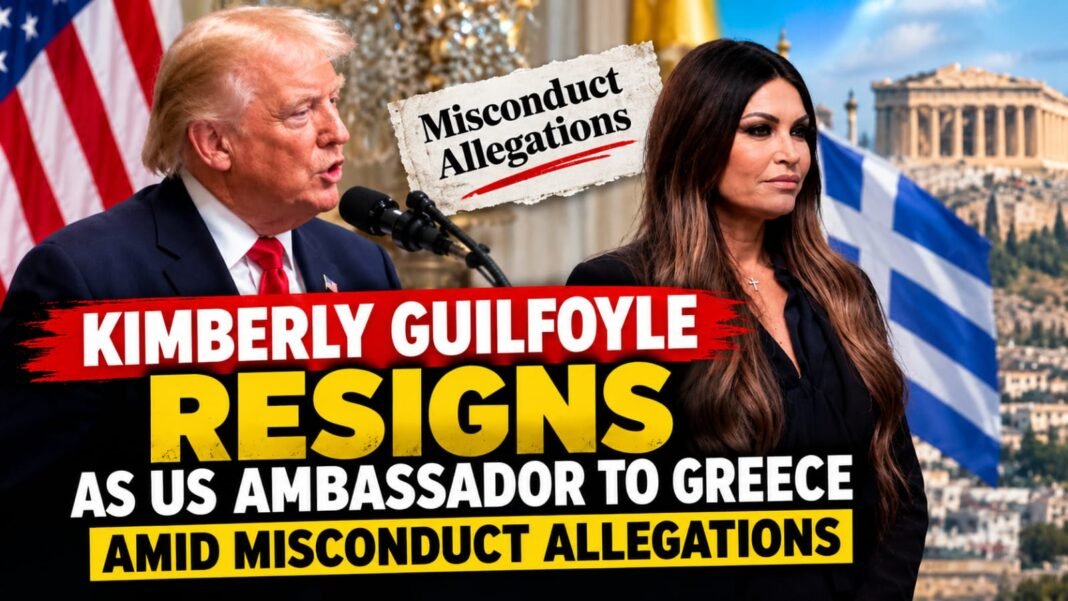
WASHINGTON: Kimberly Guilfoyle has resigned as the United States ambassador to Greece after the White House asked her to step down amid allegations of improper conduct before and during her diplomatic tenure. The decision, announced on October 13, follows weeks of media scrutiny over a reported $100,000 payment request, alleged conflicts of interest and questions about her interactions with Greek officials.
The controversy has placed a prominent political ally of President Donald Trump under increased scrutiny and raised questions about accountability, diplomatic ethics and the administration’s response to allegations involving senior appointees.
White House Confirms Resignation Request
White House Press Secretary Katie Zacharia confirmed that the administration had asked Guilfoyle to resign during a press briefing on Tuesday. The announcement followed Trump’s comments a day earlier that he was considering her removal and was unhappy with reports concerning her conduct.
According to Reuters, Trump subsequently said that although Guilfoyle had been doing a good job, the administration was dissatisfied with what it had been reading.
The White House’s decision came after multiple reports raised concerns about her conduct. However, the resignation request itself does not establish that the allegations are true.
Disputed $100,000 Payment Request
One of the most significant allegations concerns businessman Eric Deters, a supporter of Trump. According to reporting by The Wall Street Journal and CBS News, Deters said Guilfoyle asked him in July 2025 to arrange payment of a $100,000 American Express credit-card bill before her Senate confirmation hearing.
Deters alleged that the request was connected to obtaining access to senior administration officials. His account raised questions about whether personal financial assistance had been linked to political influence.
Guilfoyle’s lawyers have denied wrongdoing and disputed the allegations. They said the money related to unpaid fees for previously arranged public appearances and speaking engagements. Her legal representatives have also challenged aspects of the messages cited in reporting.
The competing accounts remain central to the controversy. The circumstances surrounding the alleged request require careful examination before any conclusion can be reached about possible misconduct.
Broader Allegations and Calls for Investigation
The controversy extends beyond the disputed payment request. Reporting cited by the Associated Press described allegations involving Guilfoyle’s interactions with Greek officials, gifts and services, embassy staff concerns, and the promotion of private business interests.
Democratic lawmakers, including Representative Gregory Meeks and Senator Jeanne Shaheen, have called for an investigation into the allegations. Their concerns reflect broader questions about the ethical responsibilities of senior government officials and the appropriate separation between public duties and private interests.
The AP also reported that the State Department’s inspector general was looking into the matter. The precise scope and status of any formal investigation should be confirmed through subsequent official statements.
An inquiry or review is not the same as a finding of wrongdoing. Establishing whether government rules were violated would require an examination of the relevant evidence and the circumstances surrounding the reported incidents.
Guilfoyle Rejects the Allegations
Guilfoyle has denied wrongdoing and said she intends to defend her reputation and integrity. In a statement reported by Reuters, she described the allegations as false and reaffirmed her support for Trump and Secretary of State Marco Rubio.
Her lawyers have also rejected the accusations, offering a different explanation for the reported payment request. Their response is an important part of the story because the central financial allegation remains disputed.
The White House, meanwhile, confirmed that it had asked Guilfoyle to resign. Its announcement did not constitute a formal finding that she had committed misconduct.
The distinction between an administration’s personnel decision and a legal or ethics determination is essential to understanding the case accurately.
Implications for US–Greece Relations
Greece is an important NATO ally of the United States, and bilateral cooperation includes defence, regional security, energy and economic ties. Guilfoyle’s departure raises questions about the continuity of diplomatic representation, but it does not automatically indicate a change in Washington’s wider policy toward Athens.
The immediate priority will be maintaining the embassy’s operations and continuing engagement with Greek officials. Further developments will depend on the administration’s next steps and whether any official review produces additional findings.
The controversy also highlights the importance of maintaining public confidence in diplomatic appointments. Ambassadors are expected to represent their countries professionally while observing applicable ethics rules and maintaining appropriate relationships with foreign governments and private-sector organisations.
Conclusion
Kimberly Guilfoyle’s resignation represents a significant development in a controversy involving a senior Trump administration appointee. Reuters establishes the White House decision, CBS News provides detail about the disputed $100,000 request, and AP places the allegations within a wider context of political scrutiny and calls for investigation.
Guilfoyle has denied wrongdoing, and the reported allegations require careful assessment. Further official findings will be important in determining whether additional action is warranted. Until then, a balanced account must distinguish between reported claims, the responses from Guilfoyle and her lawyers, and facts formally established by relevant authorities.
For now, the episode highlights the importance of transparency, ethical standards and accountability in public service, while leaving the broader US–Greece relationship an important diplomatic priority.