

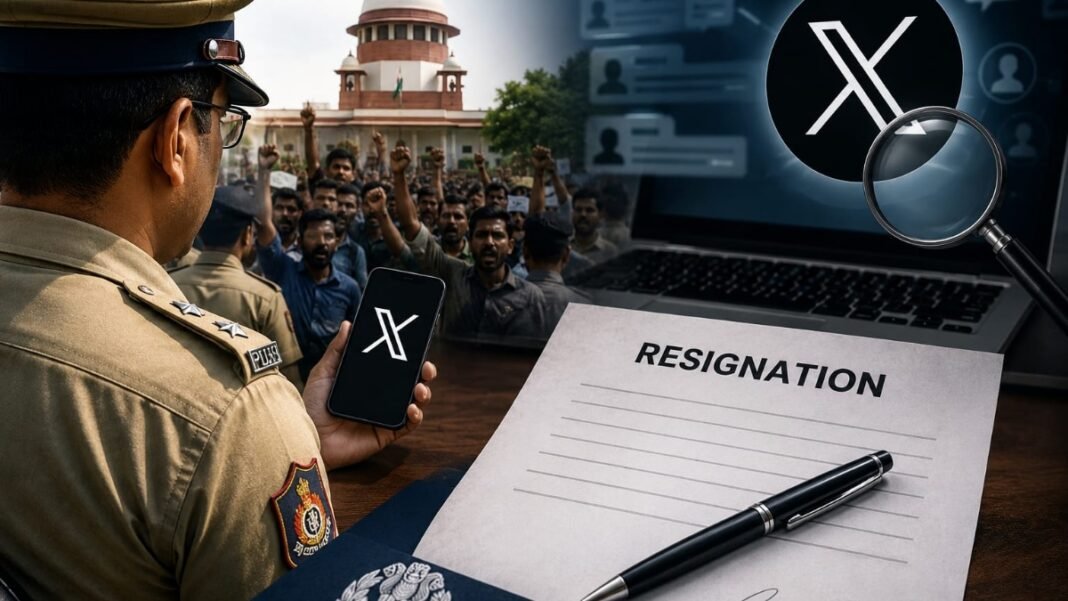
An IPS officer in Delhi has reportedly resigned amid protests linked to CJP, while police have written to social media platform X over a post alleged to contain false claims. The developments have raised questions about online misinformation, police communication and public trust. However, key details of the resignation and the disputed post require independent confirmation.
Delhi IPS Resignation and CJP Protests Put Focus on Online Claims
New Delhi: Developments in Delhi involving the reported resignation of an Indian Police Service (IPS) officer and police action over an allegedly false social media post have drawn attention amid protests linked to CJP. The situation has brought two important issues into focus: the role of public demonstrations and the spread of unverified information on digital platforms.
According to the headline, Delhi Police have written to X regarding a post that allegedly contains false claims. However, the officer’s identity, the circumstances behind the resignation and the exact content of the disputed post could not be independently established from the information available for this report.
IPS Officer’s Reported Resignation
The reported resignation of an IPS officer is a significant development because officers of the service hold important responsibilities in law enforcement, public safety and police administration.
However, a resignation can take place for several reasons, and the circumstances must be established before drawing conclusions. It is important to distinguish between a confirmed resignation, a resignation letter submitted to the authorities and a resignation formally accepted by the competent authority.
At present, the headline does not identify the officer or provide the date and official reason for the reported decision. It would therefore be premature to link the resignation directly to the protests or to any specific dispute without further evidence.
An official statement from the concerned police department or the officer involved would help clarify the circumstances and establish the sequence of events.
Police Write to X Over Allegedly False Claims
Another important part of the reported development concerns a communication sent by police to X, formerly known as Twitter, over a post alleged to contain false information.
Social media platforms allow information to reach large audiences within minutes. While this can help people share updates and discuss public issues, it can also allow inaccurate claims to spread before they are checked.
When police believe that an online post contains false or misleading information, they may contact the platform as part of an inquiry or request action under the applicable legal process. The exact nature of such a communication depends on the facts of the case and the relevant legal provisions.
In this instance, the specific post, the account that shared it and the details of the police communication have not been independently verified for this report. It is also unclear whether the letter sought information, requested removal of content or asked the platform to take another step.
Writing to a social media company does not, by itself, establish that a claim is false or that a legal violation has occurred. Those questions depend on the available evidence and the findings of the relevant authorities.
Importance of Verification During Protests
Public protests often involve strong opinions, competing claims and rapid exchanges of information. In such situations, unverified posts can create confusion and make it harder for people to understand what has actually happened.
Readers should check the original source of a claim, look for official statements and compare information with credible news reports before sharing it. Screenshots and forwarded messages may not provide enough context to establish whether a statement is genuine.
At the same time, any police action involving online speech should be understood through the relevant facts and legal framework. Accurate reporting requires clarity about what the authorities have confirmed, what remains an allegation and what is still under investigation.
What Happens Next?
Further clarity is needed on the reported IPS officer’s resignation, the connection, if any, between the resignation and the CJP protests, and the contents of the communication sent to X.
Official statements, the resignation document, if publicly available, and reliable reporting on the disputed post would help establish the facts. Until such information is confirmed, claims about the reasons behind the resignation or the legal status of the social media post should be treated with caution.
The key issue is to establish the verified facts rather than draw conclusions from online discussions or incomplete reports.