Journalism is expected to rise above religious identities. It should report faith with sensitivity, examine social practices with fairness, and apply the same standards of scrutiny to every community.
But what happens when two religious fasts are presented through noticeably different editorial lenses?
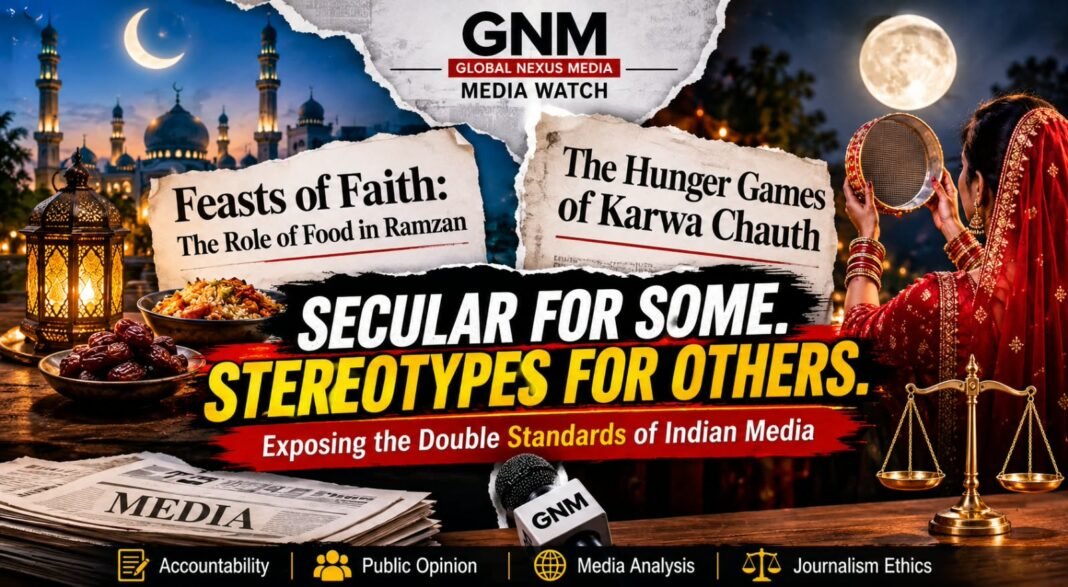
A comparison of two articles published by The New Indian Express, carrying the byline of the same journalist, Vernika Awal, raises precisely this question.One article, titled “Feasts of Faith: The Role of Food in Ramzan,” published on March 27, 2025, approaches Ramadan through the language of faith, food, community and spiritual experience.
The other, titled “The Hunger Games of Karwa Chauth,” published on October 29, 2026, takes a sharply different approach to a Hindu fasting tradition.
The contrast deserves attention—not because one religious festival must be praised or the other criticised, but because journalism must apply a consistent standard when discussing both.
Two fasts. Two headlines. Two different editorial tones.
Consider the choice of words.
“Feasts of Faith” connects Ramadan with faith and cultural experience. The framing invites readers to understand the religious and social significance of the occasion.
“The Hunger Games of Karwa Chauth” uses a provocative phrase that places hunger at the centre of the narrative. The article describes the experience of mehndi artists working long hours during the festival, including the difficulties of dealing with hungry customers and delays.The treatment of workers is a legitimate subject for journalism. No religious celebration should become an excuse to mistreat workers, and the concerns of people earning their livelihood deserve to be heard.
But there is a larger editorial question: why does a story about an unpleasant customer interaction become the defining lens through which a Hindu festival is examined?The article itself acknowledges that many women observe Karwa Chauth as an expression of devotion. Yet its concluding moral framing places the burden of the story on the conduct of women observing the fast.A legitimate workplace concern could have been reported without allowing one incident to overshadow the wider religious and cultural meaning of the festival.
The problem is not criticism. The problem is consistency.
Let us make one thing absolutely clear: journalism must be free to question religious practices.
Karwa Chauth is not beyond criticism. Neither is Ramadan. Both can be examined through the lenses of health, gender, social pressure, tradition, personal choice and changing cultural attitudes.
If a journalist wants to investigate the health implications of fasting, that is valid. If a journalist wants to question gender expectations associated with a festival, that is also valid.
But the same freedom and critical standards must apply across religious communities.
If one fast is discussed primarily through its spiritual and cultural dimensions, while another is framed through a provocative metaphor and an isolated negative experience, readers are entitled to ask whether the editorial approach is consistent.
Secular journalism cannot mean cultural sensitivity for one community and cultural suspicion for another.
A wider question about media framing
This discussion also brings attention to another distinction in Indian media coverage.
A separate set of articles published by The Indian Express in 2024 examined fasting during Karwa Chauth and Ramadan from a health perspective. One discussed possible hormonal effects associated with fasting during Karwa Chauth, while another explored potential health benefits of Ramadan fasting, including weight loss and changes in blood sugar and cholesterol.
These are not articles from The New Indian Express. They belong to a different publication and should not be confused with the two articles carrying the same journalist’s byline.
Moreover, the Ramadan health article included medical qualifications and cautions, including the need for people with diabetes to consult medical professionals. A fair comparison must acknowledge that context.
Nevertheless, the broader question remains important: when media organisations frame religious practices, do their headlines and narratives give readers a balanced understanding, or do they encourage different emotional responses depending on the tradition being discussed?
Headlines matter. Metaphors matter. The choice of anecdotes matters. What an editor chooses to emphasise—and what gets left out—can shape public perception long before a reader reaches the final paragraph.
The test of secular journalism
Secularism in journalism should not be measured by how frequently a publication uses the language of diversity or tolerance. It should be measured by whether its editorial standards remain consistent when different religious communities are involved.
A genuinely secular newsroom should be able to do all of the following:
– Discuss Hindu traditions without stereotyping Hindu devotees.
– Examine Muslim religious practices without romanticising or shielding them from legitimate scrutiny.
– Report the concerns of workers without turning an entire religious gathering into a moral caricature.
– Question gender inequality wherever it exists, irrespective of religion.
– Apply the same standards of evidence, context and language to every community.
This is not a demand for preferential treatment. It is a demand for equal treatment.
No religious community should expect immunity from criticism. Equally, no community should be made the target of a harsher editorial lens simply because its traditions are culturally or politically inconvenient.
The questions The New Indian Express should answer
The comparison of the two articles raises legitimate questions for the publication:
1. What editorial reasoning informed the contrasting titles “Feasts of Faith” and “The Hunger Games of Karwa Chauth”?
2. Were the same standards of religious and cultural sensitivity applied to both stories?
3. Why was the experience of workers used as the central lens for the Karwa Chauth article, and how was the wider diversity of women’s experiences represented?
4. Does the publication have editorial guidelines to ensure consistent framing of religious festivals and practices?
These are questions of editorial accountability, not a verdict on the intentions of the journalist or the newspaper.
The publication and the journalist should have an opportunity to explain their editorial choices. A fair media-watch investigation must remain open to that response.
Secularism Cannot Be Selective
India is a country of extraordinary religious and cultural diversity. Its media has a responsibility to protect the space for that diversity—not by praising every tradition, but by treating every tradition with fairness.A journalist may criticise a Hindu fast. A journalist may criticise a Muslim fast. A newspaper may investigate both. That is the freedom of the press.But when the tone, framing and choice of language appear markedly different, the public has every right to question the standard being applied.
Respect should not depend on religion. Criticism should not depend on identity. And editorial neutrality should not change with the festival being covered.The issue is not whether Karwa Chauth deserves praise or whether Ramadan deserves criticism. The issue is whether both are being examined with the same journalistic fairness.
One newspaper. One journalist. Two religious fasts. Two very different narratives.
If secularism is a principle, it must be applied consistently. Otherwise, it risks becoming nothing more than a convenient editorial label.
GNM — Global Nexus Media believes that every faith deserves equal dignity, every tradition remains open to fair scrutiny, and every media organisation must be accountable for the standards it applies.