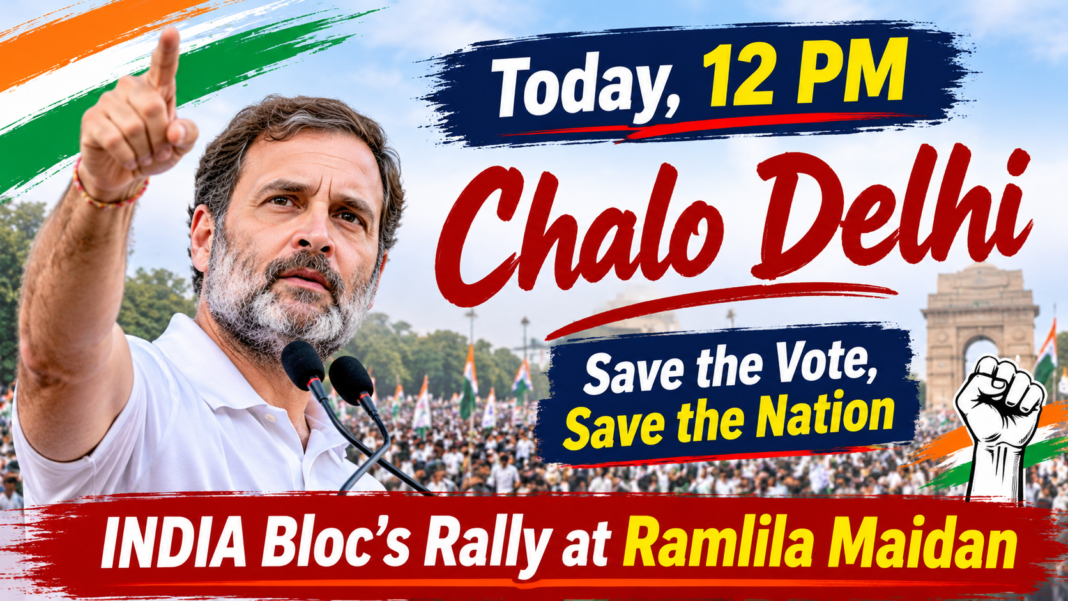
New Delhi, November 1, 2026: Delhi witnessed a major political showdown on Sunday as the opposition INDIA bloc organised its ‘Chalo Delhi’ march at Ramlila Maidan, raising serious concerns over alleged voter deletions and electoral irregularities. Congress leader and Leader of the Opposition in the Lok Sabha, Rahul Gandhi, issued a final public appeal, asking citizens from Delhi and neighbouring areas to join the demonstration scheduled for 12 PM.
The protest was organised to oppose alleged deletions of legitimate voters from electoral rolls and demand changes in the country’s election system. The opposition alliance also called for the immediate resignation of Chief Election Commissioner (CEC) Gyanesh Kumar, accusing the Election Commission of India (ECI) of failing to protect electoral integrity.
The political gathering brought several prominent opposition leaders to the national capital, while the BJP organised a separate march in West Delhi on the same day.
Rahul Gandhi’s Final ‘Chalo Delhi’ Appeal
Ahead of the rally, Rahul Gandhi shared a route map for the demonstration through a post on X. He urged people to gather at Connaught Place and march together towards Ramlila Maidan. He also gave supporters the option of reaching the rally venue directly.
In his message, Gandhi wrote, “Delhi, get ready! Save the Vote, Save the Nation. Come to Connaught Place, let’s march together. Or meet directly at Ramlila Maidan – but you must come. Today | 12 PM #ChaloDilli.”
His appeal focused on protecting voting rights and encouraging public participation in the opposition’s protest.The slogan ‘Save the Vote, Save the Nation’ became the central message of the mobilisation campaign. The opposition alliance aimed to bring public attention to its concerns about the electoral process and the alleged removal of eligible voters from electoral lists.
Why Is the INDIA Bloc Protesting?
One of the main issues behind the rally is the Special Intensive Revision (SIR) of electoral rolls conducted by the Election Commission.
The INDIA bloc has alleged that legitimate voters have been removed from electoral lists without proper verification. According to the opposition, the alleged deletions have particularly affected marginalised groups, backward communities and minority sections.
The opposition parties have questioned the manner in which the voter-list revision process is being carried out. They argue that every eligible citizen must have the right to remain on the electoral roll and participate in elections.
The alliance has also demanded the replacement of Electronic Voting Machines (EVMs) with paper ballots. Opposition leaders have raised concerns about the existing voting system and called for changes to strengthen public confidence in elections.Another major demand is the resignation of Chief Election Commissioner Gyanesh Kumar. The INDIA bloc has accused the Election Commission of failing to maintain electoral integrity and has called for accountability over the alleged irregularities.These are allegations and political demands raised by the opposition alliance and should not be treated as established findings against the Election Commission.
Major Opposition Leaders Join the Rally
Several senior leaders from different opposition parties were expected to participate in the march and address supporters at Ramlila Maidan.
The prominent leaders named in the rally included:
- Mallikarjun Kharge, Congress President
- Rahul Gandhi, Leader of the Opposition in the Lok Sabha
- Mamata Banerjee, West Bengal Chief Minister
- Abhishek Banerjee, senior Trinamool Congress leader
- Akhilesh Yadav, Samajwadi Party chief
- Hemant Soren, Jharkhand Chief Minister
- Revanth Reddy, Telangana Chief Minister
- Tejashwi Yadav, senior Rashtriya Janata Dal leader
The participation of leaders from different political parties highlighted the INDIA bloc’s effort to present a united front on electoral issues.
The rally also followed a symbolic ‘mock impeachment’ event held at Congress President Mallikarjun Kharge’s residence a day earlier, adding to the opposition’s campaign against the Election Commission leadership.
BJP Organises a Separate March in West Delhi
While the opposition alliance held its demonstration at Ramlila Maidan, the BJP organised a separate political march in West Delhi.
The BJP march was organised to remember the victims of the 1984 anti-Sikh riots. The party accused the Congress of holding a political rally on the anniversary of the violence.
The march was scheduled to begin at Hari Nagar Bus Depot and continue towards Tilak Nagar Metro Station.
Union Minister Hardeep Singh Puri, Delhi Chief Minister Rekha Gupta, Delhi BJP president Virendra Sachdeva, Minister of State Harsh Malhotra, Sardar H S Phoolka, Manjinder Singh Sirsa and MP Bansuri Swaraj were among the leaders named for the march, along with members of the Sikh community.
The two political events taking place in different parts of Delhi created a significant political contest between the ruling BJP and opposition parties.
Nearly 10,000 Security Personnel Deployed Across Delhi
With two major political gatherings taking place on Sunday, security arrangements were strengthened across the national capital.
Nearly 10,000 police and paramilitary personnel, including Delhi Police, Central Armed Police Forces (CAPF), Central Reserve Police Force (CRPF) and Rapid Action Force (RAF), were deployed to manage the events and maintain law and order.
More than 4,000 security personnel were stationed around Ramlila Maidan, along the route from Minto Bridge to the rally venue and in surrounding areas.
Authorities also installed heavy barricades around important locations, including Connaught Place, Jantar Mantar, Bhagwan Das Road and areas near the Supreme Court and the Election Commission of India office.
Security was also increased at the Delhi-Gurugram border. Border Security Force (BSF) personnel and police teams were deployed to monitor entry points into the national capital.
Security teams were checking suspicious vehicles, while multi-layered barricading was put in place along major routes connecting neighbouring cities.
These measures followed a series of planned protests and political gatherings in central Delhi.
Delhi’s Political Battle Over Electoral Integrity
The INDIA bloc’s ‘Chalo Delhi’ march has brought electoral transparency, voter rights and the role of the Election Commission into the centre of the political debate.
While the opposition is demanding accountability and changes to the electoral system, the BJP is holding its own demonstration around the 1984 anti-Sikh riots.
The two simultaneous political events highlight the growing political confrontation between the ruling party and opposition alliance.
The opposition’s demands, including the resignation of the Chief Election Commissioner and the replacement of EVMs with paper ballots, are likely to remain important points of political discussion.
The developments in Delhi have also placed the Election Commission and the issue of electoral roll revisions under greater public and political scrutiny.