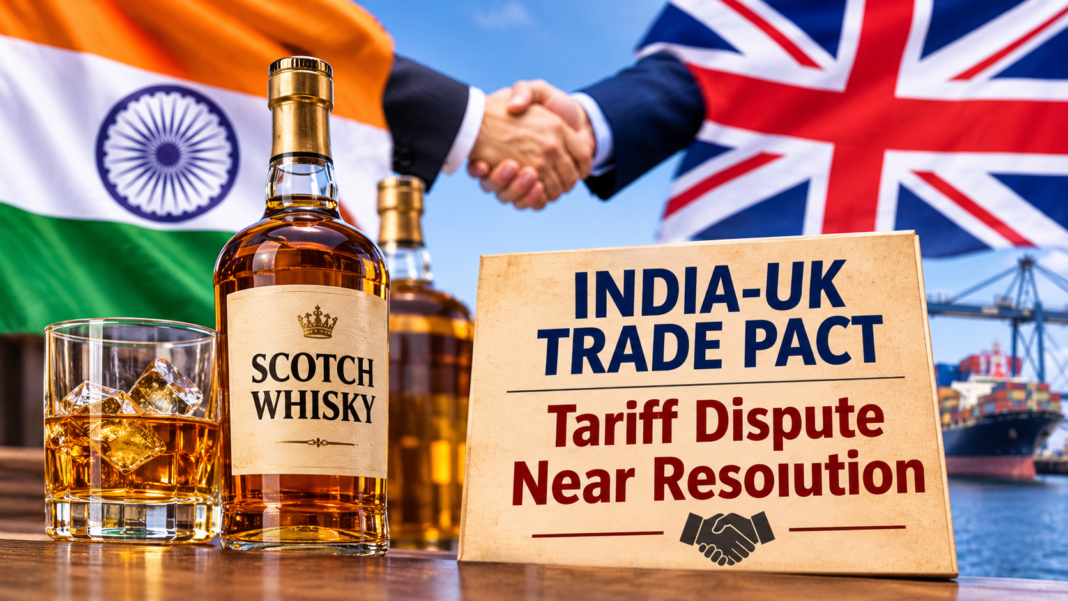
New Delhi, November 3: India has assured liquor industry representatives that it will honour its trade agreement with the United Kingdom and resolve the ongoing tariff dispute over Scotch whisky imports. The development has raised hopes of a settlement after recent tax investigations created uncertainty among major international and Indian liquor companies.
The dispute centres on whether bulk Scotch whisky imports qualify for the reduced customs duty agreed under the India-UK trade pact. Under the agreement, import duties on Scotch whisky were set to fall from 150% to 75%, providing significant relief to British whisky exporters and businesses operating in India.
However, recent actions by Indian tax authorities raised questions about whether the reduced duty would also apply to Scotch whisky imported in large containers rather than finished bottles.
During a closed-door meeting on Monday, November 2, Commerce Ministry officials reportedly assured liquor industry executives that India would implement the trade agreement in both letter and spirit.
A government source familiar with the discussions indicated that the issue could be moving towards a resolution. The source confirmed that bulk Scotch whisky imports were included in the concessions provided under the trade agreement.
Commerce Secretary Rajesh Agrawal also reportedly told industry representatives that the government was taking the necessary steps to ensure that the agreed duty concession on bulk Scotch whisky would not be affected.
Although a final resolution has not yet been publicly announced, the assurance has provided some relief to businesses concerned about the implementation of the agreement.
Why Has the Tariff Dispute Emerged?
The disagreement is mainly related to the interpretation of customs classifications under the India-UK trade agreement.
Scotch whisky enters the Indian market in different forms, including finished bottles and bulk containers. While bottled whisky is generally sold directly to consumers, bulk Scotch is imported by manufacturers for blending and production.
Indian tax officials reportedly argued that the reduced customs duty should not apply to Scotch whisky imported in bulk containers.
However, the liquor industry disagrees with this interpretation. Companies believe that the trade agreement covers all Scotch whisky imports, regardless of whether they arrive in bottles or large containers.
This difference has become the central issue behind the ongoing dispute.
Bulk Scotch is particularly important for Indian manufacturers because it is used to produce Indian-Made Foreign Liquor (IMFL) whisky. These products are manufactured by blending Scotch whisky with other spirits and ingredients before being sold in the domestic market.
If bulk imports are excluded from the reduced duty, manufacturers could face higher import costs, potentially affecting their production expenses and business operations.
Diageo and Pernod Ricard Among Companies Affected
The tariff dispute has attracted attention from some of the biggest names in the international liquor industry.
Companies such as Diageo and Pernod Ricard have a significant interest in India’s whisky market.
Indian liquor manufacturers, including Radico Khaitan and Allied Blenders and Distillers, could also be affected by the outcome.
The situation became more concerning after Indian tax officials reportedly searched the offices of several liquor companies and questioned executives in recent days.
These investigations created uncertainty across the industry, particularly over the treatment of bulk Scotch imports and the benefits promised under the trade agreement.
The companies have not publicly responded to the developments.
UK Also Raises Concerns Over Scotch Whisky Imports
The issue is not limited to Indian businesses. It has also attracted attention in the United Kingdom because Scotch whisky is an important British export.
Scotch whisky exports to India were valued at approximately $335 million in 2024. The Scotch Whisky Association has estimated that the India-UK trade agreement could increase this trade by around $1.34 billion over five years.
Following reports of the tax investigations, British officials indicated that they were working with India to address the disagreement.
The Scottish government also raised concerns with New Delhi over the treatment of bulk Scotch whisky imports.
The dispute is particularly important because the India-UK trade agreement aims to reduce trade barriers, improve market access and create new business opportunities for companies in both countries.
The agreement, which came into force in July 2026, was expected to strengthen commercial relations between India and Britain.
What Happens Next?
India’s latest assurance has raised expectations that the tariff dispute could be resolved through discussions between government officials and industry representatives.
However, businesses are still waiting for a clear decision on the eligibility of bulk Scotch whisky imports for reduced customs duties.
A final resolution could provide greater certainty to international whisky producers and Indian manufacturers while protecting the expected benefits of the trade agreement.
For India and the United Kingdom, resolving the disagreement would also be an important step towards maintaining confidence in their broader economic partnership.
The coming weeks will be important in determining how the agreed tariff concessions are applied and whether the concerns raised by the liquor industry are fully addressed.