

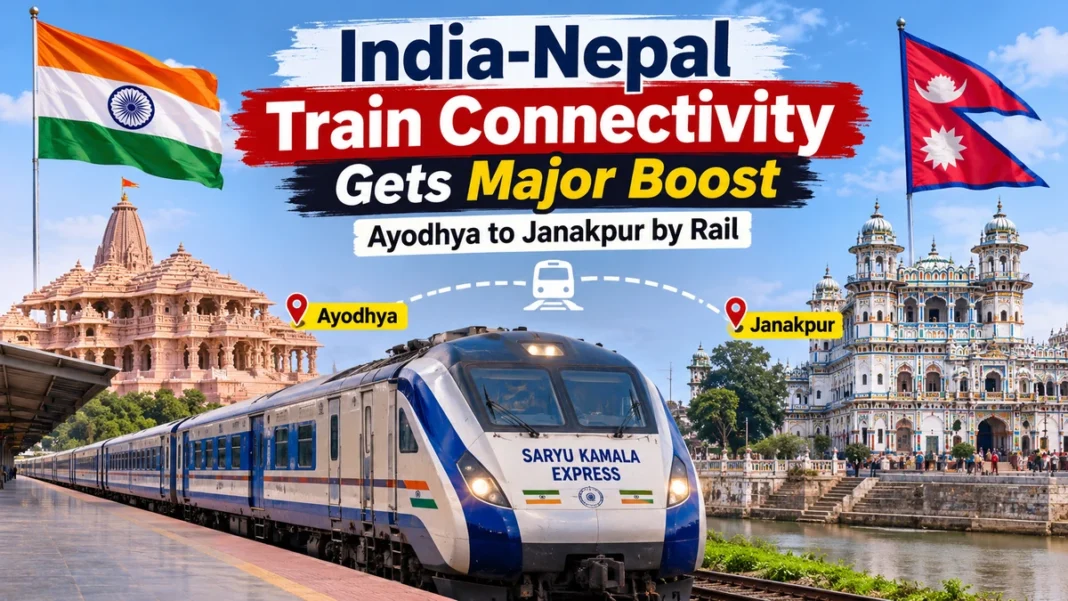
India and Nepal have taken another major step towards strengthening their bilateral connectivity with the launch of a direct train service between Ayodhya in Uttar Pradesh and Janakpur in Nepal. The new service, named Saryu Kamala Express, was jointly flagged off by Indian Prime Minister Narendra Modi and Nepalese Prime Minister Balendra Shah on November 23, 2026.
The 604-kilometre railway connection is expected to make cross-border travel more convenient while strengthening the historical, cultural and religious ties between the neighbouring countries. It will connect Ayodhya, associated with Lord Ram, with Janakpur, traditionally regarded as the birthplace of Goddess Sita.
The launch is also being viewed as an important development in India’s efforts to expand regional connectivity under its Neighbourhood First policy.
604-Kilometre Route Connecting Two Cultural Centres
The Saryu Kamala Express will cover approximately 604 kilometres, connecting Ayodhya Cantt in Uttar Pradesh with Janakpur Dham in Nepal. The train will pass through several important towns in Uttar Pradesh and Bihar before crossing the international border at Jaynagar.
The major commercial stoppages along the route include:
- Ayodhya Cantt
- Mankapur
- Basti
- Gorakhpur
- Narkatiaganj
- Raxaul
- Sitamarhi
- Shisho Halt
- Madhubani
- Jaynagar
- Janakpur Dham
According to railway information, the journey will take approximately 19 hours. The train will operate once a week in each direction.
The service is scheduled to depart from Ayodhya Cantt every Monday at 5:50 PM and reach Janakpur Dham at 12:40 PM the following day (Nepal time). In the opposite direction, it will depart from Janakpur Dham every Saturday at 1:10 PM (Nepal time) and reach Ayodhya Cantt at 8:10 AM on Sunday.
The train will have a 17-coach LHB rake, including air-conditioned and sleeper-class accommodation. Regular commercial operations are expected to begin later in November 2026.
Boost to Religious Tourism and Local Economies
One of the major objectives behind introducing the railway service is to encourage religious tourism between India and Nepal.
Ayodhya is an important pilgrimage destination for devotees of Lord Ram, particularly following the inauguration of the Ram Mandir. Similarly, Janakpur attracts pilgrims because of its association with Goddess Sita and the Janaki Temple.
The direct railway connection is expected to make travel between these destinations easier for pilgrims who previously had to depend on multiple transport options.
Beyond religious tourism, the service could also benefit local businesses, hotels, transport operators, restaurants and traditional artisans. Increased passenger movement may create economic opportunities for towns located along the railway route.
The connectivity could also support people travelling across the border for education, employment, business and family-related purposes.
India’s Broader Railway Connectivity Plans with Nepal
The Ayodhya-Janakpur connection is part of a wider effort by India and Nepal to strengthen railway infrastructure and cross-border transportation.
One of the most important existing connections is the Jaynagar-Janakpur-Bijalpura railway line, which became operational in April 2022. The railway provides passenger connectivity between Bihar and Nepal’s Madhesh Province.
Another important development is the Jogbani-Biratnagar railway connection. In July 2026, India also achieved a milestone in freight transportation when its first direct commercial container freight train travelled from Kolkata Port to Biratnagar Customs Yard in Nepal.
The development followed revisions to the India-Nepal Rail Transit Protocol, allowing direct movement of containerised cargo without transshipment at the border.
India and Nepal have also been discussing the proposed Raxaul-Kathmandu railway project, which aims to establish a direct railway connection between Bihar and Nepal’s capital.
During bilateral railway meetings held in Kathmandu in June 2026, officials from both countries reviewed ongoing railway projects, discussed the Janakpur-Ayodhya passenger service and examined plans for further railway expansion.
These developments indicate that railway cooperation between the two countries extends beyond passenger transportation to include freight movement, trade and regional infrastructure development.
Challenges and the Road Ahead
Despite the progress, expanding railway connectivity between India and Nepal will require continued cooperation in infrastructure development, technical management and railway operations.
Nepal is still developing its railway network and depends on Indian technical assistance for operating some of its existing services. The electrification of railway infrastructure on the Nepali side is also an important area requiring attention.
The proposed expansion towards Bardibas and the long-term plan to connect Kathmandu through Raxaul will require additional investment, land acquisition and construction work.
The success of the new Ayodhya-Janakpur service will also depend on passenger demand, operational efficiency and the possibility of increasing its frequency in the future.
A New Chapter in India-Nepal Relations
The launch of the Saryu Kamala Express represents more than the introduction of another international train service. It provides an additional transportation link between two neighbouring countries that share deep historical, cultural and social connections.
By connecting important destinations in Uttar Pradesh, Bihar and Nepal, the service could strengthen tourism, improve passenger mobility and create new opportunities for regional economic cooperation.
As India and Nepal continue to expand their railway infrastructure, improved connectivity could become an important part of their broader bilateral partnership.