

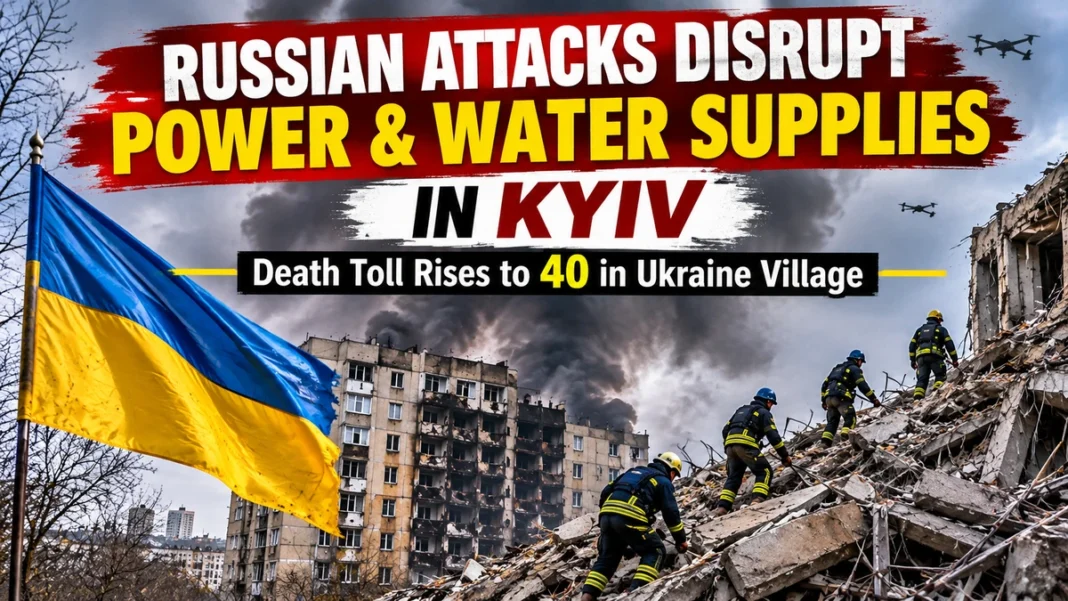
Russian attacks on Ukraine’s energy infrastructure disrupted electricity and water supplies across Kyiv and neighbouring regions on Wednesday, November 4, 2026. The outages lasted several hours, affecting residents in the Ukrainian capital and surrounding areas.
According to Ukraine’s Air Force, Russia launched 310 drones overnight, including 81 jet-powered drones. Ukrainian air defence systems intercepted or electronically suppressed 272 of them. Strikes were reported at 19 locations.
The attacks prompted local authorities to establish emergency support centres in the worst-affected areas. These centres provided hot drinks and electricity, allowing residents to charge their electronic devices.
Residents were also advised to use public drinking water fountains while water supplies remained disrupted. Electricity and water services were subsequently restored following emergency repairs.
Death Toll Rises to 40 After Strike on Humanitarian Aid Centre
Meanwhile, rescue operations continued in Komyshuvakha village in Ukraine’s southeastern Zaporizhzhia region, where a Russian airstrike on Monday, November 2, struck a former school building being used as an underground shelter and humanitarian aid distribution centre.
Ukrainian President Volodymyr Zelenskyy said the death toll had risen to 40, with approximately 30 more people feared trapped beneath the rubble.
The facility had been serving as a shelter and distributing humanitarian assistance to local residents every Monday. The attack reportedly took place as people gathered to collect essential supplies.
According to Reuters, Ivan Fedorov, co-head of the Zaporizhzhia Regional Defence Council, reported that 59 people were missing following the strikes. Emergency services also confirmed that two rescue workers and four police officers were among those killed.
Rescue teams faced additional difficulties as Russian drone activity reportedly hampered search operations. Excavators and emergency personnel continued clearing debris and searching underground areas for victims.
Ukrainian police also began collecting DNA samples from relatives because some victims could not be identified through visual examination.
Russia and Ukraine Offer Conflicting Accounts of the Attack
The attack has drawn further attention to the growing civilian cost of the war.
Ukrainian officials described the targeted location as a humanitarian facility used by residents for shelter and aid distribution. World Central Kitchen, an organisation providing food and water assistance in the region, also confirmed that the damaged facility served as a humanitarian and administrative centre for the local community.
Russia‘s Defence Ministry, however, said its forces had targeted Ukrainian military units in and around Komyshuvakha, claiming that up to 25 Ukrainian servicemen had been killed.
Both Russia and Ukraine deny deliberately targeting civilians.
International Discussions on Ukraine’s Future
The latest attacks come amid continuing diplomatic efforts to address the conflict, which has entered its fifth year since Russia launched its full-scale invasion in February 2022.
On Wednesday, officials from the United States, Germany, France, Britain, NATO, the World Bank and the European Union met in Brussels to discuss Ukraine’s post-war reconstruction and economic recovery.
European Union foreign policy chief Kaja Kallas called for discussions to address potential Russian concessions rather than focusing exclusively on the compromises expected from Ukraine.
Meanwhile, another round of US-brokered negotiations involving Russian and Ukrainian delegations was scheduled for November 10–11 in Abu Dhabi. The discussions are expected to focus on ending the conflict, post-war security arrangements and de-escalation.
The latest attacks highlight the continuing vulnerability of Ukraine’s civilian infrastructure and population, even as international diplomatic efforts to end the war continue