

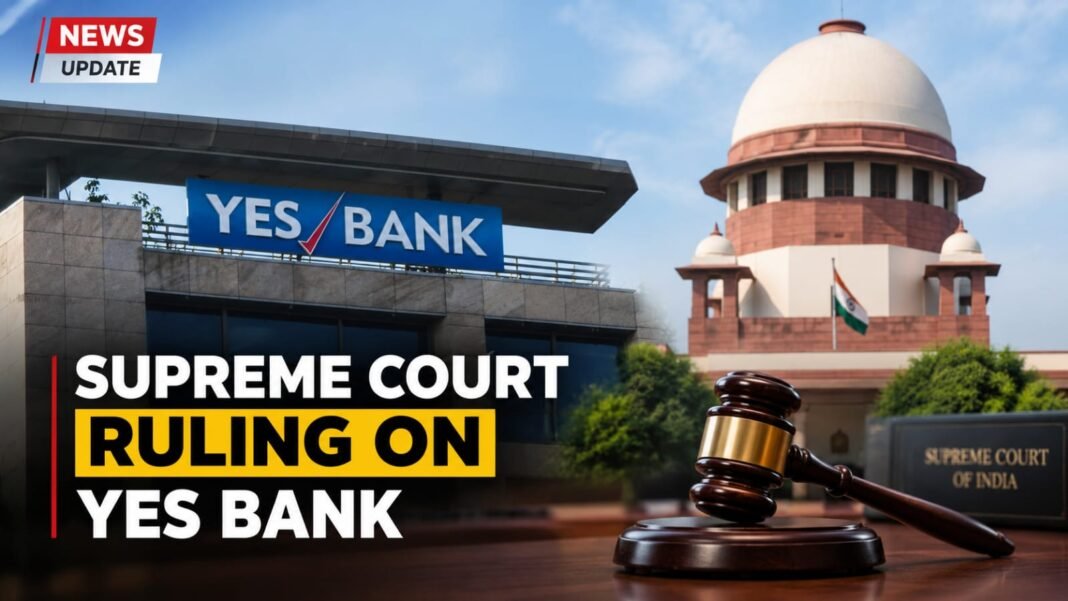
New Delhi: In a landmark judicial verdict that provides massive relief to thousands of investors, the Supreme Court of India on Thursday, October 15, 2026, upheld the Bombay High Court’s order quashing the write-off of Yes Bank’s Additional Tier-1 (AT-1) bonds valued at ₹8,415 crore.
A division bench comprising Justices Dipankar Datta and Augustine George Masih dismissed the batch of appeals filed by Yes Bank, the Reserve Bank of India (RBI), and the Union Government. The verdict brings an end to a high-stakes legal tussle following the court’s decision to reserve judgment in May after examining Union Cabinet documents, meeting minutes, and regulatory records tied to the private lender’s 2020 emergency bailout.
Origins of the Bailout and the Legal Battle
The controversy stems from March 2020, when Yes Bank faced severe financial stress caused by mounting non-performing assets (NPAs) and a run on deposits. To prevent a broader systemic failure across the banking ecosystem, the RBI placed the private lender under a moratorium, appointed an administrator, and formulated a reconstruction scheme under the Banking Regulation Act.
On March 14, 2020, as part of the restructuring process, the administrator informed stock exchanges that ₹8,415 crore worth of AT-1 debentures had been written off down to zero. AT-1 debentures are high-yield, unsecured perpetual debt instruments designed to absorb losses if a bank’s capital drops below mandatory regulatory thresholds.
Aggrieved bondholders—including retail investors, pension funds, mutual funds, and trustee firms represented by Axis Trustee Services—moved the Bombay High Court. In January 2023, the High Court quashed the write-off. The court noted that while the draft reconstruction scheme had contained a provision for writing down AT-1 bonds, that clause was explicitly deleted from the final scheme sanctioned by the Central Government. Consequently, the High Court held that the administrator lacked the legal authority to unilaterally cancel the bonds once the finalized scheme took effect.
Key Takeaways and Implications for Indian Banking
Thursday’s Supreme Court judgment sets a major precedent regarding administrative powers, regulatory transparency, and investor safeguards during emergency debt restructurings.
Comprehensive Investor Recovery: The dismissal clears a direct legal path for retail buyers, pension funds, and institutional bondholders to seek reinstatement of their debt or capital recovery after having their investments wiped out.
Strict Limits on Regulatory Powers: The apex court affirmed that administrators and banking authorities must strictly abide by finalized statutory schemes and due process, rejecting arguments that emergency administrators hold unchecked power over debt cancellations.
Precedent for High-Risk Debt Markets: The verdict brings needed clarity to India’s ₹1-lakh-crore AT-1 bond market, re-establishing investor confidence regarding loss-absorption rules and regulatory enforcement during future corporate bailouts.
For regulators and issuers across the financial landscape, the ruling highlights the necessity of absolute legal clarity and procedural adherence when drafting restructuring frameworks.
Investor Relief and Judicial Precedent for Banking Sector
The Supreme Court’s decision brings long-awaited legal finality to a multi-year courtroom battle. By dismissing all appeals and declaring “we see no reason to interfere with the impugned judgment,” the apex court confirmed that the write-off complied with neither the RBI’s Master Circular guidelines nor the terms set out in the bonds’ original information memoranda.
This verdict paves the way for investors to seek recovery, debt reinstatement, or potential equity conversion arrangements. Beyond direct relief for bondholders, the court’s ruling establishes strict legal boundaries on emergency resolutions, reinforcing that regulatory authorities cannot bypass procedural rules or statutory frameworks even during crisis management
Financial Burden and Market Shockwaves
The apex court’s ruling sent immediate shockwaves through the financial markets. Following the announcement, Yes Bank shares tumbled sharply by up to 7.8% during intraday trading, reaching ₹19.55 apiece as market participants reacted to the unexpected liability added back to the bank’s balance sheet.
From an accounting perspective, the verdict places a heavy financial obligation on Yes Bank. The lender will now be forced to evaluate how to recognize, reinstate, or address the ₹8,415 crore liability on its books. Financial experts anticipate that the bank may need to set aside significant capital provisions, arrange structured payouts, or negotiate debt-to-equity conversions to settle long-standing bondholder claims.


