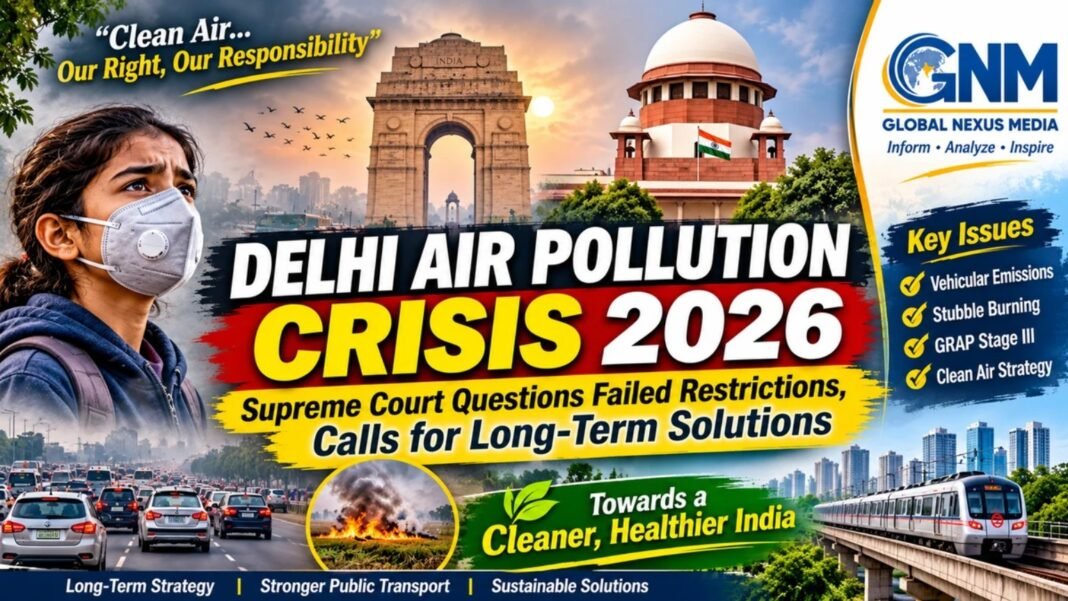
With Delhi-NCR’s air quality deteriorating and GRAP Stage III restrictions coming into force, the Supreme Court has questioned the effectiveness of recurring emergency measures and highlighted vehicular emissions, public transport gaps and the need for farmer-friendly alternatives to stubble burning.
Introduction
Delhi-NCR’s recurring winter air pollution crisis has once again reached the Supreme Court. During a hearing on 6 November 2026, a three-judge Bench led by Chief Justice of India Surya Kant questioned whether repeated restrictions on vehicles, construction activities and other sources were delivering meaningful, lasting improvements.
The Court highlighted the contribution of vehicular emissions, the limitations of the region’s public transport system and the need to address agricultural residue burning through practical economic incentives rather than relying solely on restrictions.
The observations came as Delhi’s air quality deteriorated sharply. The Commission for Air Quality Management (CAQM) invoked Stage III measures under the Graded Response Action Plan (GRAP) on 6 November.
The development raises an important policy question: Can India move beyond seasonal pollution control towards a permanent, science-based clean-air strategy?
1. What did the Supreme Court say?
The Supreme Court was hearing a suo motu matter concerning the regulatory framework for air pollution in Delhi-NCR.
The Bench, comprising CJI Surya Kant and Justices Joymalya Bagchi and V. Mohana, raised concerns about the recurring nature of the crisis and the limited effectiveness of measures repeatedly introduced during the winter months.
Key observations included:
- Vehicular emissions: The Court identified the volume of vehicles and bumper-to-bumper traffic as major contributors to pollution.
- Public transport: It questioned how people could be expected to reduce private vehicle use without an adequate and accessible public transport system.
- Pollution restrictions: The Bench questioned the effectiveness of repeatedly stopping vehicles, deploying water sprinklers and restricting activities without addressing underlying causes.
- Stubble burning: It suggested that farmers should have economic incentives and practical alternatives to burning crop residue.
- Public participation: The Court stressed that pollution control cannot depend exclusively on judicial directions and government restrictions.
The Court also questioned the disproportionate focus on stubble burning when urban sources, particularly vehicular emissions, require sustained attention.
Importantly, these were judicial observations during a hearing. They should not be interpreted as a final judicial finding that one source alone is responsible for Delhi’s pollution.
2. GRAP Stage III: Why was it imposed?
The Commission for Air Quality Management (CAQM) invoked Stage III of the Graded Response Action Plan across Delhi-NCR on 6 November 2026.
The decision followed deteriorating air quality and forecasts indicating a possibility of severe pollution levels.
According to the reported CAQM update, Delhi recorded an AQI of 382 at 4 PM on 5 November. The India Meteorological Department and IITM-Pune forecast that air quality could enter the severe category during 7–9 November.
Major restrictions under GRAP Stage III
The measures include:
- Restrictions on dust-generating construction and demolition activities across NCR, subject to specified exemptions.
- Restrictions on certain categories of older and more polluting vehicles under the applicable GRAP provisions.
- Consideration by governments in NCR of work-from-home arrangements and reduced office attendance.
- Additional dust-control and road-cleaning measures.
- Intensified enforcement against pollution-generating activities.
GRAP is an emergency response mechanism. It is designed to prevent further deterioration in air quality; it is not a substitute for long-term pollution prevention.
3. Understanding the major sources of Delhi-NCR air pollution
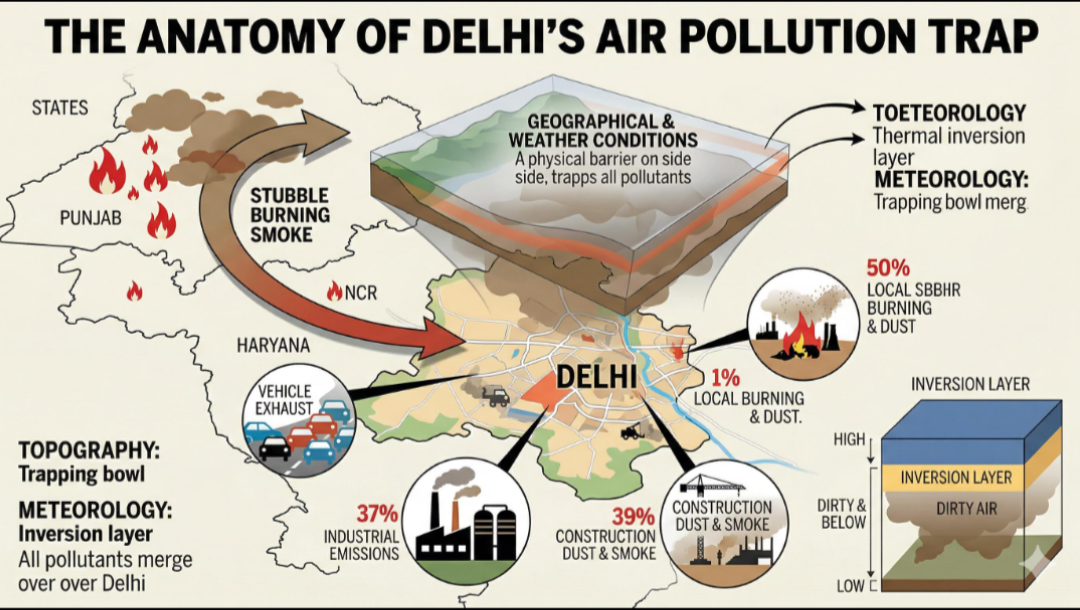
Delhi’s pollution problem is not caused by a single activity. It results from the interaction of emissions, weather conditions, geography and regional pollution movement.
A. Vehicular emissions
Road transport contributes pollutants through exhaust emissions, fuel combustion, tyre and brake wear, and traffic congestion.
The Supreme Court highlighted the growing number of vehicles moving between Delhi and neighbouring NCR cities, including Gurugram, Ghaziabad, Faridabad and Greater Noida.
An effective response requires cleaner vehicles, reliable public transport, better traffic management and improved last-mile connectivity.
B. Agricultural residue burning
After the paddy harvest, some farmers burn crop residue to clear fields quickly for the next cropping cycle.
The practice contributes to seasonal air pollution in northern India. However, its contribution varies according to the number of fires, wind direction, atmospheric conditions and other pollution sources.
During the hearing, the Court discussed advance procurement prices for crop residue so farmers could receive an economic incentive to sell rather than burn it.
This approach recognises that agricultural pollution cannot be addressed through enforcement alone.
C. Construction and road dust
Construction, demolition, uncovered materials and dust from roads contribute to particulate pollution.
Weak implementation of dust-control rules can worsen local air quality, particularly in rapidly urbanising areas.
D. Industrial and waste emissions
Industrial fuel combustion, diesel generators, waste burning and other urban activities also contribute to the pollution burden.
E. Meteorological conditions
During winter, low wind speeds, temperature inversion and a shallow atmospheric boundary layer can trap pollutants close to the ground.
This is why similar emission levels may produce significantly worse air quality during certain weather conditions.
4. Why emergency restrictions alone are insufficient
The recurring winter pollution crisis demonstrates the limitations of a predominantly reactive policy approach.
Temporary restrictions may reduce certain emissions, but they cannot independently resolve structural problems such as:
- Dependence on private vehicles.
- Inadequate public transport connectivity.
- Weak enforcement of pollution-control standards.
- Limited availability of affordable crop-residue management systems.
- Poor coordination among Delhi, neighbouring states and central agencies.
- Insufficient year-round monitoring and prevention.
A restriction-based approach can also create unintended consequences. For example, stopping vehicles at entry points without an effective traffic-management system may lead to idling and congestion.
The policy objective should therefore be to reduce emissions at their source rather than merely restrict activities after air quality deteriorates.
5. Constitutional and institutional framework
Air pollution is not merely an environmental issue. It also concerns public health, governance and constitutional rights.
Article 21 — Right to Life
The Supreme Court has interpreted Article 21 to include the right to live in a healthy environment. Severe air pollution raises serious concerns about the protection of life and health.
Article 48A — Protection of the Environment
This Directive Principle requires the State to protect and improve the environment and safeguard forests and wildlife.
Article 51A(g) — Fundamental Duty
Every citizen has a duty to protect and improve the natural environment, including forests, lakes, rivers and wildlife, and to show compassion for living creatures.
Commission for Air Quality Management Act, 2021
The Act provides an institutional framework for coordinating air-quality management in the National Capital Region and adjoining areas.
The CAQM plays a central role in coordinating pollution-control measures across the region.
Graded Response Action Plan (GRAP)
GRAP provides a graded emergency-response framework based on air-quality conditions and forecasts. It enables authorities to introduce progressively stronger restrictions as pollution worsens.
6. What should India’s long-term strategy look like?
The Supreme Court’s observations point towards a more comprehensive approach.
1. Strengthen public transport
- Expand metro and bus connectivity.
- Improve last-mile connectivity.
- Encourage integrated ticketing and multimodal transport.
- Develop reliable public transport between Delhi and NCR cities.
2. Make crop-residue management economically viable
- Announce procurement prices for crop residue in advance.
- Strengthen biomass-based energy and industrial applications.
- Improve access to machinery through cooperatives and custom-hiring centres.
- Involve Gram Panchayats in local collection and management systems.
- Provide financial and technical support to small and marginal farmers.
3. Strengthen regional coordination
Delhi’s air pollution cannot be addressed by the national capital alone.
Delhi, Haryana, Punjab, Uttar Pradesh and Rajasthan must coordinate on transport emissions, industrial pollution, agricultural residue and regional air-quality monitoring.
4. Improve scientific monitoring
- Expand real-time air-quality monitoring.
- Strengthen source-apportionment studies.
- Improve emissions inventories.
- Use satellite observations and meteorological forecasting.
- Make relevant pollution data accessible to the public.
5. Enforce standards throughout the year
Pollution control should not become a seasonal exercise.
Authorities must consistently monitor industrial emissions, construction dust, waste burning and vehicle compliance.
6. Protect vulnerable populations
Outdoor workers, children, older persons and economically weaker communities often face greater exposure and have fewer resources to protect themselves.
Clean-air policies must include public-health advisories, accessible healthcare and targeted protection for vulnerable groups.
7. Challenges in implementation
Despite a strong institutional framework, several obstacles remain:
- Federal coordination: Pollution crosses administrative boundaries, making cooperation essential.
- Economic constraints: Farmers and small businesses may struggle to adopt cleaner alternatives without financial support.
- Transport dependence: Restricting private vehicles without reliable alternatives can disproportionately affect commuters.
- Enforcement gaps: Rules may exist on paper but remain inconsistently implemented.
- Scientific uncertainty: Source contributions vary across seasons and weather conditions, requiring continuous assessment.
- Public behaviour: Long-term improvement requires changes in commuting, energy consumption, waste management and civic responsibility.
8. Way Forward: From seasonal restrictions to clean-air governance
India needs to shift from emergency pollution management towards an integrated clean-air governance model.
The following priorities are important:
- Prepare measurable, year-round emission-reduction targets for the entire NCR.
- Strengthen CAQM’s monitoring, coordination and enforcement capacity.
- Make public transport a practical alternative to private vehicles.
- Develop a financially sustainable crop-residue procurement and utilisation ecosystem.
- Improve regional data-sharing and transparent source-apportionment studies.
- Integrate air-quality objectives into urban planning, industrial policy and agricultural policy.
- Establish clear accountability for implementing pollution-control measures.
The objective should not simply be to bring the AQI below a particular threshold for a few days. It should be to create healthier cities and a cleaner regional environment throughout the year.
Conclusion
The Supreme Court’s latest intervention has once again brought Delhi-NCR’s air pollution crisis into focus. Its observations highlight an important limitation of India’s current approach: emergency restrictions cannot replace long-term planning, reliable public transport, scientific monitoring and coordinated governance.
The solution must also be economically fair. Farmers need viable alternatives to stubble burning, commuters need accessible public transport, and vulnerable communities need protection from harmful exposure.
Clean air must become a year-round governance priority, not merely a winter emergency response.
UPSC Special: Exam Preparation
GS Syllabus Mapping
GS Paper II
- Government policies and interventions.
- Centre–State relations and inter-state coordination.
- Role of institutions in environmental governance.
GS Paper III
- Environmental pollution and degradation.
- Conservation and environmental impact.
- Sustainable development.
- Science and technology in environmental management.
GS Paper IV
- Environmental ethics.
- Responsibility of public institutions.
- Citizen participation and accountability.
Important concepts to remember
| Concept | Meaning |
|---|---|
| AQI | Air Quality Index; communicates the status of ambient air quality |
| PM2.5 | Particulate matter with a diameter of 2.5 micrometres or less |
| PM10 | Particulate matter with a diameter of 10 micrometres or less |
| Temperature inversion | Atmospheric condition in which warmer air above traps cooler air and pollutants near the surface |
| Source apportionment | Scientific assessment of the contribution of different sources to pollution |
| GRAP | Graded Response Action Plan for emergency pollution control in Delhi-NCR |
| CAQM | Commission for Air Quality Management |
Prelims Practice Questions
Q1. Consider the following statements about the Commission for Air Quality Management (CAQM):
- It was established under a law enacted in 2021.
- Its jurisdiction includes the National Capital Region and adjoining areas.
- It deals exclusively with vehicular pollution.
Which of the statements given above are correct?
A. 1 and 2 only
B. 2 and 3 only
C. 1 and 3 only
D. 1, 2 and 3
Answer: A — 1 and 2 only.
Explanation: CAQM was established under the Commission for Air Quality Management in National Capital Region and Adjoining Areas Act, 2021. Its mandate covers multiple sources of air pollution, not just vehicles.
Q2. Temperature inversion can worsen winter air pollution because:
A. It increases the vertical mixing of pollutants.
B. It traps pollutants closer to the Earth’s surface.
C. It eliminates particulate matter from the atmosphere.
D. It increases rainfall.
Answer: B.
Explanation: Temperature inversion can suppress vertical atmospheric mixing, allowing pollutants to accumulate near the surface.
Q3. With reference to the Graded Response Action Plan (GRAP), consider the following statements:
- It provides graded emergency measures according to air-quality conditions.
- It is intended only for long-term reduction of industrial emissions.
- It operates in Delhi-NCR.
Which of the statements given above are correct?
A. 1 only
B. 1 and 3 only
C. 2 and 3 only
D. 1, 2 and 3
Answer: B — 1 and 3 only.
Explanation: GRAP is an emergency-response mechanism for Delhi-NCR. It does not replace long-term pollution-control policies.
Mains Practice
Question (GS Paper III | 15 Marks | 250 Words)
“Recurring air pollution in Delhi-NCR reflects not merely an environmental crisis but also a failure of coordinated urban and regional governance.” Discuss the limitations of emergency pollution-control measures and suggest a comprehensive strategy for sustainable air-quality management.
Model Answer
Delhi-NCR’s recurring air pollution crisis is driven by multiple interacting sources, including vehicular emissions, industrial activities, construction dust, agricultural residue burning and adverse meteorological conditions. Its persistence reflects both environmental challenges and institutional coordination gaps.
Emergency mechanisms such as the Graded Response Action Plan (GRAP) provide important short-term interventions. However, restrictions on construction, vehicles and other activities cannot independently address structural causes. Their effectiveness is limited when public transport remains inadequate, regional emissions continue and enforcement is inconsistent.
A comprehensive strategy should include:
- Transport reform: Expand reliable public transport, improve last-mile connectivity and encourage cleaner mobility.
- Agricultural incentives: Provide advance procurement prices for crop residue, improve access to machinery and promote biomass utilisation.
- Regional coordination: Strengthen cooperation among Delhi, Punjab, Haryana, Uttar Pradesh and Rajasthan through CAQM.
- Scientific monitoring: Improve source-apportionment studies, emissions inventories and real-time air-quality data.
- Industrial and urban regulation: Enforce emission standards, control construction dust and prevent open waste burning.
- Public participation: Promote awareness and responsible behaviour while protecting vulnerable populations.
The constitutional basis for action includes Article 21, Article 48A and Article 51A(g).
Ultimately, India must move from seasonal restrictions to preventive, science-based and regionally coordinated clean-air governance. Clean air should be treated as a continuous public-policy priority rather than a temporary winter concern.