

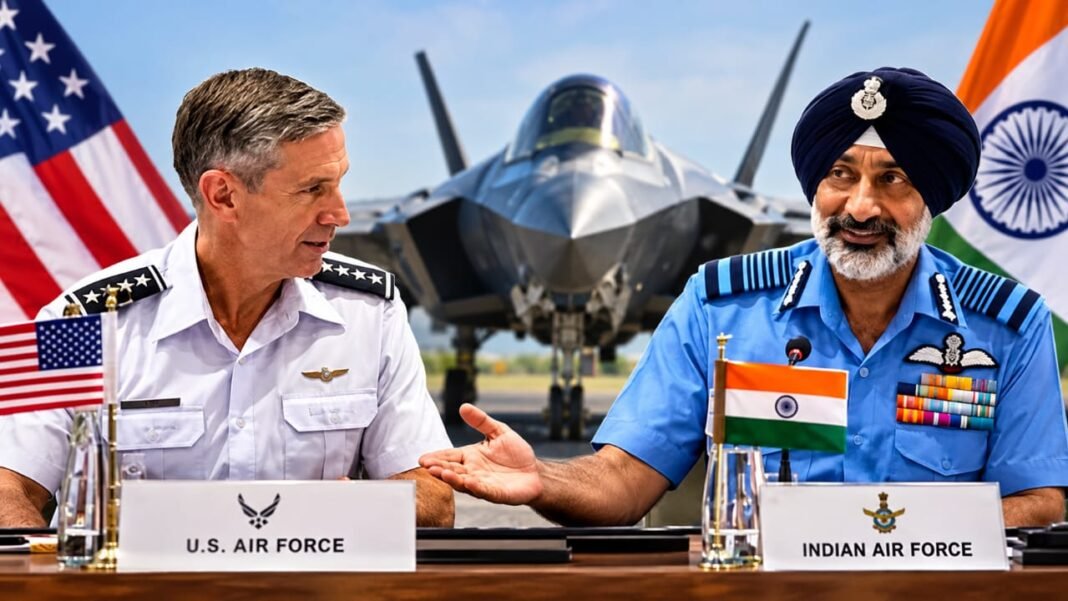
A light-hearted remark by Indian Air Force Chief Air Chief Marshal A. P. Singh has renewed attention on the prospects of India acquiring the American F-35 stealth fighter. Speaking alongside a senior US air force commander in Jodhpur, Singh highlighted restrictions on access to the aircraft and clarified that no formal sale offer had been made to India.
IAF Chief’s F-35 Remark Puts Spotlight on India’s Fighter Jet Options
JODHPUR: A candid exchange between Indian Air Force Chief Air Chief Marshal A. P. Singh and a senior American military commander has brought fresh attention to the possibility of India acquiring the United States’ advanced F-35 stealth fighter.
Speaking during a joint press conference associated with the multinational air exercise Tarang Shakti 2026, Singh made a light-hearted observation about the restrictions placed on Indian personnel seeking access to the American aircraft.
Addressing General Kevin Schneider, commander of US Pacific Air Forces, Singh remarked that American personnel did not allow Indian representatives to get close to the F-35, even as discussions about a possible sale continued to attract attention.
However, the IAF chief made one point clear: the United States had not made a formal offer to sell the F-35 to India.
The exchange highlighted the difference between public discussions about a potential defence deal and the formal process required to turn such discussions into an actual procurement proposal.
Six American F-35A Jets Participate in Tarang Shakti 2026
The remarks came as six US Air Force F-35A aircraft participated in Tarang Shakti 2026 in Jodhpur, Rajasthan.
The exercise brought together several foreign air forces for joint flying activities, operational exchanges and professional interaction. The American aircraft’s participation provided an opportunity for participating forces to observe and operate alongside an advanced fifth-generation fighter.
The F-35A is a conventional take-off and landing variant of the F-35 family. It combines stealth design with advanced sensors, information-sharing capabilities and integrated mission systems.
Its participation in an Indian-hosted exercise was significant for military engagement, but it did not indicate that a purchase agreement with India was in place.
Why Has an F-35 Sale to India Become a Talking Point?
The possibility of India acquiring the F-35 entered the broader defence conversation in February 2025, when US President Donald Trump said Washington would pave the way for the eventual supply of the aircraft to India.
That announcement generated speculation about whether the American fighter could become part of India’s future combat aircraft fleet.
However, political statements about a potential sale are different from a formal offer containing the terms, conditions and details required for a procurement decision.
Singh’s latest clarification addresses that distinction. According to his statement, India has not received an official US offer for the F-35.
Any future proposal would need to be assessed against India’s operational requirements, financial considerations, maintenance needs, technology access and wider strategic priorities.
Access to Sensitive Technology Remains a Key Issue
The IAF chief’s remark also drew attention to the strict security arrangements surrounding advanced military aircraft.
During the exchange, Singh referred to restrictions on access to the F-35’s cockpit. He also noted that Indian aircraft had been allowed to fly in close formation with the American fighter.
These are different levels of access. Flying alongside an aircraft during an exercise does not automatically provide access to its classified systems, technical information or operational software.
General Schneider indicated that decisions about sharing sensitive F-35 programme information were governed by established security and classification rules.
Such restrictions are common in advanced defence programmes, where governments protect sensitive technology even while conducting military exercises with partner nations.
Russia’s Su-57 Offer Also Awaits a Decision
The F-35 is not the only fifth-generation fighter being discussed in the context of India’s future air combat capabilities.
Russia has offered its Su-57 fighter to India, but Singh indicated that the Indian Air Force was awaiting a government decision on whether to evaluate the aircraft.
The assessment, if authorised, would examine how well the Russian platform meets India’s requirements.
A meaningful comparison between the F-35 and Su-57 would involve more than headline performance figures. Factors such as sensors, weapons integration, operational availability, lifecycle costs, maintenance support and technology arrangements would also be important.
At present, the reported Russian proposal should not be confused with a final Indian purchase decision.
India’s Indigenous AMCA Programme Remains Important
India is also pursuing the Advanced Medium Combat Aircraft (AMCA) programme, an indigenous effort to develop a fifth-generation fighter.
The programme reflects India’s longer-term ambition to strengthen domestic aerospace design, development and manufacturing capabilities.
The choice between a foreign platform and an indigenous programme involves several considerations, including the urgency of military requirements, the time needed to develop new technology, costs and the degree of technological independence available.
For Indian defence planners, the challenge is to maintain operational readiness while building the capabilities needed for future combat aircraft.
What Does This Mean for India-US Defence Relations?
Singh’s comment should be understood in the context of military cooperation and the sensitivities surrounding advanced defence technology. It does not, by itself, establish a diplomatic dispute or signal the rejection of a potential American offer.
India and the United States continue to engage through military exercises and broader defence cooperation. At the same time, access to sensitive systems and decisions on high-value equipment purchases remain subject to separate procedures.
The F-35 question therefore remains open in the broader strategic debate, but the immediate procurement position is clear: according to the IAF chief, Washington has not formally offered the aircraft for sale to India.
Conclusion
The exchange in Jodhpur brought a practical issue into focus participating in a military exercise does not automatically provide access to an aircraft’s sensitive technology, and public discussion of a possible sale does not amount to a formal procurement offer.
For India, any decision on a future fifth-generation fighter will depend on operational needs, costs, technology considerations and long-term defence priorities.
For now, the F-35 remains a subject of strategic interest rather than a confirmed acquisition. Russia’s Su-57 proposal and India’s indigenous AMCA programme also remain relevant to the country’s future fighter aircraft planning.


