

By Global Nexus Media | 17 November 2026
India has taken another step towards modernising its public administration with the launch of the second phase of Census 2027 in four states and selected areas of Uttarakhand.
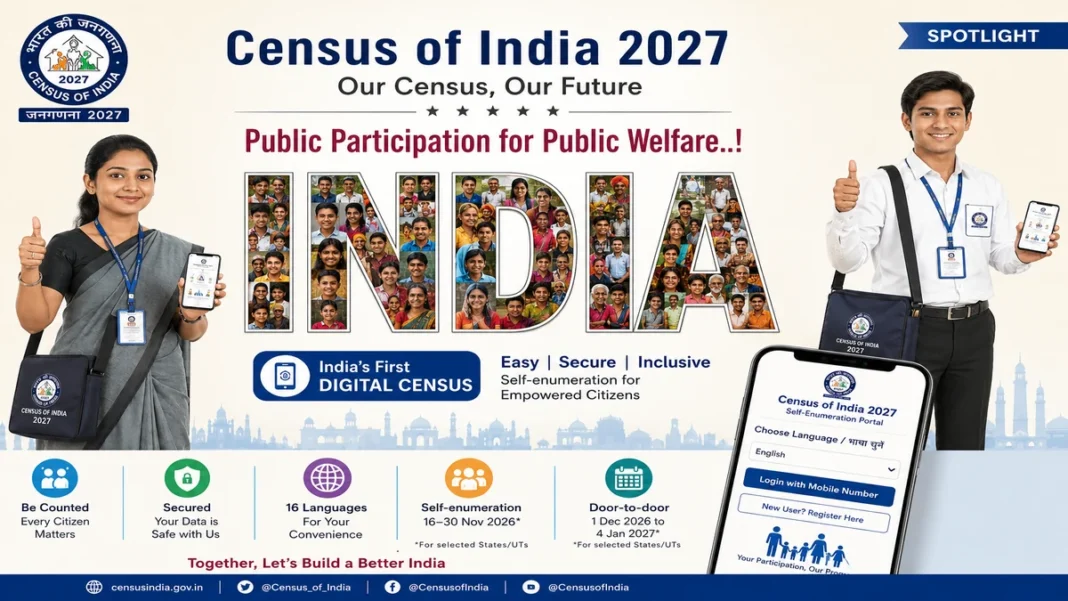
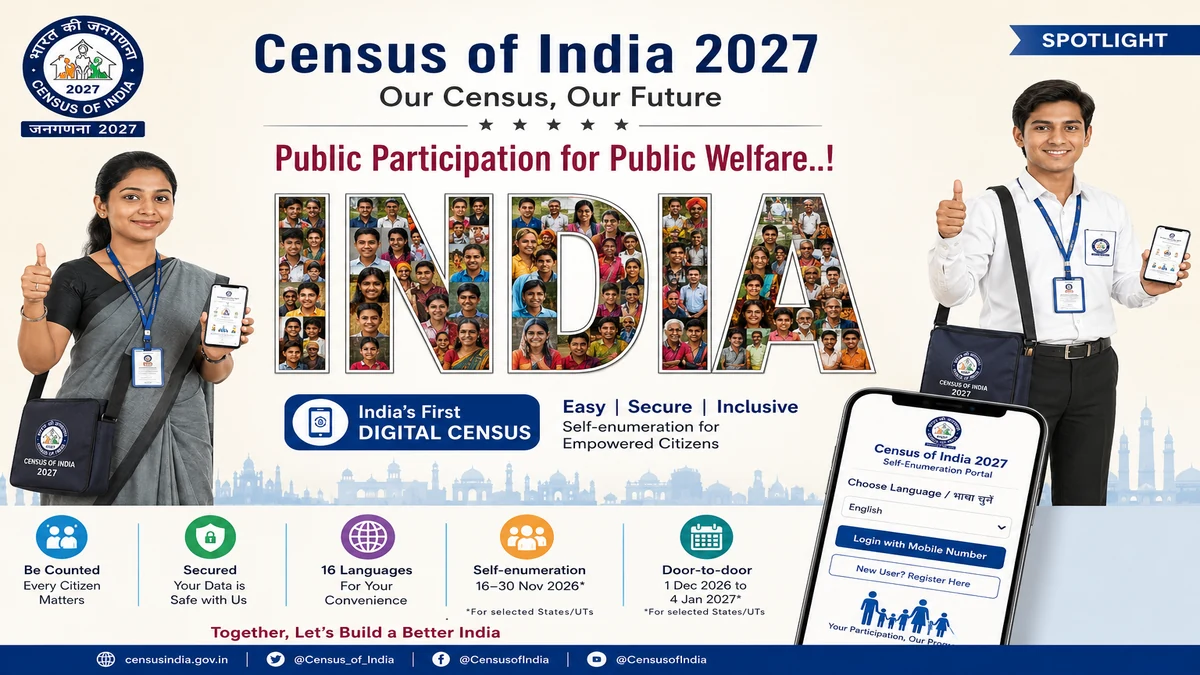
The Ministry of Home Affairs announced on 16 November that the self-enumeration facility for the Population Enumeration phase had commenced in Uttar Pradesh, Punjab, Goa and the non-snow-bound areas of Uttarakhand. Residents in these areas can submit their household details online through the official Census portal until 30 November 2026.
This is an important development because Census 2027 is India’s first census to use digital tools for data collection, with an online self-enumeration facility allowing households to provide information themselves before the visit of an official enumerator.
The initiative is expected to make the process more convenient and improve the collection and management of population data. However, its success will depend on accurate information, public participation, digital accessibility and confidence in data protection.
The significance of the exercise goes beyond counting India’s population. Census data forms an important foundation for planning public services, understanding demographic changes and designing development policies.
How Will Self-Enumeration Work?
Under the new system, eligible residents can access the official self-enumeration portal:
Official portal: https://se.census.gov.in
The process involves the following steps:
- Visit the official Self-Enumeration portal.
- Log in using a mobile number, preferably the number registered during Phase I, along with the required basic details.
- Complete the 40 notified questions covering household and individual particulars.
- Submit the information through the portal.
- Receive a unique Self-Enumeration ID (SE ID).
- Share this ID with the enumerator during the subsequent household visit.
The facility is available in 16 Indian languages, making it accessible to people from different linguistic backgrounds.
Importantly, self-enumeration is an additional facility, not a replacement for the traditional door-to-door process. Census enumerators will continue visiting their allocated households to complete the exercise.
Households that do not use the online facility will also be covered through the regular enumeration process.
Census 2027: Important Dates and Schedule
The second phase is being conducted in different schedules to accommodate administrative and regional requirements.
Phase II: Four States and Selected Areas
| Activity | Schedule |
|---|---|
| Self-Enumeration | 16–30 November 2026 |
| Door-to-door Population Enumeration | 1 December 2026–4 January 2027 |
| Revisional Round | 5–9 January 2027 |
| Reference Date | 00:00 hours, 5 January 2027 |
This schedule applies to Uttar Pradesh, Punjab, Goa and the non-snow-bound areas of Uttarakhand.
Remaining States and Union Territories
| Activity | Schedule |
|---|---|
| Self-Enumeration | 10–24 January 2027 |
| Door-to-door Population Enumeration | 25 January–28 February 2027 |
| Revisional Round | 1–5 March 2027 |
| Reference Date | 00:00 hours, 1 March 2027 |
The Ministry has stated that the first phase, House Listing and Housing Census, has been completed across 35 States and Union Territories, except Manipur.
These different schedules are important for understanding why Census 2027 will not take place simultaneously across all regions.
Why Is Census 2027 Different?
India’s Census has traditionally depended on a large field workforce visiting households and recording information.
Census 2027 introduces several technological changes.
1. Digital data collection
Enumerators will use mobile applications to collect information instead of relying entirely on traditional paper-based procedures.
2. Online self-enumeration
For the first time, households have been given an additional option to submit their information online before the enumerator’s visit.
3. Multilingual access
The self-enumeration facility is available in 16 Indian languages, including Hindi and English.
4. Digital monitoring
The Census Management and Monitoring System (CMMS) portal supports the monitoring of field operations and administrative progress.
5. Improved data management
Digital collection and processing are intended to improve efficiency, reduce paperwork and support the timely availability of census information.
These changes represent an important shift towards technology-enabled public administration.
Why Does India Need a Census?
A population census is much more than a numerical exercise. It provides a detailed picture of the country’s demographic, social and economic structure.
Its findings can help governments understand:
- Population size and distribution.
- Age composition and demographic trends.
- Migration patterns.
- Literacy and educational characteristics.
- Household conditions and amenities.
- Employment and socio-economic characteristics.
- Fertility and other population-related indicators.
This information supports planning in areas such as education, healthcare, housing, transport, sanitation and infrastructure.
For example, population data can help authorities assess where new schools, hospitals and public facilities may be required.
It can also help researchers understand urbanisation, migration, changing family structures and regional inequalities.
However, census data is only as useful as its accuracy, coverage and appropriate interpretation.
Caste Enumeration: One of the Most Significant Features
One of the major policy developments associated with Census 2027 is the decision to include caste enumeration.
On 30 April 2025, the Cabinet Committee on Political Affairs decided that caste enumeration would be included in the upcoming Census.
The Ministry of Home Affairs subsequently confirmed that caste enumeration would take place during the Population Enumeration phase.
This is significant because, since Independence, regular Census operations have systematically enumerated Scheduled Castes and Scheduled Tribes, while comprehensive caste enumeration of all communities was not part of the regular Census.
The inclusion of caste data is expected to add an important dimension to India’s understanding of its social structure.
Such information could contribute to discussions on social justice, representation, welfare policy and inclusive development.
However, the collection of caste data also raises important questions about methodology, classification, accuracy and responsible interpretation.
The government has stated that the detailed Population Enumeration questions, including those relating to caste, will be finalised and notified through the established procedure.
Therefore, the exact questionnaire and its implementation details should be assessed on the basis of the official notification rather than assumptions.
Data Privacy: Can Citizens Trust the Digital Census?
The use of digital technology in a national exercise involving millions of households makes data protection particularly important.India’s $400-Billion Renewable Energy Opportunity: Can Clean Energy Deliver Energy Security?
People may naturally have questions about how their personal information will be stored, accessed and used.
The government has stated that information collected under the Census Act, 1948, remains strictly confidential and is used for statistical purposes and development planning.
Section 15 of the Census Act provides an important legal safeguard for individual census records. Personal information collected during the Census is confidential and cannot ordinarily be accessed as public information or used as evidence in court proceedings.
This protection is essential for building public trust.
At the same time, digital systems require strong cybersecurity, secure data storage, controlled access and effective safeguards against unauthorised disclosure.
Public awareness about the official portal is also important. Citizens should use government-authorised channels and avoid sharing personal information through unverified links or messages.
Digital convenience must go hand in hand with digital security.
The Digital Divide: A Challenge for Inclusive Participation
Although self-enumeration offers convenience, not every household has equal access to smartphones, reliable internet connectivity or digital literacy.
This is particularly relevant for:
- Rural households with limited internet access.
- Elderly citizens unfamiliar with online services.
- People with disabilities.
- Migrant workers and mobile populations.
- Households with limited access to digital devices.
If digital participation is not supported by adequate assistance, some groups may find the process difficult.
The continuation of door-to-door enumeration is therefore essential.
The government must ensure that digital tools improve participation rather than create additional barriers for vulnerable sections of society.
A successful digital Census should be inclusive by design.
What Does Census 2027 Mean for Uttar Pradesh?
The launch of self-enumeration in Uttar Pradesh makes this development particularly relevant for one of India’s most populous states.
Accurate population information is important for planning schools, hospitals, transport networks, housing, sanitation and other public services.
It can also help policymakers understand migration, urban expansion, rural development and changing demographic patterns.
For rapidly growing cities and urban areas, reliable population data is important for infrastructure planning and public-service delivery.
The exercise also offers an opportunity to improve awareness about digital government services among citizens.
However, the quality of the final data will depend on participation across urban, rural and socially diverse communities.
The Global South Perspective: Why Reliable Population Data Matters
For developing economies across the Global South, population data is an essential resource for development planning.
Countries with large and diverse populations face challenges involving urbanisation, migration, poverty, employment, education and healthcare.
Reliable demographic information helps governments identify these challenges and allocate public resources more effectively.
India’s digital Census can offer useful lessons for other developing countries seeking to modernise large-scale statistical exercises.
However, technology alone cannot guarantee accurate data. Institutional capacity, public trust, trained personnel and inclusive participation remain equally important.
India’s experience will therefore be relevant not only for its own governance system but also for the wider discussion on digital public administration in the Global South.
Conclusion: A Census Must Count Everyone
Census 2027 represents an important transition in India’s statistical and administrative systems.
Digital data collection, online self-enumeration and improved monitoring offer opportunities to make the exercise more efficient and accessible.
The inclusion of caste enumeration also makes this Census significant for debates on social structure and inclusive development.
Yet the success of the exercise cannot be measured simply by the number of households completing an online form.
It must be judged by the accuracy of information, inclusion of vulnerable communities, protection of personal data and usefulness of the final statistics for public policy.
India needs a Census that is technologically advanced but also transparent, inclusive and trustworthy.
The real achievement of Census 2027 will be not merely counting India’s population digitally, but ensuring that every household and every individual is accurately represented in the country’s development record.
Global Nexus Media will continue tracking the Census 2027 process, its implementation and its implications for governance and public policy.
UPSC SPECIAL: CENSUS 2027 AND DIGITAL GOVERNANCE
Syllabus Mapping
GS Paper I – Indian Society and Geography
- Population and demographic composition.
- Population distribution and migration.
- Urbanisation and associated challenges.
- Social structure and caste.
GS Paper II – Governance
- Government policies and interventions.
- E-governance and digital public services.
- Transparency, accountability and citizen participation.
- Rights and protection of personal information.
GS Paper III – Economy
- Data-based development planning.
- Inclusive growth.
- Human resource development.
Important Facts for Prelims
- Census is a Union subject under Entry 69 of the Union List in the Seventh Schedule.
- The Census Act was enacted in 1948.
- Census 2027 is India’s 16th Census in the series and the eighth after Independence.
- Census 2027 is being conducted in two phases: House Listing and Housing Census, followed by Population Enumeration.
- The first phase collects information on housing conditions, household amenities and assets.
- The second phase collects individual demographic and socio-economic information and includes caste enumeration.
- Section 15 of the Census Act protects the confidentiality of individual census records.
- The official self-enumeration facility is available at se.census.gov.in.
Prelims Practice Questions
Q1. With reference to the Census of India, consider the following statements:
- Census is a Union subject under the Seventh Schedule of the Constitution.
- The Census Act was enacted in 1948.
- Census data is collected only by State Governments.
Which of the statements given above are correct?
A. 1 and 2 only
B. 2 and 3 only
C. 1 and 3 only
D. 1, 2 and 3
Answer: A. 1 and 2 only.
Explanation: Census is a Union subject. The exercise is centrally coordinated and implemented in cooperation with States and Union Territories.
Q2. Consider the following statements about Census 2027:
- It introduces digital data collection.
- It provides an optional self-enumeration facility.
- Self-enumeration completely replaces household visits by enumerators.
Which of the statements given above are correct?
A. 1 and 2 only
B. 2 and 3 only
C. 1 and 3 only
D. 1, 2 and 3
Answer: A. 1 and 2 only.
Explanation: Self-enumeration is an additional facility. Enumerators will continue to visit households.
Q3. Section 15 of the Census Act, 1948, is primarily associated with:
A. Delimitation of constituencies
B. Confidentiality of census records
C. Reservation in public employment
D. Establishment of the Finance Commission
Answer: B. Confidentiality of census records.
Explanation: Section 15 protects the confidentiality of individual census records.
UPSC Mains Practice Question
GS Paper II
“Digital transformation of public administration can improve governance, but its success depends on inclusion, data protection and public trust.” Discuss in the context of Census 2027.
Model Answer
Digital transformation has the potential to improve the efficiency, accessibility and transparency of public administration. Census 2027 represents an important example of this transition through mobile-based data collection, online self-enumeration and digital monitoring systems.
The initiative can reduce paperwork, improve administrative coordination and support more efficient data processing. Reliable census information is essential for planning education, healthcare, housing, infrastructure and welfare programmes.
However, digital governance also presents challenges. Limited internet connectivity, lack of digital literacy and unequal access to devices may exclude vulnerable households. The collection of personal information also requires strong safeguards against unauthorised access and misuse.
Census 2027 addresses some of these concerns by retaining door-to-door enumeration alongside self-enumeration and providing multilingual access. The Census Act, 1948, also establishes legal safeguards for the confidentiality of individual records.
Further improvements should include public awareness campaigns, accessible assistance, cybersecurity measures and transparent communication about data usage.
Conclusion: Digital governance should not be measured only by technological advancement. Its real success depends on whether every citizen can participate safely, confidently and equally.