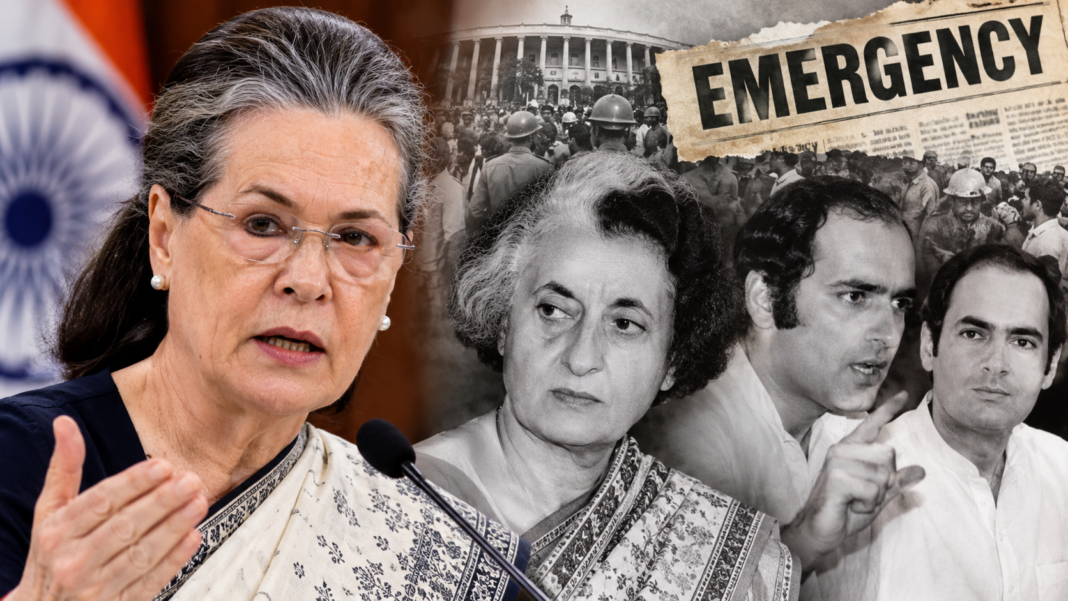
Sonia Gandhi has described the imposition of the Emergency in 1975 as a mistake, revealing how the controversial decision created differences within the Gandhi family. Ahead of the release of her memoir, Belonging: A Journey of Love, the Congress leader has shared personal details about disagreements between her husband, Rajiv Gandhi, and his younger brother, Sanjay Gandhi, over the decision taken by former Prime Minister Indira Gandhi.
In an interview with The Guardian, Sonia said she believed Indira Gandhi was a democrat at heart and was never fully comfortable with imposing the Emergency. She also suggested that keeping Sanjay Gandhi under control could have prevented much of the damage that followed.
Her comments offer a personal account of the political circumstances and family tensions surrounding one of the most controversial periods in India’s democratic history.
Rajiv and Sanjay Gandhi Disagreed Over Emergency
According to Sonia Gandhi, Rajiv and Sanjay had different opinions about how their mother should respond to the growing political crisis.
She said Rajiv Gandhi advised Indira Gandhi to wait for the next general election rather than impose the Emergency. Sanjay Gandhi, however, supported taking strong action against the Opposition.
Sonia recalled that the disagreement also created tensions within the family. According to her account, the final push came during a family dinner when Sanjay reportedly told Indira Gandhi, “They must be stopped”, referring to the Opposition.
Rajiv attempted to challenge his mother’s position, but Indira did not accept his advice.
Sonia believes that controlling Sanjay’s influence could have reduced the damage caused during the Emergency.
Although Sanjay Gandhi did not hold an official Cabinet position or government post, he exercised considerable influence over Indira Gandhi and government decisions during this period.
Why Did Indira Gandhi Impose the Emergency in 1975?
The Emergency was declared on June 25, 1975, under Article 352 of the Indian Constitution. It remained in force until March 21, 1977.
The decision came at a time when Indira Gandhi’s government was facing growing political opposition, public protests and demands for her resignation.
One of the major developments was the Allahabad High Court judgment of June 12, 1975, which set aside Indira Gandhi’s election from Rae Bareli over electoral malpractice. The judgment created a serious political challenge for her government.
Following the declaration of the Emergency, civil liberties were restricted, several Opposition leaders were arrested and press freedom faced severe limitations.
The government also introduced strict controls over political activities and public criticism. The period remains widely criticised for the suspension of democratic rights and the use of government power against political opponents.
Senior Congress Leaders Also Pressured Indira Gandhi
Sonia Gandhi also suggested that Sanjay was not the only person who supported imposing the Emergency. According to her remarks in an interview with The Hindu, some senior Congress leaders also put pressure on Indira Gandhi to take strong action.
She explained that only a few people around the former Prime Minister, including Rajiv Gandhi, held a different opinion.
Sonia said Indira Gandhi was uncomfortable with the situation and believed the decision weighed heavily on her. She described her mother-in-law as a democrat at heart, despite the actions taken during the Emergency.
Sonia had expressed a similar view in a 2016 interview, when she said Indira Gandhi’s decision to call general elections in 1977 indicated that she was uncomfortable continuing the Emergency.
Sanjay Gandhi’s Role in Forced Sterilisation and Slum Demolitions
Sanjay Gandhi became one of the most influential figures during the Emergency, despite not holding an official government position.
He was closely associated with controversial campaigns involving forced sterilisation and slum demolitions.
The sterilisation drive, popularly known as nasbandi, was presented as an effort to control population growth. However, the campaign faced widespread criticism because people were subjected to coercion and pressure to undergo sterilisation.
Sanjay Gandhi was also associated with slum-clearance operations in Old Delhi. These demolitions displaced thousands of people and became another major source of public anger.
These actions remain among the most criticised aspects of the Emergency.
Sonia Gandhi said Indira eventually understood the situation and recognised the excesses committed during that period. According to Sonia, her mother-in-law later took steps to address the damage and apologised for what had happened.
Emergency Ended With Congress Defeat in 1977
Sonia also said she understood the full extent of the restrictions imposed during the Emergency only after it ended.
Democratic rights had been curtailed, political opponents were detained and the press faced censorship. The suspension of habeas corpus, which protects individuals against unlawful detention, became another major controversy.
The Emergency ended on March 21, 1977. Indira Gandhi had announced general elections earlier that year, and the Congress suffered a major defeat.
The Janata Party formed the government under Morarji Desai, marking the first time a non-Congress government came to power at the Centre.
The political consequences of the Emergency continued to shape debates about democracy, constitutional rights and the limits of government power in India.
Sonia Gandhi’s Memoir to Release on November 10
Sonia Gandhi’s memoir, Belonging: A Journey of Love, is scheduled for release on November 10.
The book revisits her childhood and early life in Italy, her marriage to Rajiv Gandhi and her journey into Indian public and political life.
It also shares her personal experiences of important events involving the Gandhi family and the country’s political history.
Her latest remarks on the Emergency have brought renewed attention to the events of 1975-1977. By discussing the differences between Rajiv and Sanjay Gandhi, Sonia has provided a personal perspective on the family disagreements surrounding Indira Gandhi’s decision.
The Emergency remains a significant chapter in India’s history, raising important questions about democratic institutions, civil liberties and political accountability.