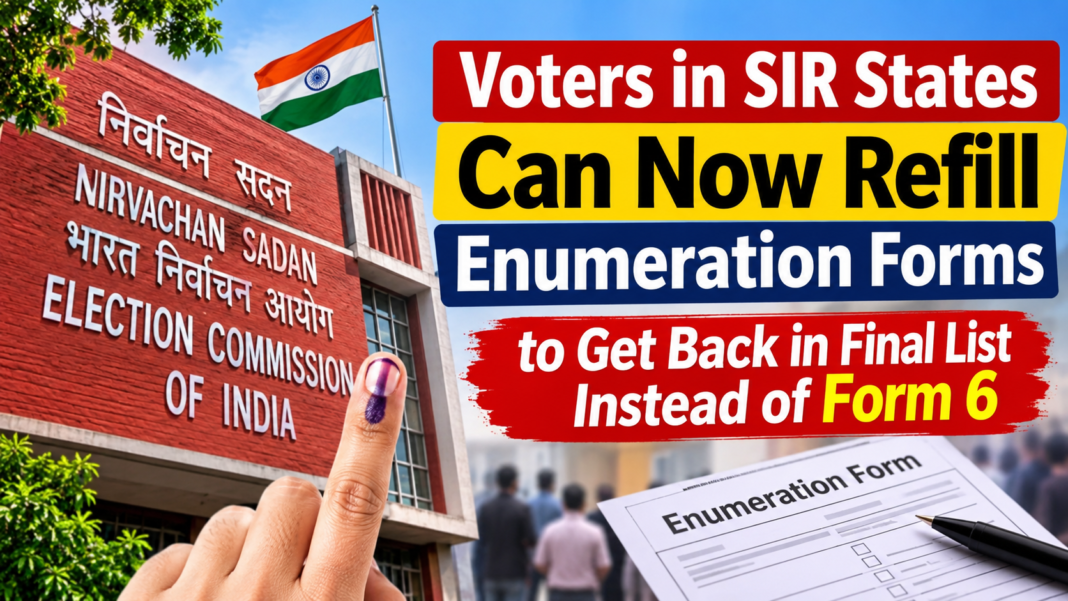
The Election Commission of India (ECI) has given another opportunity to voters whose names were marked as Absent, Shifted, Dead or Duplicate (ASDD) during the ongoing Special Intensive Revision (SIR) of electoral rolls in seven states. These voters can now submit their Enumeration Forms again to seek inclusion in the final electoral list instead of going through the process of applying through Form 6.
The decision applies to Delhi, Maharashtra, Haryana, Andhra Pradesh, Jharkhand, Telangana and Nagaland. The Election Commission issued fresh directions to the Chief Electoral Officers (CEOs) of these seven states on Friday, November 6, 2026.
The move is aimed at providing relief to eligible voters whose names were excluded from the draft electoral rolls because their Enumeration Forms were not received by election officials.
Why Has the Election Commission Issued Fresh Instructions?
During the SIR exercise, election officials distributed Enumeration Forms to registered voters to verify their details and confirm their eligibility. However, several forms were not returned to the authorities.
As a result, the affected voters were placed in the ASDD category, which includes four classifications: Absent, Shifted, Dead and Duplicate. Their names could not be included in the draft electoral rolls because the required information was not received.
Under the latest instructions, these voters will get another opportunity to complete the enumeration process and establish their eligibility for inclusion in the final voter list.
Fresh Enumeration Forms to Be Generated Through ECINET
The Election Commission has directed that partially filled Enumeration Forms for all such ASDD voters should be generated afresh through the Electoral Registration Officer (ERO) dashboard on the ECINET platform.
The Commission has also instructed election authorities to display booth-wise lists of voters marked under the ASDD category on the notice boards of their respective polling stations.
These lists will contain the names of voters whose Enumeration Forms were not received, along with the probable reasons for their non-inclusion in the draft electoral rolls.
The step is intended to help voters identify their status and understand why their names were excluded.
What Should Voters Do If They Have Not Changed Their Address?
The ECI has provided separate instructions depending on whether a voter has shifted residence.
Voters who have not changed their residential address can submit their properly completed and signed Enumeration Forms along with a statement explaining why they could not submit the form earlier.
However, voters who have shifted their residence within the state must submit the Enumeration Form along with a statement mentioning their new residential address and Assembly Constituency.
These details will help election officials verify the voters’ current residential information and process their applications accordingly.
No Need to Submit Form 6 Again If Already Applied
One of the most important clarifications in the latest ECI directive concerns Form 6.
Previously, voters whose names were missing from the draft electoral rolls were required to apply for inclusion through Form 6. This form is generally used by eligible individuals seeking registration as voters, including first-time voters.
However, the Commission has now clarified that voters who have already submitted Form 6 do not need to submit the Enumeration Form and accompanying statement afresh.
This clarification is expected to reduce unnecessary paperwork and confusion among voters who have already applied for enrolment.
ECI Directs Officials to Protect Eligible Voters
The Election Commission has also asked officials to establish a monitoring mechanism to ensure that no eligible elector is deprived of the opportunity to be included in the final electoral roll.
The latest instructions come amid continuing concerns about voter exclusions during the SIR exercise.
In Delhi, figures cited by representatives in the report showed that 47.56 lakh names were deleted during the first phase and placed under the ASDD category. Of these, 31.59 lakh were reportedly marked as shifted, while 11.73 lakh were classified as absent or untraceable.
Congress leader Jairam Ramesh criticised the deletion process and questioned the repeated clarifications and changes introduced during the revision exercise.
Earlier, concerns had also been raised by representatives over the impact of large-scale exclusions on voters’ electoral rights.
What Happens Next?
The seven states will have to implement the fresh instructions through their respective election authorities. Voters marked under the ASDD category should check the booth-wise lists displayed at their polling stations and contact the relevant election officials for guidance on submitting their forms.
The latest decision does not automatically restore deleted names to the electoral rolls. Eligible voters will still need to complete the required submission and verification process.
The Election Commission’s move provides an additional opportunity for affected voters to establish their eligibility and seek inclusion in the final electoral list.
By allowing the resubmission of Enumeration Forms instead of requiring a fresh Form 6 application in these cases, the Commission aims to make the SIR process more accessible and ensure that eligible citizens are not left out of the electoral system.