

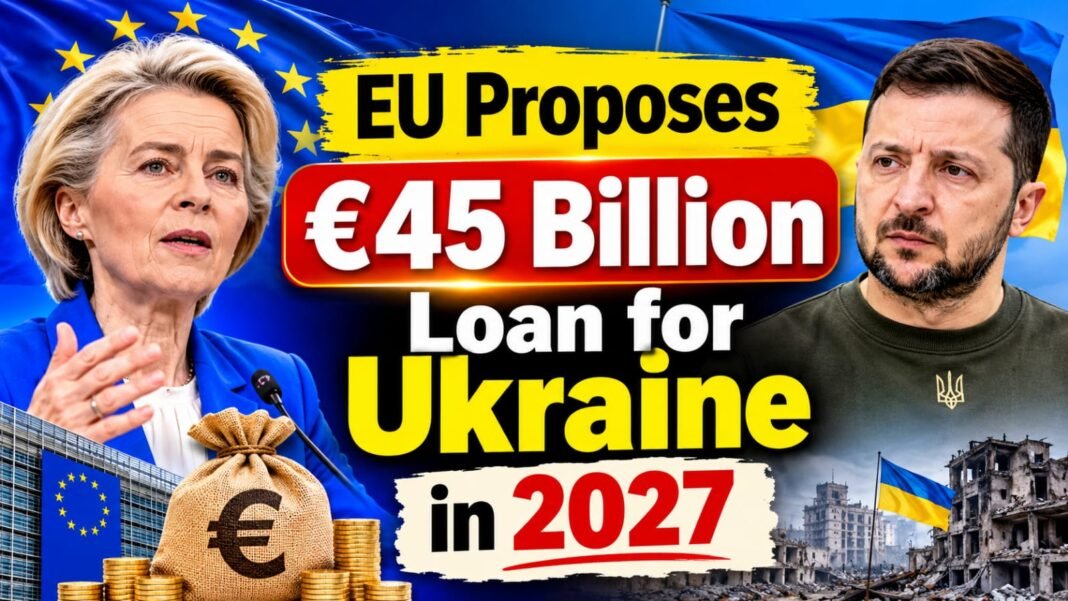
The European Commission’s proposed financial package aims to cover nearly two-thirds of Ukraine’s estimated €70 billion funding gap for 2027, combining military assistance and government budget support amid the continuing Russia-Ukraine war.
BRUSSELS | November 18, 2026: The European Union has proposed an additional €45 billion financial loan for Ukraine to help meet its economic and defence-related requirements in 2027, with repayment linked to Russia paying reparations for damage caused by the ongoing war.
European Commission President Ursula von der Leyen announced the proposal on Wednesday, saying Europe would continue supporting Ukraine as it faces mounting financial pressure and intensified Russian attacks on critical infrastructure.
The proposed package is expected to cover approximately two-thirds of Ukraine’s estimated €70 billion financing gap for 2027. The remaining funding is expected to come from Ukraine’s other international partners.
The proposal will require approval from EU member states, with European leaders expected to discuss the financing plan at an upcoming summit later this month.
How Will the €45 Billion Loan Be Distributed?
According to the European Commission’s proposal, the additional financial assistance will be divided into two major components.
- €25 billion for military assistance: Intended to support Ukraine’s defence-related requirements.
- €20 billion for budget support: Designed to help maintain government operations, public services and economic stability.
The funding will be raised through joint borrowing by the European Union on international financial markets.
The arrangement is intended to provide Ukraine with financial assistance while distributing the borrowing responsibility through the EU’s common financial framework.
Ukraine Will Repay the Loan Through Russian Reparations
One of the most significant features of the proposed financial arrangement is its repayment mechanism.
Under the proposal, Ukraine would be required to repay the loan only after Russia pays reparations for the damage caused by the war.
The European Union has also been considering the potential use of immobilised Russian sovereign assets as a financial backstop if Moscow refuses to pay compensation.
However, the proposed arrangement does not mean that frozen Russian assets have already been transferred to Ukraine. Their possible use remains subject to legal and political considerations.
The issue is particularly sensitive because billions of euros in Russian state assets remain immobilised under European sanctions.
Why Does Ukraine Need Additional Financial Support?
Ukraine continues to face substantial economic pressure due to the prolonged conflict with Russia, which began with Moscow’s full-scale invasion in February 2022.
Repeated attacks on energy infrastructure have increased the country’s financial requirements, particularly as winter approaches.
Damage to infrastructure, disruptions to trade and pressure on government revenues have made it increasingly difficult for Kyiv to maintain essential services while meeting its defence requirements.
The European Commission estimates that Ukraine will face a financing gap of approximately €70 billion in 2027.
The proposed €45 billion European contribution is intended to address a significant portion of that shortfall.
EU’s Previous €90 Billion Support Package
The latest proposal comes alongside an earlier €90 billion Ukraine Support Loan covering 2026 and 2027.
That existing package was designed to provide financial assistance for Ukraine’s defence capabilities, public expenditure and economic resilience.
The European Parliament approved the legislation for the €90 billion support package in February 2026.
The newly proposed €45 billion contribution is a separate additional funding effort intended to address Ukraine’s remaining financing requirements for 2027.
This distinction is important because the two financial arrangements should not be treated as a single newly approved €135 billion loan.
Russia Criticises Europe’s Continued Support for Ukraine
The proposed loan comes amid continuing tensions between Moscow and European governments over economic sanctions and financial assistance to Kyiv.
Russia has repeatedly criticised Western economic restrictions, arguing that sanctions have damaged economic relations and created additional pressure on European economies.
European leaders, meanwhile, maintain that financial and diplomatic support for Ukraine is necessary to defend its sovereignty and maintain regional security.
The latest proposal demonstrates that the EU intends to remain financially involved in Ukraine’s long-term recovery and defence, even as diplomatic efforts to resolve the conflict continue.
What Happens Next?
The European Commission’s proposal will now move to EU member states for consideration and approval.
European leaders are expected to discuss Ukraine’s financial requirements at their upcoming summit later in November.
If approved, the additional financing could provide Ukraine with greater financial certainty for 2027, helping the government prepare for continued economic and security challenges.
However, the final structure, approval process and implementation of the proposed loan will depend on decisions taken by EU member states.
Conclusion
The European Union’s proposed €45 billion loan represents another major financial commitment to Ukraine as the Russia-Ukraine war continues.
By linking repayment to Russian war reparations, Brussels is attempting to establish a financial mechanism that places the ultimate responsibility for war-related compensation on Moscow.
The proposal also highlights Europe’s growing role in supporting Ukraine’s economy and security as uncertainty continues over the duration and outcome of the conflict.


