

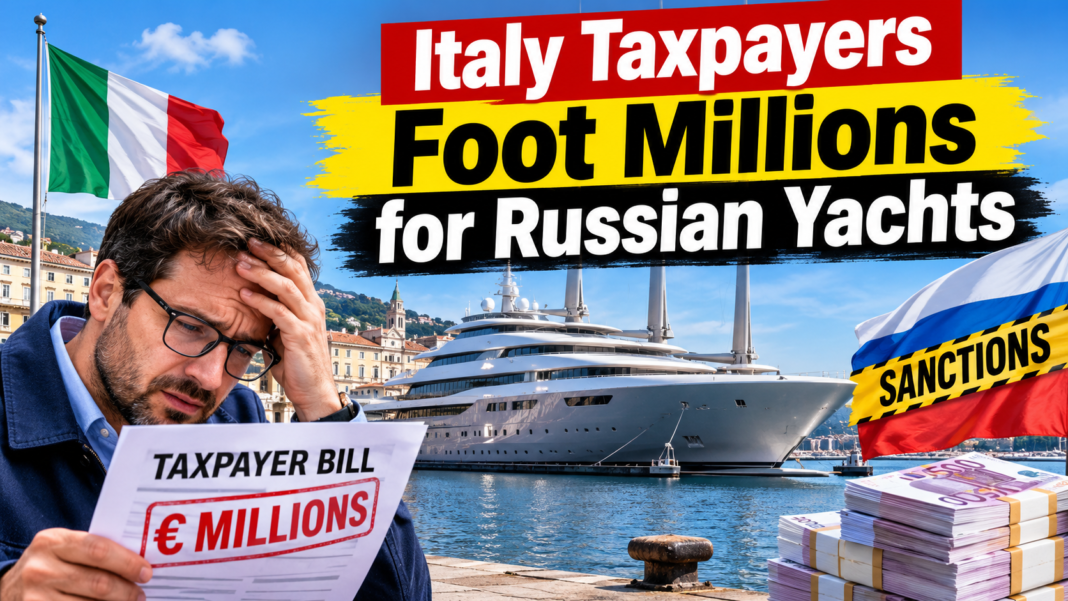
ROME, Italy: Italy is facing a growing financial burden as taxpayers continue to fund the maintenance of luxury superyachts seized or frozen under sanctions against Russian billionaires following Russia’s invasion of Ukraine in February 2022.
Several multimillion-dollar vessels remain anchored in Italian ports, unable to return to their owners while legal and sanctions-related restrictions remain in place. However, keeping these enormous yachts operational requires substantial spending on crew salaries, fuel, insurance, security, cleaning and regular maintenance.
According to a November 1 report by CNN, the maintenance of one of the most prominent vessels, Sailing Yacht A, costs approximately $30,000 per day, equivalent to nearly $11 million annually, according to Trieste Mayor Roberto Dipiazza.
The situation has reignited debate over whether ordinary taxpayers should continue financing the upkeep of luxury assets belonging to sanctioned Russian business figures.
Sailing Yacht A: An $600 Million Vessel Creating a Financial Burden
One of the most expensive vessels at the centre of the controversy is Sailing Yacht A, associated with Russian billionaire Andrey Melnichenko.
The 468-foot sailing superyacht, valued at approximately $600 million, was undergoing maintenance in the northern Italian port of Trieste in March 2022 when Italian authorities froze it following the introduction of sanctions against Melnichenko.
Designed by renowned French designer Philippe Starck, the vessel is among the world’s largest sailing yachts. Its distinctive structure includes three rotating carbon-fibre masts and a technologically advanced exterior.
Despite its extraordinary value, the yacht has remained in the port for more than four years.
Mayor Roberto Dipiazza has repeatedly questioned the financial implications of maintaining the vessel. According to his estimates shared with CNN, approximately 20 crew members, generator fuel, specialised cleaning, insurance and security contribute to its daily operating costs.
Italian law requires sequestered vessels to be maintained rather than abandoned and allowed to deteriorate. If sanctions are eventually lifted, Melnichenko would be required to reimburse the relevant maintenance expenses to recover the yacht.
Scheherazade: More Than $15 Million in Maintenance Costs
Another major vessel involved in the controversy is the 465-foot superyacht Scheherazade, anchored at Marina di Carrara in Tuscany.
The yacht, valued at approximately $700 million, has attracted international attention because of allegations surrounding its ownership. It is reportedly registered to Eduard Khudainatov, a former Rosneft executive, while the late Russian opposition leader Alexei Navalny’s Anti-Corruption Foundation alleged that it was connected to Russian President Vladimir Putin. The ownership allegations should not be treated as judicially established facts.
CNN reported that Tuscan taxpayers have spent more than $15 million on the vessel’s skeleton crew since its seizure. Additional expenses include security arrangements and measures to prevent unauthorised access or departure.
On August 28, 2026, the yacht reportedly left the port for technical tests before returning approximately 10 hours later, according to vessel-tracking information cited by CNN.
Other Russian Yachts Adding to Italy’s Expenses
Italy’s financial responsibilities extend beyond these two vessels.
Other yachts include:
Lady M: Associated with Russian steel billionaire Alexei Mordashov. The vessel has reportedly cost Italian taxpayers approximately $2 million in maintenance and related expenses.
Lena: A 126-foot yacht associated with Russian billionaire Gennady Timchenko, which is also being maintained in Italy.
A separate investigation published by Forbes in July 2026 estimated that Italy had spent nearly $100 million maintaining four frozen Russian superyachts.
These figures illustrate how the financial consequences of asset freezes can extend well beyond the initial seizure.
Why Are Italian Taxpayers Paying the Bill?
The central issue is the legal difference between freezing an asset and permanently confiscating it.
Under sanctions, authorities can restrict an owner’s ability to use, sell or transfer a yacht. However, freezing does not automatically transfer ownership to the government.
As a result, authorities must preserve the vessels while their legal status remains unresolved. Large superyachts cannot simply be abandoned because deterioration, mechanical failures and inadequate security could create additional financial and legal complications.
Italy’s situation also raises questions about how governments should manage expensive assets that remain frozen for years.
According to Reuters, Italy had frozen approximately €2.3 billion ($2.64 billion) in Russian oligarch assets by June 2025. These included bank accounts, luxury properties, yachts and vehicles.
A Wider European Challenge
Italy is not the only European country facing the financial consequences of maintaining Russian-linked luxury vessels.
Germany, France and Spain are also dealing with maintenance responsibilities involving seized or frozen superyachts.
Some governments have explored selling confiscated vessels to recover expenses. Gibraltar, for example, auctioned the yacht Axioma for approximately $37.5 million.
However, selling a frozen yacht is legally different from selling an asset that has been permanently confiscated. Governments generally need an appropriate legal basis before they can transfer ownership and complete a sale.
The Political and Financial Debate
The growing costs have prompted criticism from local officials and raised questions about the long-term effectiveness of asset-freezing arrangements.
Trieste Mayor Roberto Dipiazza has argued that local residents should not have to bear the continuing costs of maintaining a billionaire’s luxury yacht.
Meanwhile, Italian Prime Minister Giorgia Meloni has maintained support for sanctions against Russian figures linked to the Kremlin following the invasion of Ukraine.
The controversy highlights a difficult policy challenge: governments want to enforce international sanctions and prevent sanctioned individuals from benefiting from their wealth, but the cost of preserving frozen assets can ultimately fall on public finances.
For Italy, the question is no longer simply who owns these luxury yachts. It is also how long taxpayers should be expected to pay to keep them afloat.


