

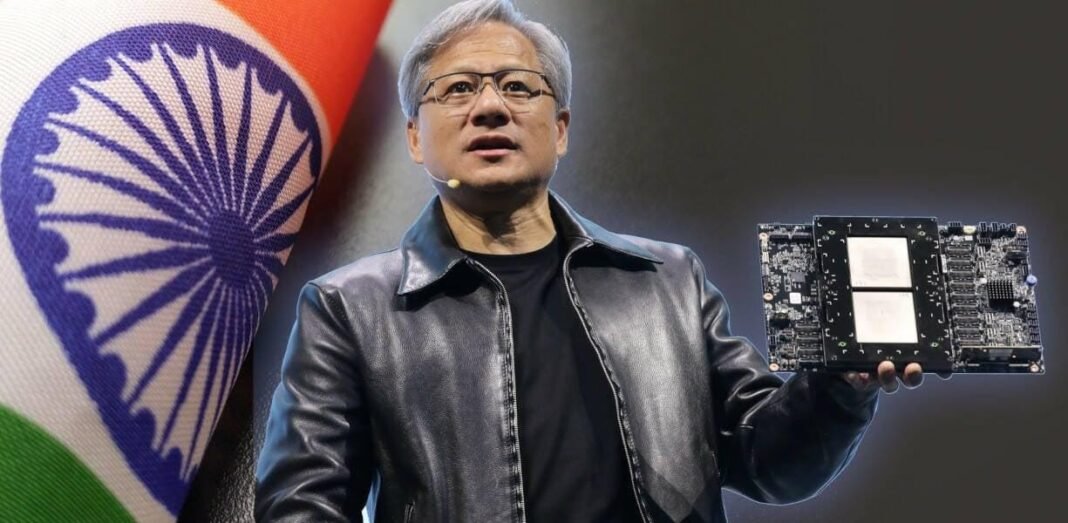
A reported Nvidia share sale linked to US Congressman Ro Khanna’s household and a separate investigation involving CEO Jensen Huang have brought global semiconductor security into focus. For India, the developments underline the importance of domestic chip manufacturing, AI infrastructure and technological self-reliance.
NEW DELHI: A developing controversy surrounding American technology giant Nvidia has brought global attention back to semiconductor security, artificial intelligence and the growing competition between the United States and China. For India, the developments carry significance beyond international politics, as the country works to establish itself as a major destination for semiconductor manufacturing and advanced technology.
The controversy has two separate elements. A congressional financial disclosure in the United States shows that shares of Nvidia were sold by the household of Congressman Ro Khanna on October 7, 2026. Separately, Nvidia CEO Jensen Huang has become the subject of scrutiny following reports about his personal relationship with a business executive allegedly linked to Chinese intelligence.
The timing of the reported stock transaction has generated questions on social media. However, there is no established evidence that Khanna had advance knowledge of the separate controversy or engaged in insider trading.
For India, the more important question is how developments involving one of the world’s leading AI chip companies could influence global semiconductor supply chains and create opportunities for Indian businesses.
Why Nvidia Matters to India’s Technology Future
Nvidia is one of the most influential companies in the global artificial intelligence industry. Its Graphics Processing Units (GPUs) power AI training, data centres, scientific research and several advanced computing applications.
India’s growing AI ecosystem also depends on access to high-performance computing infrastructure and advanced semiconductor technology.
Indian technology companies, startups, research institutions and government-backed AI programmes require powerful processors to develop and operate AI models.
Any major disruption involving Nvidia’s leadership, business operations or international chip supply could therefore attract attention from Indian technology companies.
However, the current investigation does not establish that Nvidia’s chip supplies to India have been disrupted.
India’s Semiconductor Mission Gains Greater Strategic Importance
India has been working to reduce its dependence on imported semiconductor technology through domestic manufacturing, chip design and advanced packaging.
The Union Cabinet approved Semicon 2.0 on July 15, 2026, with a budgetary outlay of ₹1,27,500 crore.
The programme focuses on six major areas: semiconductor design, manufacturing equipment and materials, fabrication facilities, advanced packaging, research and development, and talent development.
According to the Ministry of Electronics and Information Technology, 12 semiconductor manufacturing projects had been approved under the earlier programme, involving committed investments of more than ₹1.64 lakh crore.
Three projects had already started commercial production, including facilities associated with Micron, Kaynes and CG Semi.
The government has also supported 24 semiconductor design projects and provided access to industry-standard design tools to 105 startups and MSMEs.
These developments indicate that India’s semiconductor strategy is gradually expanding beyond electronics assembly towards building a wider domestic chip ecosystem.
AI Infrastructure: Another Major Opportunity for India
India’s semiconductor ambitions are closely connected with its artificial intelligence strategy.
The government approved the IndiaAI Mission with an allocation of ₹10,371.92 crore over five years to strengthen the country’s AI ecosystem.
The programme includes support for computing infrastructure, indigenous AI models, research, innovation and AI applications.
India is also working towards developing domestic computing capabilities to reduce long-term dependence on internationally sourced hardware.
This is particularly important because access to advanced GPUs can influence the cost and availability of AI computing services.
For Indian startups, universities and businesses, a stronger domestic semiconductor ecosystem could improve access to technology and create opportunities for innovation.
Could Global Semiconductor Tensions Benefit India?
The United States and China are competing for leadership in advanced semiconductor technology. Export restrictions, national security concerns and disputes over technology transfers have made chip supply chains an important geopolitical issue.
India could benefit from companies looking to diversify their manufacturing and technology partnerships.
The country’s skilled engineering workforce, expanding electronics sector and government incentives provide opportunities to attract semiconductor-related investments.
However, becoming a major global chip manufacturing centre will require more than government incentives.
India needs specialised manufacturing equipment, reliable power and water supplies, advanced research facilities, skilled professionals and a strong network of domestic suppliers.
Developing these capabilities will be essential if India wants to compete in the global semiconductor market.
What About the Ro Khanna Nvidia Share Sale?
According to congressional trading disclosure records, a sale of Nvidia shares valued between $1,001 and $15,000 was reported under the ownership of Ro Khanna’s spouse.
The transaction took place on October 7 and was disclosed on November 9, 2026.
The disclosure has attracted attention because Khanna is involved in congressional discussions concerning US-China technological competition.
However, the financial disclosure does not establish that the transaction was based on confidential information or that the congressman personally made the investment decision.
The stock transaction and the investigation involving Nvidia’s CEO are separate developments and should not be treated as evidence of a connection between them.
The Bigger Picture: India’s Opportunity in the Global AI Race
The latest developments highlight an important lesson for India: technological strength is increasingly connected with economic security and national security.
Semiconductors are essential for smartphones, automobiles, telecommunications, defence systems, medical equipment and artificial intelligence.
A stronger domestic manufacturing ecosystem could help India improve supply-chain resilience, support employment, attract foreign investment and strengthen its position in global technology markets.
For India, the objective should not simply be to benefit from uncertainty surrounding international technology companies. It should be to build long-term domestic capabilities in chip design, manufacturing, advanced packaging and AI computing.
The real opportunity for India is to transform global semiconductor uncertainty into a stronger foundation for technological self-reliance.