

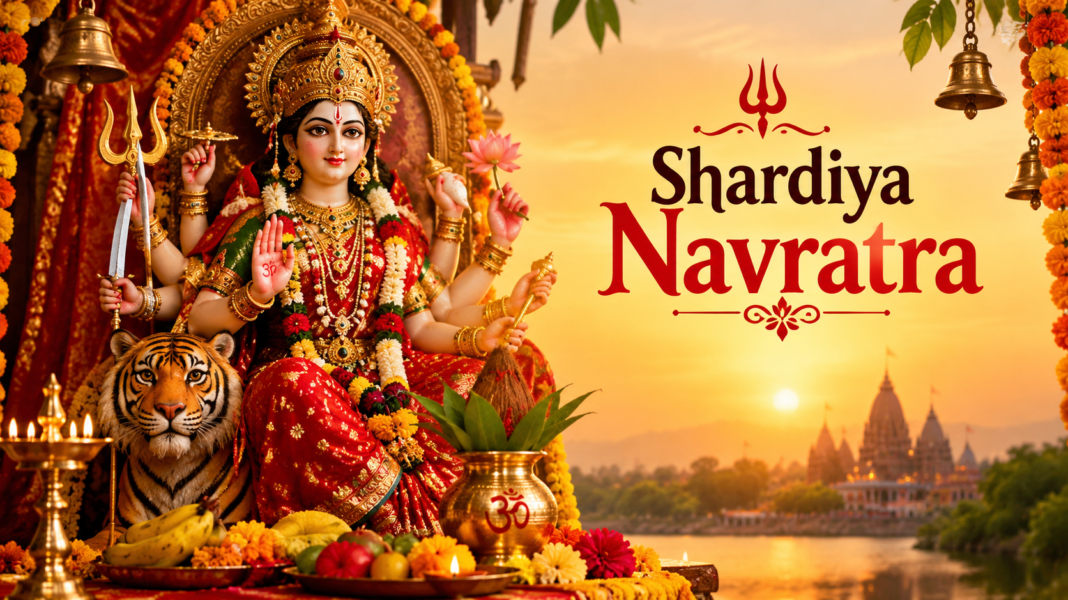
Shardiya Navratri 2026: Festival begins on October 11
Shardiya Navratri, one of the most significant Hindu festivals dedicated to Goddess Durga, will begin on Sunday, October 11, 2026. Devotees across India will mark the occasion with prayers, fasting, temple visits and rituals honouring the nine forms of the goddess.
The festival begins on Ashwin Shukla Pratipada, the first day of the bright lunar fortnight in the Hindu month of Ashwin. Ghatasthapana, also known as Kalash Sthapana, marks the beginning of the worship.
According to the Drik Panchang calendar, the festival’s principal observances extend from October 11 to October 20, with Vijayadashami falling on Tuesday, October 20, in the standard North Indian calendar. The lunar tithi schedule includes an overlap in the daily observances, which is why the festival appears across 10 calendar dates this year.
Ghatasthapana Muhurat 2026: Timings for Varanasi
Ghatasthapana is the ritual installation of a sacred pot, or kalash, at the beginning of Navratri. It symbolises the invocation of divine energy and marks the formal commencement of the nine-night festival.
For Varanasi, Uttar Pradesh, Drik Panchang lists the following timings for Sunday, October 11, 2026:
- Ghatasthapana Muhurat: 5:54 AM to 9:48 AM
- Alternative Abhijit Muhurat: 11:21 AM to 12:08 PM
- Pratipada Tithi ends: Approximately 9:30 PM on October 11
These timings are specific to Varanasi and should not be applied automatically to other cities. For comparison, published Delhi timings give a Ghatasthapana window of 6:19 AM to 10:12 AM and an Abhijit Muhurat of 11:44 AM to 12:31 PM.
The difference arises from local sunrise and other location-specific Panchang calculations. Devotees should consult the calendar for their own city before performing the ritual.
Why is the muhurat important?
In Hindu tradition, Ghatasthapana is performed during an appropriate period on Pratipada. Traditional Panchang guidance also considers the prevailing nakshatra, yoga and other astrological factors.
For Varanasi, Drik Panchang notes that Chitra Nakshatra and Vaidhriti Yoga are present during the calculated Ghatasthapana period. These factors are traditionally considered when determining an auspicious time. The same source explains that they are not absolute prohibitions and that the overall ritual timing is determined by several considerations.
Because different Panchang systems may apply different rules, devotees who follow a particular family or temple tradition should seek guidance from their customary priest.
How to perform Kalash Sthapana
The ritual usually begins with cleaning the place of worship and preparing a dedicated space for Goddess Durga.
A traditional arrangement may include the following steps:
- Place a clean cloth on a raised platform and install an image or idol of Goddess Durga.
- Prepare the kalash according to the family’s customary ritual, using water and the prescribed worship materials.
- Place mango leaves and a coconut on the pot where required by the tradition.
- Sow barley seeds in a bed of soil if this is part of the household’s practice.
- Offer prayers, light a lamp and make a devotional vow, or sankalpa, to observe Navratri.
- Continue daily worship, aarti, recitation of devotional texts and fasting according to personal ability and family custom.
The exact materials and sequence may differ across regions and religious traditions. Devotees should follow the method customary in their household or temple.
Goddess Durga’s arrival on an elephant: What does tradition say?
A traditional belief associates Goddess Durga’s arrival vehicle with the weekday on which Navratri begins. Since Shardiya Navratri starts on Sunday in 2026, the goddess is traditionally said to arrive on an elephant.
In religious interpretations, an elephant symbolises strength, stability, prosperity and favourable rainfall. This belief is frequently discussed in connection with the festival’s traditional symbolism.
The goddess’s departure vehicle is also interpreted according to traditional rules. Some published reports associate the 2026 departure with a rooster because Vijayadashami falls on Tuesday.
These interpretations belong to religious and astrological traditions. They should not be presented as scientifically established forecasts of rainfall, agricultural production, political developments or economic conditions.
Sandhi Puja 2026: Date and significance
Sandhi Puja is an important ritual observed at the transition between Durga Ashtami and Maha Navami. According to the traditional calculation, the ritual covers the final 24 minutes of Ashtami and the first 24 minutes of Navami, making a total period of approximately 48 minutes.
The worship is associated with Goddess Chamunda and the religious account of the destruction of the demons Chanda and Munda.
Drik Panchang lists the following Sandhi Puja window for October 19, 2026, in the locations checked:
- Date: Monday, October 19, 2026
- Time: 10:27 AM to 11:15 AM
- Duration: Approximately 48 minutes
The precise timing depends on the local tithi transition. For publication specifically aimed at Varanasi readers, the final time should be checked against the Varanasi Sandhi Puja calendar rather than assumed to be identical to the timing for another city.
Durga Ashtami, Maha Navami and Vijayadashami: Important dates
The final days of Navratri include several significant rituals, but the dates assigned to Ashtami and Navami can vary according to local Panchang calculations and regional observances.
The standard North Indian calendar for 2026 identifies October 19 with Durga Ashtami and Sandhi Puja observances, while October 20 is marked for Vijayadashami. The lunar tithi schedule and the way rituals are assigned to a particular day should be distinguished from the simple count of calendar dates.
In West Bengal and other parts of eastern India, Durga Puja follows its own established ritual calendar. Accordingly, readers should check the relevant regional calendar when planning Ashtami, Navami, idol immersion or related ceremonies.
Why can the festival span 10 calendar dates?
Navratri literally refers to nine nights. However, Hindu festivals are determined by lunar tithis rather than by midnight-to-midnight calendar dates.
When a tithi continues across more than one sunrise, or when ritual observances are assigned according to specific rules, the sequence of festival dates can extend over 10 calendar dates. This does not mean that the festival has changed its traditional meaning; it reflects the relationship between lunar tithis and the civil calendar.
Nine forms of Goddess Durga worshipped during Navratri
Each day of Navratri is traditionally associated with one of the nine forms of Goddess Durga, collectively known as Navdurga:
- Day 1: Shailputri
- Day 2: Brahmacharini
- Day 3: Chandraghanta
- Day 4: Kushmanda
- Day 5: Skandamata
- Day 6: Katyayani
- Day 7: Kalaratri
- Day 8: Mahagauri
- Day 9: Siddhidatri
Devotees may observe fasts, recite devotional texts, perform aarti and visit temples during the festival. Kanya Pujan, in which young girls are honoured as symbolic representations of the goddess, is commonly performed on Ashtami or Navami, depending on family and regional tradition.
Vijayadashami 2026: Festival of victory
Vijayadashami, also known as Dussehra, will be observed on Tuesday, October 20, 2026, in the standard North Indian calendar.
The festival commemorates the victory of good over evil. In one widely observed tradition, it marks Lord Rama’s victory over Ravana. It is also associated with Goddess Durga’s victory over Mahishasura.
The day is observed through prayers, community celebrations, cultural performances and, in many places, the burning of effigies of Ravana. Rituals and local customs differ from region to region.