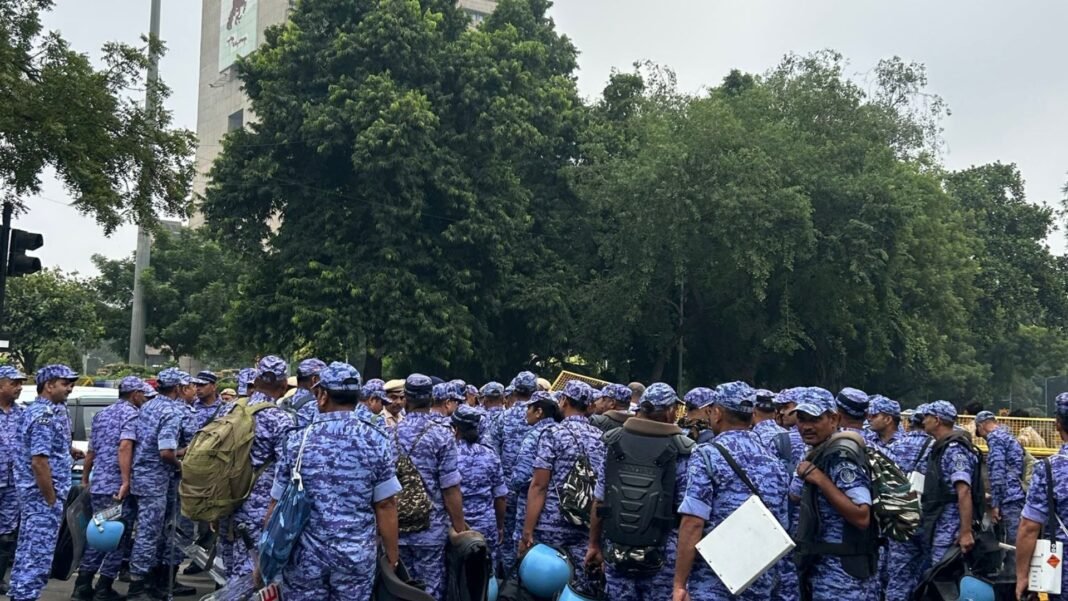
CJP announces fresh Jantar Mantar protest for October 11 after police detentions; questions over electoral transparency, public order and democratic rights remain in focus.
By Global Nexus Media | National News
Published: October 10, 2026 | New Delhi
Delhi CJP Protest New Delhi witnessed a major political and public-order confrontation on Saturday as police detained thousands of people ahead of a planned protest by the Cockroach Janta Party (CJP) against Chief Election Commissioner Gyanesh Kumar. The demonstration centred on allegations surrounding the Election Commission of India’s Special Intensive Revision (SIR) of electoral rolls.
According to Reuters, more than 2,000 people were detained in Delhi as authorities deployed police and paramilitary personnel, sealed off access to the planned protest site at Jantar Mantar and imposed restrictions in parts of the capital. Reuters also reported that mobile internet services were suspended in the central business district and several metro stations and markets were closed.
CJP has alleged that the electoral-roll revision threatens voting rights and demanded Kumar’s resignation. The Election Commission and the Bharatiya Janata Party (BJP) have denied allegations of wrongdoing, with the Commission maintaining that eligible voters whose names were incorrectly removed can re-enrol.
The developments have brought three interconnected issues into focus: the accuracy of India’s electoral rolls, the legal limits of restrictions on public demonstrations and the importance of maintaining public confidence in democratic institutions.
What Happened During the Delhi CJP Protest?
The CJP demonstration was planned at Jantar Mantar, a prominent location for political protests in the national capital. Authorities denied permission for the gathering, citing security and public-order considerations.

Police subsequently detained protesters at multiple locations. Reuters reported that CJP founder Abhijeet Dipke and senior leaders Saurav Das and Ashutosh Ranka were detained after their flight from Mumbai landed in Delhi.https://www.reuters.com/world/india/delhi-sealed-off-ahead-youth-protest-against-indian-election-chief-2026-10-10/
Reuters also reported the detention of several opposition politicians, including former chief ministers Mamata Banerjee, Arvind Kejriwal and Pinarayi Vijayan. A Reuters journalist and journalists from other digital news organisations were also briefly detained while covering the events.
The reported scale of the operation extended beyond the protest site, with checkpoints, barricades and restrictions affecting movement in parts of the capital.
The precise number of people detained remains disputed. Reuters reported more than 2,000 detentions in Delhi, citing a Home Ministry official. Separately, CJP claimed that more than 15,000 people had faced detention and police action. The latter figure is the organisation’s own claim and has not been independently established by the cited reporting.
These distinctions matter. Accurate reporting must separate official information, independently reported events and claims made by political organisations.
Why Is the SIR Voter List Revision Controversial?Leads to Delhi CJP Protest
The Special Intensive Revision is an electoral-roll verification exercise intended to help maintain accurate voter lists.https://voters.eci.gov.in/
Reliable electoral rolls are essential to any election. They must include eligible citizens, address duplicate or ineligible entries through lawful procedures and provide effective remedies when an eligible voter is mistakenly excluded.
The present controversy concerns allegations that the revision removed a large number of voter entries and may have affected electoral participation.
Reuters reported that approximately 130 million entries were removed during the verification exercise. According to the report’s account of Election Commission data, these included around 63 million people who had relocated, 30 million who could not be traced and 28 million who had died.
These figures describe entries removed during the exercise; they should not be interpreted as proof that 130 million eligible citizens were unlawfully disenfranchised.
Opposition parties have alleged that the deletions affected the outcome of recent state elections won by the BJP. The BJP and Election Commission have denied wrongdoing.
The central question is whether the verification process correctly distinguished between ineligible entries and eligible citizens whose records required correction.
Answering that question requires more than political statements. It requires examination of the relevant electoral-roll data, reasons for individual deletions, notices issued to voters, appeals filed and the results of those appeals.
What Does Form 6 Have to Do With Voter Registration?
Form 6 is used for new voter registration. The Election Commission’s official Voters’ Services Portal provides access to voter-registration services and information about the SIR process.
Citizens concerned about their registration should use the official portal to check their electoral status and follow the applicable procedures for registration or correction.
Official portal: https://voters.eci.gov.in/
For a transparent assessment of the controversy, authorities should clearly explain the relationship between the revision process and subsequent registration applications, including Form 6. Citizens should also be able to understand what documentation is required, how to respond to notices and how to challenge an incorrect decision.
A functioning grievance process is particularly important when administrative decisions can affect a constitutional right.
Public Order Versus the Right to Peaceful Protest
India’s Constitution protects freedom of speech and peaceful assembly, subject to constitutionally permitted restrictions.
Article 19(1)(a) protects freedom of speech and expression, while Article 19(1)(b) protects the right to assemble peaceably and without arms. Article 19 also permits reasonable restrictions under specified conditions, including in the interests of public order.
Authorities have a legitimate responsibility to prevent violence, protect public safety and regulate demonstrations in accordance with the law. Organisers must also comply with applicable legal requirements.
However, refusing permission for a gathering and detaining individuals are distinct actions. Each must have an appropriate legal basis.
In the Delhi case, the relevant questions include whether the restrictions were necessary and proportionate, what legal grounds applied to individual detentions, and whether detainees were afforded the safeguards required by law.
The answers should be established through police statements, relevant orders, court records where applicable and independently verified reporting.
A peaceful demonstration does not become unlawful simply because its message is critical of the government. Equally, the right to protest does not exempt participants from lawful restrictions or responsibility for unlawful conduct.
Why Electoral Transparency Matters Beyond Party Politics
Electoral-roll accuracy is not an issue that belongs exclusively to the ruling party or the opposition. It affects the credibility of the democratic process itself.
An inaccurate voter list can create problems in either direction: eligible citizens may be excluded, while duplicate or ineligible entries may undermine the reliability of the register.
The appropriate response is a process that is transparent, reviewable and accessible to citizens.
The Election Commission can strengthen public confidence by publishing clear explanations of revision procedures, providing accessible correction and appeal mechanisms, and reporting verified information about additions and deletions.
Political parties and campaign organisations also have a responsibility to substantiate claims of irregularities rather than presenting allegations as established findings.
For the public, the most useful evidence includes documented individual cases, official electoral data, court findings and independently verified investigations.
The issue should ultimately be assessed through evidence rather than political affiliation.
CJP Announces Another Protest for October 11
The confrontation is not necessarily over.
In a report published late on October 10, The Indian Express said CJP had announced another demonstration at Jantar Mantar for Sunday, October 11, at 10 a.m.
The organisation said it would continue its campaign until its demand for Kumar’s resignation was addressed. Delhi Police indicated that its deployment would remain at the same level as on Saturday, with further measures involving public transport to depend on the situation.
The announcement signals the possibility of further confrontation if organisers and authorities do not find a way to manage the demonstration lawfully and safely.
The situation should be monitored through updated police advisories, transport announcements and verified reports. Readers planning to travel through central Delhi should consult current official advisories rather than relying on unconfirmed social-media posts.
What Should Happen Next?
Several steps could help clarify the situation and reduce uncertainty.https://www.indiacode.nic.in/handle/123456789/18881?col=123456789%2F2505&view_type=search
First, clarify the status of those detained. Authorities should provide accurate information about custody, the legal grounds for detention and subsequent release or proceedings, subject to applicable law.
Second, improve transparency around voter-roll revisions. The Election Commission should make relevant procedures and remedies accessible and explain how eligible voters can challenge errors.
Third, document individual cases. Where voters allege wrongful deletion, their claims should be examined against electoral records and the applicable legal process.
Fourth, ensure lawful and proportionate policing. Restrictions on demonstrations should be grounded in law, supported by specific reasons and implemented with appropriate safeguards.
Finally, maintain responsible public communication. Government authorities, political organisations and digital creators should distinguish verified facts from allegations and avoid circulating unconfirmed figures.
These steps would help establish what happened, which claims are supported by evidence and what remedies may be available.
The Larger Question: Can Democratic Institutions Maintain Public Trust?
The events in Delhi have brought the relationship between electoral administration, public protest and state authority into sharp focus.
The authorities have a responsibility to maintain public order. Citizens have a right to participate in peaceful democratic debate, while the Election Commission has a responsibility to administer electoral processes in accordance with the law.
These responsibilities should reinforce one another rather than be treated as mutually exclusive.
India’s democratic credibility depends on institutions being able to explain their decisions, correct errors and provide meaningful remedies. It also depends on public debate being informed by evidence rather than speculation.
The CJP protest is therefore more than a confrontation at Jantar Mantar. It raises questions about how electoral disputes should be resolved, how restrictions on public assembly should be justified and how citizens can verify competing claims.
The ultimate test is whether the concerns can be addressed through transparent procedures, lawful action and independently verifiable evidence.
Global Nexus Media will continue to follow verified developments concerning the CJP protest, the Election Commission’s SIR process and the status of those detained.