

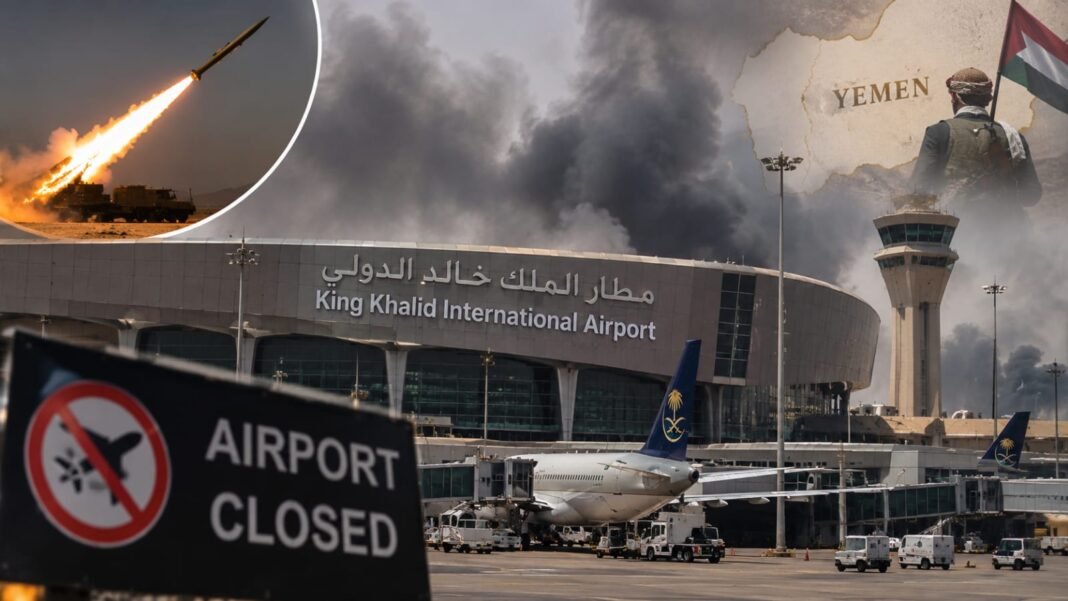
Saudi Arabia has kept its main international airport in Riyadh closed after a week of Houthi attacks that killed 20 people, including an American, pushing oil prices up and prompting President Trump to consider joining the Saudi-led campaign in Yemen. The crisis has become the centre of the wider Middle East war.
A week of escalating strikes
The assaults began early last week. Saudi authorities said attacks on Tuesday and Wednesday killed three people and wounded 36 at Riyadh’s King Khalid airport and Abha airport near the Yemeni border. On Thursday, two more strikes on the Riyadh airport killed three Saudi nationals, among them Saudia pilot Captain Hamoud Ali Alkalthami. Images verified by CNN showed smoke over Terminal 4 and a damaged Saudi aircraft, while two regional officials said three planes were hit. [Attack on Saudi airport kills 3 as Iran-backed Houth
The deadliest blow came on Saturday. The civil aviation authority said at least 12 people were killed and 309 wounded, with all flights diverted. India’s embassy later said an Indian citizen died of his injuries, raising the toll to 13. On Sunday, a projectile struck terminals 3 and 4, killing one person and injuring 11, a Pakistani resident according to the authority. [Saudi airport to remain closed after deadly attacks by Iran-aligned Houthis
Airport closed, travellers warned
King Khalid International is Saudi Arabia’s second-busiest airport and serves a city of about eight million people. Authorities say several hundred flights have been cancelled while safety checks continue, and a notice to air missions indicates the closure could last until at least October 17. The US, UK, Spain and Canada have warned their citizens against using the airport.
A new front in the Iran war
The surge in attacks, which has also hit other airports, military facilities and oil infrastructure, came in the week after a Saudi-led coalition launched a major offensive against the Houthis. According to Al Jazeera, a UN-brokered ceasefire that had largely held since 2022 has collapsed, and heavy fighting continues around Mocha and Dhubab on the Red Sea coast. These cities matter for control of the Bab al-Mandeb strait. Al Jazeera describes the latest strikes as the deadliest assault on Saudi soil in more than a decade.
The pattern was visible earlier. In September, the coalition said it intercepted a suspected Houthi ballistic missile fired at the same airport, and a day later smoke rose from a fuel storage area nearby.
Fighting on both sides
The air campaign is not one-sided. Houthi-run media reported air strikes attributed to Saudi Arabia in Sanaa’s Airport Road and Hamdan districts on Sunday, with no information on casualties. Yemen’s Saudi-backed government says Houthi-held airports are used to shuttle delegations to and from Iran, and that its strikes aim to stop Iranian flights from landing. Sanaa has the only airport offering international flights to Houthi territory, where most Yemenis live.
Washington weighs in
Asked whether the US would join Saudi strikes, Trump answered, “We may. We’re going to look at it.” CNN reports that last month he rejected two appeals from Crown Prince Mohammed bin Salman for US strikes on the Houthis. Secretary of State Marco Rubio condemned the attacks, saying they took innocent lives, including an American. Iran, meanwhile, has called the US response insufficient amid stalled talks to end the war. [New video shows terrifying moment Saudi airport struck in deadly Houthi attack +
Riyadh’s response and the economic stakes
Saudi Energy Minister Prince Abdulaziz bin Salman said the kingdom had been tested but would respond in an “equally serious” way. The attacks come while the kingdom hosts the World Petroleum Congress, which organisers say is proceeding, and ahead of the Future Investment Initiative on October 26–29. Saudi Arabia, preparing to host the 2032 FIFA World Cup, has long marketed itself as a secure destination for events, tourism and investment, an image now under strain.
What analysts expect
Hisham al-Omeisy of the European Institute of Peace told Al Jazeera that the Houthis no longer treat civilian airports as a red line. He called them a maximalist group seeking more concessions from the Saudis. He predicted more airport attacks because of the strong public reaction they generate, and a possible widening to oil pipelines and energy facilities.
What to watch
Three questions will shape the coming days. Will Washington commit forces or stay with rhetoric? Will Riyadh reopen its main hub on schedule? And will energy infrastructure become the next target? Casualty figures have varied between agencies, and some claims, including the Sanaa strikes, rest on one side’s media. This report will be updated as official statements are confirmed.


