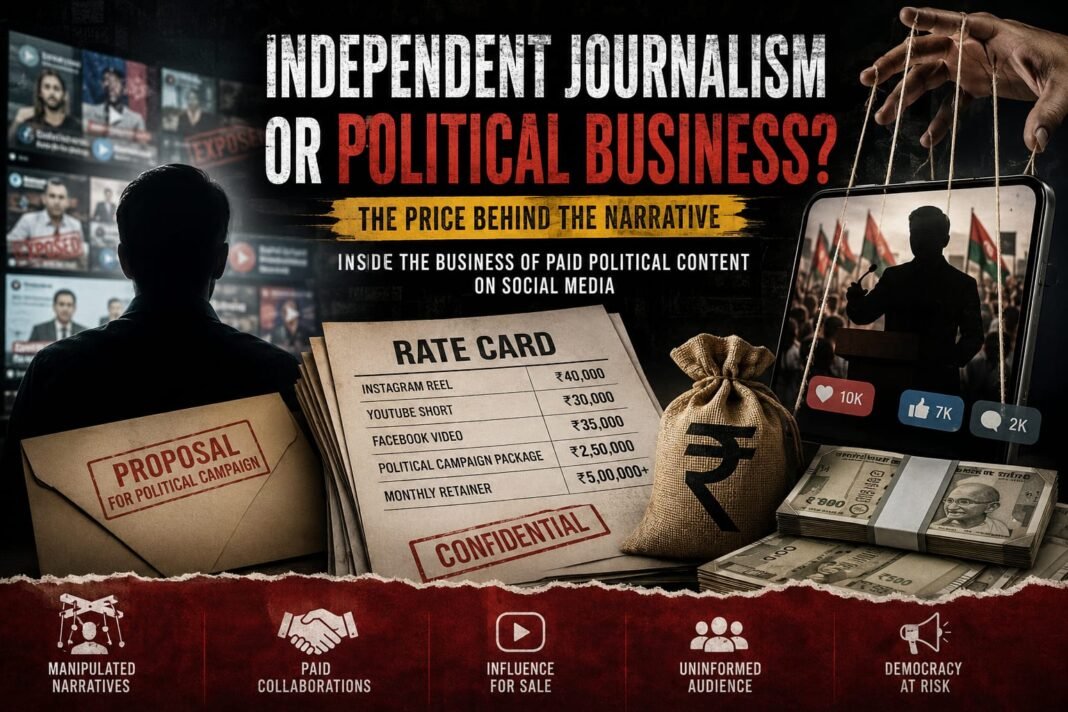
The investigation raises a question that goes beyond money
When a political message appears on a journalist’s social media account, how can viewers know whether they are watching independent reporting, commercial content or political promotion?
That question has returned to the spotlight following an email investigation published by Vishal Maheshwari on social media on October 14 and 15, 2026. According to Maheshwari’s published account, he contacted individuals associated with digital media and political commentary about a proposed political-video project involving the Samajwadi Party (SP), ahead of the 2027 Uttar Pradesh Assembly election.
The material he shared reportedly included responses discussing professional rates, individual video prices, bulk packages and possible longer-term arrangements.
The disclosures have prompted questions about the relationship between journalism, influencer marketing and political communication in India’s increasingly digital media environment.
However, the available claims require careful interpretation.
A creator quoting a price does not establish that a contract was signed. An email exchange does not prove that payment was made, a video was produced or a political party authorised the proposal. Nor does a willingness to discuss commercial work automatically establish that someone has misrepresented themselves as an independent journalist.
The central issue is not simply whether political content has a price. It is whether audiences are clearly informed when political messaging is paid for or connected to a campaign.
Global Nexus Media spoke with Maheshwari on October 15 to understand his account of the investigation and the response he said followed its publication.
This report distinguishes between the claims attributed to Maheshwari, the questions those claims raise and the facts that still require independent verification.
How the investigation unfolded
In his conversation with GNM, Maheshwari said that he began the outreach on October 7, 2026. According to his account, he located email addresses through publicly available biographies on Instagram, YouTube and other platforms and contacted individuals about a proposed political-content project.
He said that some people responded to the initial outreach, while others were contacted again. Subsequent exchanges included questions about the project, previous work, commercial arrangements and rates, according to the material he later published.
On October 14, Maheshwari posted the first part of his investigation. A second post followed on October 15, adding further names and reported responses.
The proposal, as described in his posts, involved producing political videos for the Samajwadi Party ahead of the 2027 Uttar Pradesh Assembly election. The responses he published varied considerably: some included specific prices; others did not establish a final rate; and some were preliminary discussions rather than confirmed commitments.
That variation matters. A professional creator may legitimately charge for video production, editing, distribution or campaign work. The critical questions are what the work was intended to be, whether the proposal was accepted, whether any content was ultimately produced and how the relationship would have been disclosed to viewers.
GNM has not independently authenticated every underlying email or established that the reported proposal was commissioned, funded or approved by the Samajwadi Party. The investigation is therefore best understood as a set of reported exchanges that raise questions requiring evidence-based scrutiny—not as proof that every person named accepted a political assignment.
The reported rate card: What the figures do and do not establish
The material attributed to Maheshwari contains several reported quotations for political videos and social media content.
The figures below are reproduced from the account supplied for this report. They have not been independently verified against every original email and should not be interpreted as confirmed payments.
| Name or account | Reported commercial terms | Verification status |
|---|---|---|
| P. Singh, identified with News Capsule | ₹30,000–₹35,000 per reel; lower rates reportedly discussed for bulk work | Original correspondence requires authentication |
| Prisha Yadav | ₹13,000 for one reel; ₹50,000 for five; ₹85,000 for ten | Reported quotation; contract and payment unverified |
| Manish Rajput | ₹15,000 per reel | Reported quotation; final agreement unverified |
| Vandana Meena | Packages reportedly ranging from ₹15,000 for one reel to ₹2.50 lakh for twenty; a monthly arrangement was also reported | Exact terms require verification |
| Milan Sar / Anil Kumar | Platform-specific prices reportedly discussed for Instagram, Facebook and YouTube content | Identity, correspondence and terms require verification |
| Garima Singh, identified with Human Online | ₹12,000 per reel | Reported quotation; payment unverified |
| Alok Tripathi | ₹30,000 per reel | Reported quotation; final arrangement unverified |
| Alka Maurya | ₹50,000 per reel | Reported quotation; payment unverified |
| Fiza Zamiruddin, associated in the material with 4PM | Rates of ₹40,000–₹50,000 per reel and a monthly arrangement reportedly discussed; Maheshwari said she later declined the proposed videos | Exact terms and sequence require verification |
| Other individuals named in the published material | Some reportedly requested further details, shared work samples or sought telephone discussions | No confirmed agreement established in the supplied account |
How to read this table: These are reported figures and descriptions, not proof of money received or political content delivered. Names, affiliations, spellings and exact package terms must be checked against the original screenshots before publication. Some details in secondary summaries are inconsistent or incomplete, so uncertain rates have not been presented as established facts.
The table also does not establish that the Samajwadi Party directly contacted the people named, paid them, approved the proposed arrangements or knew about the outreach. Those would require separate evidence.
A price quotation is not a conviction
There is an important distinction between offering commercial services and misrepresenting paid content as independent journalism.
A video producer can charge for a reel. A social-media creator can offer campaign packages. A journalist can have a commercial activity outside their reporting. These facts alone do not prove dishonesty or a breach of professional standards.
Nor does a person become guilty of political propaganda merely because they respond to a proposal or share a rate card. A quotation can be part of an initial business discussion. A request for more details is not acceptance. A willingness to talk is not proof of a contract.
To establish that a particular person completed a paid political assignment, further evidence would be needed: the final agreement, the scope of work, proof of payment where relevant, the content produced or published, and any disclosure made to viewers.
The distinction becomes more consequential if someone presents paid political material as independent news coverage while concealing a material financial relationship. That is where the questions of journalistic ethics and public trust become acute.
The issue is not whether journalists and creators are allowed to earn money. It is whether audiences are being given an honest account of the content they are watching.
Why the distinction matters before the 2027 UP election
Uttar Pradesh is one of India’s most politically consequential states. As the 2027 Assembly election approaches, parties, campaign organisations, digital agencies, influencers and online media personalities will have strong incentives to compete for public attention.
Political communication increasingly travels through short videos, reels, podcasts, livestreams and clips that can appear indistinguishable from news reporting. A video may feature a reporter at a protest, a political commentator discussing an issue or a creator speaking directly to the camera. Without clear context, a viewer may not know whether the content was independently produced, sponsored or commissioned as part of a campaign.
This creates a transparency challenge for the entire media ecosystem.
Political parties have a legitimate interest in communicating their messages. Commercial creators have a legitimate interest in being paid for their work. Audiences have an equally legitimate interest in knowing when content is sponsored or connected to a political campaign.
These interests are not mutually exclusive. Clear disclosures can allow political advertising to exist without being confused with independent reporting.
The concern arises when the boundary is blurred—when an audience is encouraged to trust a message as independent journalism without being given relevant information about its sponsorship or purpose.
The same standard must apply to every party. A paid political video does not become independent journalism because it supports a favoured party, and a critical video does not become propaganda merely because it challenges the ruling party. The evidence, the format and the disclosure matter more than the political side involved.
The backlash Maheshwari says followed publication
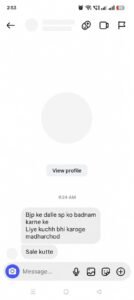
In his conversation with GNM on October 15, Maheshwari said that after publishing the investigation he received abusive messages, threats and communications warning of possible legal consequences.
He also described receiving messages challenging the publication with questions along the lines of: “हमने पैसे कब लिए?”—“When did we take money?”
That response highlights a key distinction at the centre of the controversy. Maheshwari’s published material concerned outreach, responses and reported rates. Those facts, if accurately represented, are not the same as proof that the people involved actually received payment.
A denial that money was received may therefore address one question without necessarily resolving every question about what was discussed or proposed. Equally, the existence of a quoted rate cannot be used to assert that money was received.
GNM has not independently examined the alleged abusive messages, threats or legal warnings, and the exact messages were not available for independent verification at the time of writing. Their existence and content are therefore presented as Maheshwari’s account of what he experienced, rather than as independently established findings.
Threats and harassment should not be used to silence legitimate scrutiny. At the same time, scrutiny must remain evidence-led. Publishing an investigation does not exempt a journalist from the responsibility to distinguish fact from inference, or to correct any error that may emerge.
The proper response to disputed reporting is evidence, clarification and lawful accountability—not intimidation.
The credibility test for those who call themselves independent
The word “independent” carries weight because it suggests that a journalist’s reporting is not secretly controlled by a political party, sponsor or commercial client.
Independence does not mean that a journalist has no opinions. Journalists, like other citizens, may have political views. Nor does it mean that a media professional can never accept paid work. The essential question is whether commercial relationships are managed transparently and whether they influence the presentation of purportedly independent reporting.
Consider three different situations.
First, a creator openly advertises a political campaign video as paid content. The audience is informed of the relationship and can judge the message accordingly.
Second, a journalist produces a commercial video unrelated to their reporting and maintains an appropriate separation between the two roles. That may raise questions about internal policies or conflicts, but it is not automatically proof of misconduct.
Third, a person publishes a paid political message in a format designed to look like independent reporting, without disclosing a relevant sponsorship or financial relationship. If established, that is a far more serious ethical concern because the audience may be making judgments without material information.
These situations should not be treated as equivalent.
The public has a right to question the third situation without automatically accusing everyone involved in the first or second. A serious media investigation must preserve that distinction.
The double standard problem
In India’s increasingly polarised media environment, accusations of bias are often directed at journalists and outlets whose political coverage is unpopular with one side. Labels such as “godi media” are used to question the independence of established outlets, while digital creators frequently present themselves as alternatives to traditional news organisations.
But a claim of independence should invite accountability, not place someone beyond it.
Those who demand transparency from mainstream media should be prepared to explain their own sponsorships, commercial arrangements and editorial boundaries. Equally, those investigating independent creators must apply the same standards they would apply to major broadcasters, newspapers or political influencers aligned with their own views.
A journalist’s credibility cannot be judged solely by whether their reporting helps one political party or hurts another. It must be judged by how they gather information, test claims, disclose conflicts and correct mistakes.
The question is not whether a journalist is pro-government or anti-government. The question is whether the audience can understand the basis on which the journalist is speaking.
What the evidence still needs to establish
The published material raises legitimate questions, but several important points remain unresolved.
Did any of the reported discussions progress to a final agreement? Was any payment made? Did anyone ultimately create or publish a video under the proposed arrangement? If content was published, was the sponsorship or political connection disclosed? Who, if anyone, commissioned and financed the work? And how did the individuals approached understand the nature of the proposal?
Those questions should be answered through the original correspondence, verifiable records, published content and responses from the people concerned.
It is also important not to infer party authorisation from the political nature of the proposal alone. The available material cited here does not independently establish that the Samajwadi Party authorised or funded Maheshwari’s outreach. Any such claim would require evidence of the party’s involvement.
For the same reason, a reported price should not be described as a payment, a preliminary discussion should not be described as an accepted contract, and a proposed video should not be described as published propaganda unless the evidence establishes those facts.
That approach does not weaken the investigation. It makes its conclusions more credible.
The rules of professional conduct still matter
The Press Council of India’s Norms of Journalistic Conduct provide a useful reference point for discussions about accuracy, fairness and responsible reporting. They should be read alongside the relevant laws and rules applicable to the specific work being undertaken.
The broader ethical principles are straightforward: verify information before publishing it, distinguish allegations from established facts, give people a fair opportunity to respond where appropriate, disclose material conflicts and avoid presenting commercial promotion as independent reporting.
For digital media professionals, practical safeguards can include written policies on sponsored content, clear labels for paid partnerships, separation of advertising and editorial decisions, and transparent correction procedures.
For political parties and campaign organisations, disclosure of paid content and compliance with applicable election and platform rules are equally important.
For audiences, the ability to identify sponsorship is not a minor technical detail. It is part of the information needed to evaluate a political message.
GNM’s editorial view: Independence is a responsibility, not a slogan
The most important question raised by Maheshwari’s investigation is larger than the reported rates or the individuals named in the email exchanges. It concerns the public’s ability to trust what it sees and hears in a crowded political information environment.
Journalism depends on credibility. That credibility is damaged when paid promotion is concealed as independent reporting, but it can also be damaged when allegations are presented as proven wrongdoing without adequate evidence.
Both risks deserve attention.
The individuals named in a reported exchange should not be condemned solely because a price was quoted. A commercial proposal is not proof of payment, publication or deception. But anyone who claims the authority of independent journalism should also recognise that relevant commercial relationships and political sponsorships can be legitimate subjects of public scrutiny.
Maheshwari’s account of the abuse and threats he says followed publication raises a separate concern: journalists must be able to investigate matters of public interest without intimidation. That principle applies regardless of the journalist’s political outlook or the party involved.
Ultimately, the media industry must answer a simple question: when viewers encounter a political reel, do they have enough information to know whether they are watching independent reporting, personal commentary or paid promotion?
If the answer is no, transparency has failed the audience.
A press card does not guarantee integrity. A large following does not guarantee independence. A claim of being fearless does not remove the obligation to provide evidence. And a commercial rate does not, by itself, prove misconduct.
The responsibility is shared by journalists, influencers, media organisations and political campaigns. All must be willing to explain their work honestly and submit their claims to the same standard of scrutiny.
Truth must come before influence. Transparency must come before trust. And public interest must come before private gain.
—
Sources and further reading
Original investigation by Vishal Maheshwari
1. Part 1 — X: https://x.com/vishalPosts/status/2110196436403151132
2. Part 2 — X: https://x.com/vishalPosts/status/2110576489641157013
3. Archived text of Part 1: https://en.rattibha.com/thread/2110196436403151132
4. Archived text of Part 2: https://en.rattibha.com/thread/2110576489641157013
Related reporting
5. OpIndia report: https://www.opindia.com/2026/10/undercover-operation-independent-journalists-propaganda-samajwadi-party/
6. Detail News India report: https://dnimedia.in/2026/10/15/cjp-%E0%A4%AA%E0%A5%8D%E0%A4%B0%E0%A4%A6%E0%A4%B0%E0%A5%8D%E0%A4%B6%E0%A4%A8-%E0%A4%AE%E0%A5%87%E0%A4%82-%E0%A4%B0%E0%A4%BF%E0%A4%AA%E0%A5%8B%E0%A4%B0%E0%A5%8D%E0%A4%9F%E0%A4%BF%E0%A4%82%E0%A4%97/
Professional standards
7. Press Council of India — Norms of Journalistic Conduct: https://presscouncil.nic.in/Norms.aspx
Reporting note: GNM spoke with Vishal Maheshwari on October 15, 2026. His account of the outreach timeline and the abuse, threats and legal warnings he says followed publication is attributed to that conversation. GNM has not independently authenticated every underlying email or the alleged messages. Reported rates are not proof of payment, and the material cited here does not establish that the Samajwadi Party authorised or financed the outreach. Any later verified responses or evidence should be reflected in an updated version of this report.