Neha Bora invoked Bangladesh’s Gen-Z uprising as inspiration. Prashant Bhushan declared that the struggle was for “ Regime-Change”. The critical question is not whether India’s government can change—it can. It is whether the people advocating change will defend the constitutional rules that make democratic change legitimate.
By GNM Editorial Desk | Global Nexus Media
India’s latest political confrontation has exposed a question that deserves far more scrutiny than the familiar exchange of accusations between government and opposition: when political activists invoke democracy to challenge an elected government, what exactly do they propose to replace it with—and by what means?
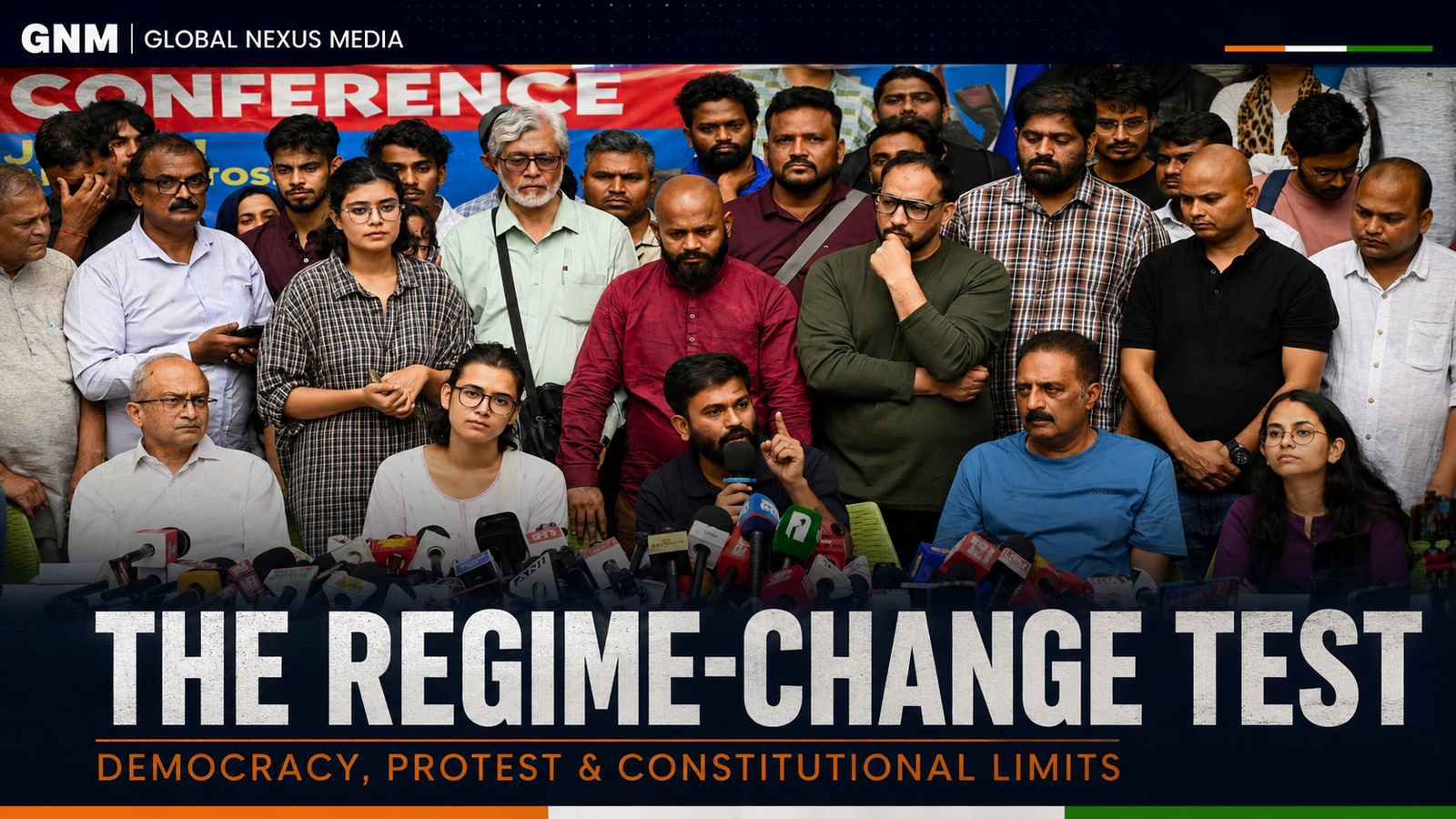
The controversy intensified after All India Students’ Association president Neha Bora praised Bangladesh’s Gen-Z movement for “showing us the way”. Shortly afterwards, lawyer-activist Prashant Bhushan described the ongoing agitation as a fight for regime change, insisting that seeking such change was a democratic right.
Their remarks are on the public record. Their political implications are contested. Neither statement, by itself, proves a conspiracy to overthrow India’s constitutional order. But together, they raise a legitimate and urgent question: where does democratic resistance end and the pursuit of power outside democratic safeguards begin?
That question should not be dismissed as partisan rhetoric. It should be answered by the people making the demands.
1. The Bangladesh analogy demands more than a slogan
Bora’s praise for Bangladesh’s 2024 student-led uprising has become the most politically consequential part of the controversy. The movement began amid anger over public-sector job quotas and expanded into a nationwide confrontation that ended Sheikh Hasina’s long tenure in power.
The United Nations Human Rights Office estimated that as many as 1,400 people may have been killed between 1 July and 15 August 2024. Its investigation documented serious violations by state security forces, including unlawful killings and arbitrary detention. The report also described abuses by violent actors and called for accountability. These findings make one point unavoidable: Bangladesh’s upheaval was not a cost-free political spectacle. It was a human tragedy as well as a historic political rupture.
Source: UN Human Rights Office, 12 February 2025.
The lesson is not that citizens should tolerate repression or abandon protest. The UN findings demonstrate why accountability, civil liberties and the protection of peaceful demonstrators matter. But they also make it irresponsible to romanticise a dramatic change of government while ignoring the violence, institutional disruption and uncertainty surrounding such upheavals.
If Bangladesh is presented as a model for India, the comparison requires precision. Is the inspiration the mobilisation of young citizens, the demand for accountable institutions, or the removal of a government through escalating street confrontation? These are not interchangeable propositions.
Bora’s reported remarks support scrutiny of the analogy she chose to invoke. They do not, on their own, establish that she advocates violence. The responsibility now is to clarify what practical lessons she believes India should draw from Bangladesh—and what limits she recognises.
2. “Regime change” is not a blank cheque
Prashant Bhushan’s statement that the struggle is for regime change puts the central democratic distinction into sharp focus.
A change of government through elections is a normal feature of representative democracy. Citizens may campaign for a prime minister’s resignation, demand an election, challenge official decisions in court, organise protests and seek constitutional reform. No government possesses a permanent entitlement to power.
But the phrase “regime change” carries a broader meaning in international politics. It can refer to anything from electoral turnover to the removal of an established political order. Its meaning depends on the methods proposed and the constitutional framework in which the change is sought.
That is why Bhushan’s assertion that regime change is a democratic right is only the beginning of the debate—not its conclusion.
The crucial questions are straightforward:
- Does the proposed change mean defeating the incumbent government in an election?
- Does it mean pursuing legal and constitutional remedies against alleged electoral wrongdoing?
- Does it mean peaceful mass mobilisation that respects the rights of other citizens?
- Or is any participant suggesting that street pressure should replace constitutional procedures, or that force and intimidation are acceptable instruments of political change?
The public statements cited in this controversy do not establish that Bhushan endorses a violent overthrow. They do, however, justify asking him to specify what he means by “regime change” and how he proposes to achieve it.
A democratic objective does not automatically make every method used in its pursuit democratic.
3. The ideological double standard that deserves examination
India’s political debate frequently divides citizens into competing camps: defenders of democracy on one side, alleged authoritarians on the other. Yet democratic principles cannot be selectively applied.
If a government restricts peaceful protest without adequate legal justification, it should face scrutiny. If a protest movement uses violence, intimidation or unlawful coercion, it should face scrutiny too. If election officials are accused of wrongdoing, evidence and due process must determine the outcome. If activists accuse institutions of systematic misconduct, they must be prepared to substantiate their claims.
This standard is particularly important when activists describe themselves as defenders of constitutional democracy.
The issue is not whether someone identifies as left-wing, liberal, conservative or nationalist. Ideological labels cannot settle a factual dispute. The relevant test is whether the person’s stated principles and proposed methods are consistent with constitutional freedoms, peaceful political competition and the rule of law.150 Detained, Including CJP Leader Abhijeet Dipke and AISA President Neha Bora, During Protest Against CEC Gyanesh Kumar
A useful challenge to any political activist is therefore this: would you defend the same right to protest if your political opponents exercised it? Would you accept an election result that went against your preferred side? Would you insist on evidence and due process when the allegations targeted your allies?
These questions expose inconsistency more effectively than insults ever could.
4. The foreign-influence question: investigate, do not presume
Bangladesh has also become part of a wider debate over foreign funding and political influence. In March 2025, the Observer Research Foundation published American Aid and Regime Change in Bangladesh: A Primer, examining the activities of USAID, the National Endowment for Democracy and organisations associated with them. The report raises questions about foreign assistance, civil-society networks and political influence.
That report is a legitimate source for examining the debate. It is not, by itself, conclusive proof that the United States orchestrated Sheikh Hasina’s removal.
The distinction matters. On 13 August 2024, the White House denied involvement in Hasina’s ouster, calling reports of US involvement “simply false”. Reuters reported that denial and noted that the allegation itself was disputed. A responsible investigation must consider both the allegations and the evidence supporting or undermining them.
Sources: ORF, March 2025 and Reuters, 13 August 2024.
The broader issue is worth investigating: foreign funding can shape civil-society priorities, political communication and institutional capacity. Transparency about donors, beneficiaries and programme objectives is a reasonable public-interest demand.
But evidence of foreign funding for an organisation does not automatically prove that every recipient is engaged in covert political engineering. Nor does an activist’s ideological position or praise for a foreign protest movement establish foreign direction.
If anyone alleges that India’s current protests are externally orchestrated, the allegation should be tested against documented financial links, communications, credible investigative findings and independently corroborated evidence. Without that material, the claim remains an allegation—not an established fact.
5. The voter-list dispute must be investigated on its merits
The present protests are rooted in allegations surrounding the revision of electoral rolls and demands for the resignation of Chief Election Commissioner Gyanesh Kumar. Protesters say eligible voters risk being excluded; the Election Commission’s stated position is that the exercise seeks to identify duplicate and ineligible entries.
These are consequential claims. A voter wrongly removed from the rolls may lose a fundamental opportunity to participate in representative government. Equally, maintaining accurate electoral rolls is a legitimate administrative objective.
The answer is not to decide the matter through political slogans. It is to examine the scale and causes of disputed deletions, the procedures for restoring eligible voters, the availability of appeals, the transparency of official data and the evidence offered by both critics and election authorities.
Reuters reported on 3 October 2026 that the Election Commission had instructed officials to register newly eligible voters and people who had been omitted from the rolls. That detail belongs in any serious assessment of the dispute, alongside evidence of alleged wrongful exclusions and the commission’s explanations.
Source: Reuters, 3 October 2026.
A movement that claims to defend voting rights should welcome a transparent, independently scrutinised process that identifies wrongful deletions and corrects them. Government authorities, in turn, should provide accessible remedies and credible data. Neither side should be permitted to substitute accusation for verification.
6. Protest is a right. So is the public’s right to ask hard questions
India’s constitutional framework protects freedom of speech and peaceful assembly, subject to lawful restrictions. Peaceful protest is not evidence of anarchy. Nor does a demand for the resignation of a public official automatically become an attack on democracy.
The method matters.
Peaceful demonstrations, court proceedings, parliamentary scrutiny, investigative journalism and election campaigns are legitimate avenues for political pressure. Violence, threats, destruction of property and coercive attempts to prevent others from exercising their rights raise different legal and democratic questions.
Authorities must not use the language of public order as a pretext to silence peaceful dissent. Activists must not use the language of democratic rights as a pretext to excuse violence or intimidation. Both propositions can be true at the same time.
That is the standard by which this controversy should be judged—not by the political identity of the person speaking.
7. The questions the leaders should answer
The public does not need another round of competing labels. It needs clear answers.
To Neha Bora: When you say Bangladesh’s Gen-Z movement “showed us the way”, which specific methods and outcomes are you endorsing? Do you mean youth mobilisation and the demand for accountable institutions, or do you support replicating the wider confrontation that brought down the Hasina government? What constitutional limits should Indian protesters observe?
To Prashant Bhushan: When you say the struggle is for regime change, do you mean a change of government through elections and constitutional remedies? What would constitute success, and what methods do you rule out? Do you unequivocally reject violence and coercion as instruments of political change?
These are questions, not findings of guilt. Neither individual should be presumed to endorse unconstitutional conduct without evidence. But leaders who use language as consequential as “regime change” should expect their objectives and methods to be examined carefully.
Conclusion: Democracy must be the method, not merely the slogan
India does not need to choose between unquestioning support for the government and uncritical support for every movement against it. A functioning democracy requires the freedom to challenge power, the institutions to investigate wrongdoing and the constitutional procedures through which governments can be replaced.Supreme Court Steps In
The Bangladesh experience illustrates both the power of popular mobilisation and the terrible human consequences that can accompany a political crisis. It should therefore be studied seriously—not reduced to a slogan, celebrated without qualification or invoked as proof of a conspiracy without evidence.
Neha Bora’s comparison and Prashant Bhushan’s declaration have opened a legitimate debate about political change. They have not, by themselves, proved an agenda of anarchy. The decisive question is what each advocate says about the methods, limits and constitutional safeguards that must govern that change.
The standard should be uncompromising and universal: no government is above democratic scrutiny, and no movement is above democratic rules.
If the objective is to defend democracy, the means must protect peaceful dissent, equal political rights, due process and constitutional government. Otherwise, the language of democracy risks becoming a slogan used to justify whatever a political camp wants.
India’s citizens deserve more than declarations of intent. They deserve transparent evidence, clear commitments and a political culture in which every claim to defend democracy is tested against the democratic conduct it demands of others.
That is the real regime-change test.