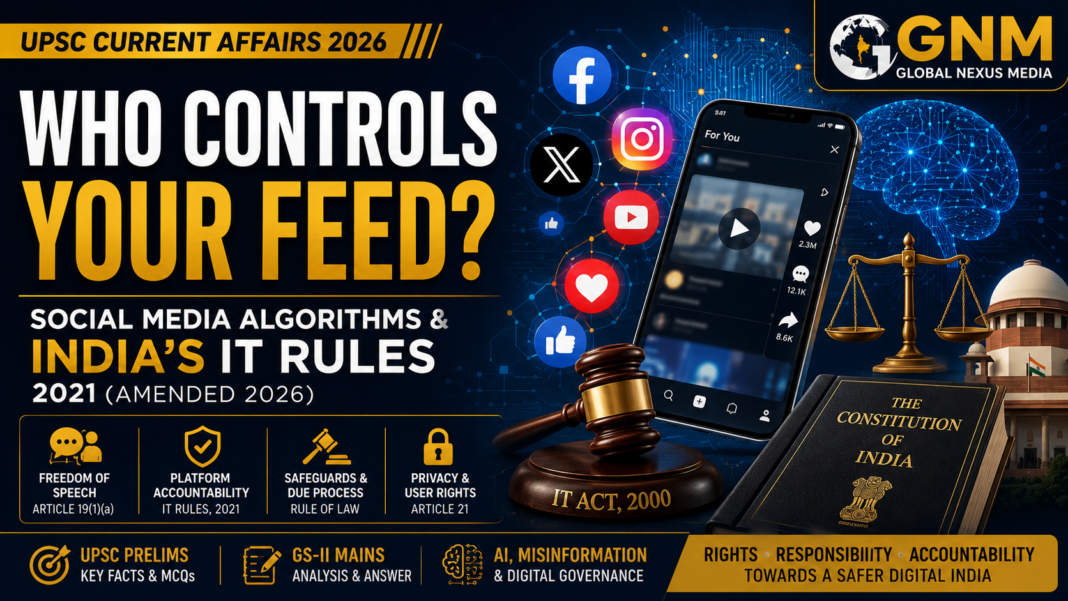
UPSC Relevance: GS Paper II — Governance, Constitution, Polity, Social Justice; GS Paper III — Science and Technology, Cybersecurity
Also Useful For: Essay, Ethics, digital governance and current affairs
Reading Time: 12–15 minutes
Updated: 19 October 2026
Why in News?
India’s regulation of online platforms has become increasingly important as social media algorithms shape the information users encounter, while artificial intelligence makes it easier to generate realistic but potentially misleading content.
A significant recent development is the Information Technology (Intermediary Guidelines and Digital Media Ethics Code) Amendment Rules, 2026, notified by the Ministry of Electronics and Information Technology (MeitY) on 10 February 2026 and effective from 20 February 2026. The amendments address synthetically generated information and revise certain intermediary obligations. The notified legal text—not headlines or social media posts—should be treated as the authoritative source for the precise obligations that apply.
For UPSC aspirants, the issue goes beyond social media regulation. It raises a fundamental governance question:
How can India protect citizens from unlawful online content while safeguarding freedom of speech, privacy, due process and democratic debate?
This topic connects constitutional principles with digital governance, artificial intelligence, platform accountability and the state’s regulatory role.
1. The Issue in 60 Seconds
Social media platforms do more than host posts. Their recommendation systems rank and suggest content using signals such as a user’s activity, expressed interests, interactions and the characteristics of the content.
These systems can help users discover relevant information, but they can also amplify sensational material, reinforce existing preferences or make misleading content more visible. The actual effects depend on the platform, its design, the content and the behaviour of users; algorithms do not operate identically across services.India’s Digital Public Infrastructure
India’s regulatory framework includes the Information Technology Act, 2000, the IT Rules, 2021, constitutional protections and applicable judicial decisions.
The central policy challenge is to balance five objectives:
- Safety: Responding to unlawful content, fraud, harassment and harmful synthetic media.
- Freedom: Protecting lawful expression, criticism and democratic debate.
- Accountability: Making platforms answerable for their legal obligations and moderation processes.
- Privacy: Avoiding disproportionate collection, disclosure or surveillance of users’ information.
- Due process: Ensuring that restrictions are legally grounded, proportionate and open to appropriate challenge.
The goal should not be to treat every controversial post as unlawful or every algorithm as inherently harmful. Effective regulation requires clear legal standards, transparent processes and safeguards against misuse.
2. What Are Social Media Algorithms?
A social media algorithm is a set of computational rules or models used to organise, rank, recommend or moderate content on a digital platform.
When a user opens a feed, the platform may have far more available posts than it can display. Ranking systems help determine which posts appear first and which are recommended.
How recommendation systems generally work
Step 1 — Collect relevant signals: Depending on the service and its settings, the platform may consider follows, likes, watch time, searches, shares, feedback and information about the content.
Step 2 — Estimate relevance: A model may predict the likelihood that a user will watch, read, like, share or otherwise engage with a particular item.
Step 3 — Rank or recommend: The platform orders or selects content using its objectives, constraints and ranking rules.
Step 4 — Learn from interactions: Further activity can influence later recommendations, although the degree and method vary between platforms.
This is a simplified explanation. The exact systems used by individual companies are proprietary and can change over time.
Why does this matter for democracy?
Imagine two posts about the same public policy. One provides a carefully sourced explanation; the other makes an emotionally charged claim without evidence. If a ranking system rewards signals associated with engagement, the second post may receive substantial visibility. But this is not inevitable: platforms can design systems that incorporate quality, safety and other considerations.
Potential concerns include:
- Misinformation: Incorrect claims can circulate rapidly before verification.
- Echo chambers: Personalised feeds may narrow the range of perspectives a user encounters.
- Political polarisation: Repeated exposure to highly divisive content may intensify existing disagreements in some circumstances.
- Manipulated engagement: Coordinated accounts, bots or artificial engagement can distort perceptions of public opinion.
- Opaque decisions: Users may not understand why content was recommended, downranked or removed.
- Synthetic media: AI-generated images, audio and video can make fabricated events appear authentic.
These are risks to investigate, not proof that every recommendation system causes these outcomes. Strong analysis must distinguish evidence about a specific platform or event from broader assumptions about technology.
The important distinction
A recommendation algorithm and a content-moderation system are not the same thing.
| Concept | Main function | Example |
|---|---|---|
| Recommendation or ranking | Determines what content is suggested or shown prominently | Recommending a news explainer |
| Content moderation | Applies platform policies or legal requirements to content | Removing a post that violates a rule |
| Content labelling | Provides information about content’s nature or provenance | Identifying certain AI-generated media |
| Government direction | Invokes applicable legal powers to require specified action | A legally valid direction concerning unlawful content |
A platform may use several of these systems together, but each raises different questions of accountability and oversight.
3. India’s Legal and Constitutional Framework
Understanding the law is essential because UPSC questions often test the difference between a constitutional right, a statutory provision, a delegated rule and a judicial interpretation.
A. Information Technology Act, 2000
The Information Technology Act, 2000 provides the principal statutory framework for several aspects of electronic records, cyber offences and intermediary liability.
Section 79 — Conditional safe-harbour protection
Section 79 provides conditional protection to intermediaries from liability for third-party information, data or communication links hosted by them, subject to statutory conditions.
This protection is not an unconditional exemption from all legal responsibility. Compliance with applicable legal requirements and the relevant statutory conditions matters.
Section 69A — Blocking of information
Section 69A provides a legal framework for the Central Government, or an authorised officer, to direct the blocking of public access to specified information through a computer resource on grounds set out in the law and subject to prescribed procedures.
It should not be confused with every individual content-removal request or with the separate duties imposed on intermediaries by the IT Rules.
UPSC takeaway: Know the broad functions of Sections 69A and 79, and do not treat blocking powers and safe-harbour protection as interchangeable concepts.
B. IT Rules, 2021
The Information Technology (Intermediary Guidelines and Digital Media Ethics Code) Rules, 2021 were notified on 25 February 2021 under the Information Technology Act, 2000. They establish due-diligence requirements for intermediaries and include additional obligations for significant social media intermediaries.
The Rules have been amended over time. For an examination or legal discussion in 2026, aspirants should consult the latest notified text rather than rely solely on an original 2021 summary.
Key areas include:
- Publication of relevant user-facing policies and terms.
- A mechanism for receiving and addressing user grievances.
- Additional due-diligence obligations for significant social media intermediaries.
- Compliance with applicable lawful directions and requirements.
- Provisions addressing specified categories of unlawful content and, following the 2026 amendments, synthetically generated information.
The exact obligation depends on the applicable rule, the nature of the intermediary, the circumstances and the current legal text.
C. What changed in 2026?
The amendments notified through G.S.R. 120(E), dated 10 February 2026, include provisions concerning synthetically generated information (SGI).
The updated Rules address certain audio, visual or audiovisual information that has been artificially or algorithmically created, generated, modified or altered so that it appears real or authentic and depicts an individual or event in a way that may be perceived as indistinguishable from a real person or event, subject to the definition and qualifications in the Rules.
This matters because synthetic media can be used for legitimate purposes—education, accessibility, creativity and entertainment—but can also be misused to impersonate people, spread deceptive claims or violate legal rights.
Do not make the mistake of assuming that all AI-generated content is unlawful. The legal definition, applicable exceptions or qualifications, the nature of the content and the relevant obligation must be considered.
The amendments also revise certain compliance timelines and intermediary obligations. Because these requirements are specific and may depend on the circumstances, refer to the current notified Rules before stating a precise deadline or asserting that a particular post must be removed within a given number of hours.
Official sources:
The FAQs explain the government’s interpretation and are useful for understanding the changes, but the notified legal text remains the primary reference for legal obligations.
D. Article 19 of the Constitution
Article 19(1)(a) guarantees citizens the right to freedom of speech and expression, subject to the constitutional framework.
Article 19(2) permits reasonable restrictions on that right on specified grounds, including the sovereignty and integrity of India, security of the State, friendly relations with foreign States, public order, decency or morality, contempt of court, defamation and incitement to an offence.
A restriction must be grounded in the applicable law and satisfy constitutional requirements. The existence of harmful or controversial online speech does not automatically justify every form of restriction.
For UPSC, remember that Article 19(2) does not create an unlimited power to restrict speech. The grounds listed in the Constitution matter, as do legality, reasonableness and applicable judicial standards.
E. Article 21 and privacy
Article 21 protects life and personal liberty. The Supreme Court’s decision in Justice K.S. Puttaswamy (Retd.) v. Union of India recognised privacy as a constitutionally protected right.
Digital governance can affect privacy through data collection, tracking, profiling, identity verification and the disclosure of user information. Regulation must therefore consider not only the removal of harmful content but also the handling of personal data and the potential for disproportionate surveillance.
4. What Has the Supreme Court Said?
Judicial decisions help explain how constitutional principles apply to technology and state action. Two important cases offer useful context.
Shreya Singhal v. Union of India (2015)
The Supreme Court struck down Section 66A of the Information Technology Act as unconstitutional. The provision had criminalised certain forms of online communication using broad language.
The judgment is important for the distinction between protected expression and legally permissible restrictions on speech. It also addressed aspects of Section 69A and intermediary takedown provisions.
Why it matters: Vague or overbroad restrictions on online speech can create a chilling effect, discouraging people from expressing lawful opinions because they fear legal consequences.
Anuradha Bhasin v. Union of India (2020)
In the context of restrictions on internet access in Jammu and Kashmir, the Supreme Court held that freedom of speech and expression and freedom to practise a profession or carry on trade or business through the internet enjoy constitutional protection under Articles 19(1)(a) and 19(1)(g).
The Court also emphasised proportionality and held that indefinite suspension of internet services was impermissible under the applicable suspension framework.
Why it matters: Restrictions affecting digital access must be examined against constitutional standards. The judgment does not mean that every online service or every internet activity is immune from lawful regulation.
Important distinction: These cases do not resolve every modern question about recommendation algorithms, AI-generated media or every provision of the amended IT Rules. Apply their principles carefully rather than attributing findings to the Court that it did not make.
5. Freedom of Speech vs Platform Accountability
This is the central analytical issue for GS-II.
A democratic state has a legitimate interest in responding to unlawful threats, fraud, targeted harassment, certain forms of non-consensual intimate imagery and other content prohibited by law. Platforms also exercise substantial influence over what users can publish, discover and share.
At the same time, content regulation can create risks if decisions are opaque, deadlines are impractical, legal standards are unclear or users have no meaningful way to challenge mistakes.
Arguments supporting stronger platform accountability
- Protection of users: Effective grievance mechanisms can help people respond to harassment, impersonation and other harms.
- Reduced abuse: Clear obligations may encourage platforms to address unlawful content and repeated misuse.
- Transparency: Reporting and procedural requirements can make platform practices easier to scrutinise.
- Public interest: Coordinated manipulation and deceptive synthetic media can undermine informed public debate.
- Legal accountability: Companies operating in India must comply with applicable Indian law.
Concerns about overregulation
- Over-removal: Platforms may remove lawful material to avoid regulatory or legal risk.
- Chilling effect: Users may hesitate to criticise public authorities or participate in contentious debates.
- Due-process concerns: Rapid decisions without adequate context can produce errors.
- Privacy risks: Traceability or identity-related requirements can raise concerns about anonymity, data security and proportionality.
- Concentration of power: If rules are vague or oversight is weak, excessive discretion may shift from users and courts towards platforms or executive authorities.
A serious UPSC answer should not assume that either unrestricted platform autonomy or unrestricted state control is the correct solution. It should evaluate the law, evidence, institutional safeguards and practical consequences.
6. What Should a Balanced Regulatory Framework Look Like?
India needs a framework that protects users without unnecessarily restricting lawful expression or innovation.
1. Clear and precise legal standards
Rules should distinguish unlawful content from merely unpopular, critical or controversial opinions. Clear standards can reduce arbitrary decisions and improve compliance.
2. Transparency in recommendation systems
Platforms can publish meaningful information about their main recommendation principles, the types of signals used and the options available to users. Independent scrutiny may be appropriate where it can be conducted without exposing personal data or legitimate security-sensitive information.
Transparency does not necessarily require publishing every line of source code.
3. Effective user appeals
Where content is removed, restricted or downranked, users should receive meaningful information about the decision where legally appropriate, along with access to an effective review mechanism.
4. Proportionate enforcement
Government directions and platform action should be consistent with applicable law, sufficiently specific and proportionate to the legitimate objective pursued. Appropriate review and remedies can help correct mistakes.
5. Privacy and data protection
Recommendation and moderation systems should be designed with attention to data minimisation, security and the rights of users. Accountability measures should not become a pretext for unnecessary collection or disclosure of personal information.
6. Responsible use of AI
Platforms should address deceptive synthetic media in accordance with the law. Appropriate labelling, provenance information, user reporting and safeguards against impersonation may help, depending on the content and context.
7. Digital literacy
Citizens should be encouraged to verify sources, recognise manipulated media, understand the limits of recommendation feeds and pause before forwarding unverified claims.
Schools, universities, civil society and public institutions can contribute to this effort.
8. Evidence-based policy evaluation
Regulators should assess whether a rule achieves its stated objective, how frequently errors occur, whether lawful speech is affected and whether less restrictive measures could work. Evaluation should be transparent enough to support informed public debate.
7. Why Is This Important for India?
The issue affects more than technology companies. It touches governance, citizenship, national security, innovation and social trust.
Democratic participation: Social media allows citizens to debate public policy, scrutinise institutions and organise civic activity. Rules should preserve the space for lawful dissent.
Public order and safety: Digital platforms can be misused for fraud, threats, incitement and coordinated manipulation. A lawful and effective response is necessary.
Economic innovation: Predictable regulation can support investment and responsible innovation. Unclear or disproportionate obligations may increase compliance costs, particularly for smaller businesses.
Digital inclusion: Many citizens rely on digital services for news, education, public information and access to opportunities. Accessible grievance mechanisms and digital literacy are therefore important.
Strategic autonomy: India must be able to shape its digital regulatory framework while engaging with global platforms, international standards and cross-border technology developments.
The policy objective should be a digital ecosystem that is safe, innovative, rights-respecting and accountable.The Price of Political Influence:
8. Prelims Revision: Facts You Must Remember
| Topic | Key point |
|---|---|
| IT Act | Enacted in 2000; provides the statutory framework for electronic transactions and several cyber-law matters |
| Section 69A | Framework for blocking public access to specified information, subject to law and prescribed procedure |
| Section 79 | Conditional intermediary safe-harbour protection |
| IT Rules | Information Technology (Intermediary Guidelines and Digital Media Ethics Code) Rules, 2021 |
| 2026 amendment | Includes provisions concerning synthetically generated information |
| Article 19(1)(a) | Freedom of speech and expression |
| Article 19(2) | Specified grounds for reasonable restrictions on speech |
| Article 21 | Protection of life and personal liberty; relevant to privacy |
| Shreya Singhal (2015) | Section 66A struck down as unconstitutional |
| Anuradha Bhasin (2020) | Internet-based speech and trade enjoy constitutional protection; proportionality is relevant to restrictions |
Prelims trap 1: Section 69A and Section 79 serve different legal functions.
Prelims trap 2: Freedom of speech is constitutionally protected, but it is not absolute.
Prelims trap 3: The IT Rules are delegated legislation made under the Information Technology Act; they are not themselves a constitutional amendment.
Prelims trap 4: Not every intermediary is automatically subject to every additional obligation applicable to significant social media intermediaries.
Prelims trap 5: Not every AI-generated image or video is automatically unlawful. The applicable definition, legal provisions and context matter.
Prelims trap 6: A government announcement, an explanatory FAQ, a proposed rule and a final notified rule are not interchangeable sources of law.
9. UPSC-Style Practice MCQs
These are original practice questions prepared for revision. They are not previous-year UPSC questions.
Question 1
With reference to the Information Technology Act, 2000, consider the following statements:
- Section 69A provides a legal framework for blocking public access to specified information.
- Section 79 provides conditional safe-harbour protection to intermediaries.
- Section 79 gives every intermediary unconditional immunity from all legal liability.
Which of the statements given above are correct?
A. 1 and 2 only
B. 2 and 3 only
C. 1 and 3 only
D. 1, 2 and 3
Correct answer: A. 1 and 2 only
Explanation: Section 69A concerns blocking of public access to specified information, while Section 79 deals with conditional intermediary protection. The third statement is incorrect because safe harbour is not unconditional.
Question 2
Article 19(2) of the Constitution of India is primarily concerned with:
A. The power to suspend all fundamental rights during ordinary administration
B. Specified grounds on which reasonable restrictions may be imposed on freedom of speech and expression
C. The automatic removal of all online criticism of the government
D. A general prohibition on anonymous speech
Correct answer: B
Explanation: Article 19(2) lists specified grounds for reasonable restrictions on the right protected by Article 19(1)(a). It does not authorise a blanket ban on criticism or create a general prohibition on anonymity.
Question 3
Which one of the following best describes a recommendation algorithm?
A. A constitutional provision governing online speech
B. A system that ranks or suggests content based on selected signals and objectives
C. A court order directing an intermediary to remove specified content
D. A statutory guarantee of intermediary immunity
Correct answer: B
Explanation: Recommendation systems help select, rank or suggest content. They are technical systems, not constitutional provisions or legal orders.
Question 4
With reference to the IT Rules, 2021, consider the following statements:
- They were notified under the Information Technology Act, 2000.
- They provide additional due-diligence obligations for significant social media intermediaries.
- Their provisions and amendments never need to be checked after the original 2021 notification.
Which of the statements given above are correct?
A. 1 only
B. 1 and 2 only
C. 2 and 3 only
D. 1, 2 and 3
Correct answer: B. 1 and 2 only
Explanation: The Rules were made under the IT Act and include additional requirements for significant social media intermediaries. Since the Rules have been amended, aspirants must consult the latest applicable text.
Question 5
Which of the following is the most appropriate constitutional approach to regulating harmful online content in a democracy?
A. Remove every controversial opinion without review
B. Allow all online content without regard to any law
C. Apply clear legal standards, protect lawful expression and provide appropriate procedural safeguards
D. Replace judicial review with the internal decisions of private platforms
Correct answer: C
Explanation: A balanced approach combines lawful protection against harm with freedom of expression, proportionality, accountability and appropriate review.
10. Mains Practice: GS Paper II
Question: “Regulation of social media platforms requires a careful balance between freedom of speech, user safety and accountability.” Discuss the constitutional and governance challenges involved in regulating algorithm-driven platforms in India. Suggest a balanced way forward. (250 words)
Model Answer
Social media platforms have transformed public communication by enabling rapid information-sharing, civic participation and access to diverse viewpoints. However, algorithm-driven recommendation systems, coordinated manipulation and deceptive synthetic media can create challenges relating to misinformation, privacy and accountability.
Constitutionally, Article 19(1)(a) protects freedom of speech and expression, while Article 19(2) permits reasonable restrictions on specified grounds. Article 21 and the constitutional protection of privacy are also relevant to the collection and use of personal information. The Information Technology Act, 2000 and the IT Rules, 2021 establish important elements of India’s intermediary-regulation framework, which has been amended over time.
The principal challenge is to prevent unlawful harm without creating excessive restrictions on lawful expression. Broad or opaque rules may encourage over-removal of content, discourage legitimate criticism and weaken trust. Conversely, inadequate accountability can leave users vulnerable to impersonation, harassment and coordinated deception.
A balanced approach should include:
- Clear and legally precise standards for unlawful content.
- Transparent platform policies and meaningful explanations of moderation decisions.
- Accessible grievance redressal and effective appeal mechanisms.
- Proportionate enforcement consistent with constitutional safeguards.
- Privacy-conscious oversight and responsible use of synthetic-media labels where appropriate.
- Digital literacy and evidence-based evaluation of regulatory outcomes.
India should pursue a rights-respecting digital governance framework that protects citizens while supporting innovation and democratic debate. Effective regulation requires not merely faster content removal, but also transparency, accountability, due process and public trust.
11. How to Use This Topic in the UPSC Exam
For Prelims: Revise the constitutional articles, the functions of Sections 69A and 79, the scope of the IT Rules and the key judicial decisions. Practise distinguishing a statutory rule from a constitutional right.
For GS-II Mains: Use the topic under governance, transparency, accountability, fundamental rights, citizen-centric administration and regulatory institutions.
For GS-III Mains: Connect it to artificial intelligence, cybersecurity, emerging technologies, data governance and the responsible use of digital systems.
For Essay: Possible themes include technology and democracy, freedom and responsibility, and the relationship between innovation and regulation.
For Ethics: Discuss transparency, accountability, privacy, fairness, public trust and the ethical responsibilities of technology companies and public institutions.
12. Frequently Asked Questions
Are social media algorithms illegal in India?
No. Recommendation algorithms are not inherently illegal. Their design and use may raise legal, regulatory or ethical questions depending on the circumstances and the applicable law.
Do the IT Rules, 2021 apply to every website in exactly the same way?
No. The Rules distinguish between categories of intermediaries and impose additional obligations on significant social media intermediaries. The precise duties depend on the applicable provisions and the entity concerned.
Does freedom of speech protect every online post?
No. Article 19(1)(a) protects freedom of speech and expression, subject to the constitutional framework, including reasonable restrictions under Article 19(2) and other applicable law.
Is all AI-generated content prohibited?
No. The legal treatment depends on the applicable definition, the nature and context of the content, and the requirements of the current Rules. Synthetic media can have legitimate uses as well as potential for misuse.
What is the most important takeaway for UPSC?
The issue is not simply whether social media should be regulated. It is how regulation can be lawful, proportionate, accountable and effective while protecting constitutional freedoms.
Conclusion
Social media algorithms are increasingly important intermediaries between citizens and information. They can expand access to knowledge and public debate, but their design, opacity and interaction with AI-generated content can create significant governance challenges.
India’s task is to build a digital environment that protects users from unlawful harm without weakening lawful expression, privacy or democratic accountability. The Information Technology Act, the amended IT Rules, constitutional principles and judicial safeguards must be understood together—not in isolation.
For UPSC aspirants, this is a valuable case study in the relationship between technology, rights and governance. The strongest answer will avoid extreme positions, use the relevant legal framework accurately and propose practical safeguards grounded in constitutional principles.
Official Sources and Further Reading
- Ministry of Electronics and Information Technology (MeitY): Information Technology Rules, 2021, as amended
- MeitY: FAQ on the 2026 Amendment Rules
- Press Information Bureau: Government notification of the IT Rules, 2021
- Supreme Court of India: Shreya Singhal v. Union of India (2015).
- Supreme Court of India: Anuradha Bhasin v. Union of India (2020).
- Supreme Court of India: Justice K.S. Puttaswamy (Retd.) v. Union of India (2017).
Editorial note: This article is an educational resource for UPSC preparation, not legal advice. Verify the latest notified legal text and relevant judgments before relying on a specific provision or deadline.