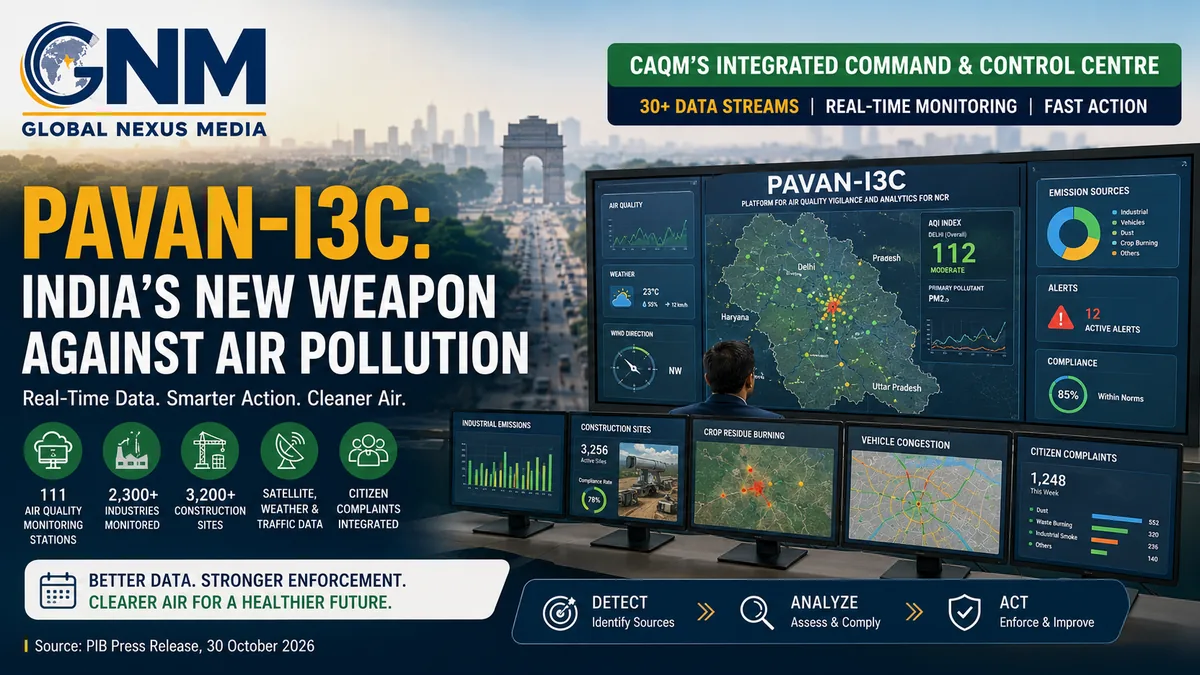
CAQM’s new integrated command and control centre brings together 30+ data streams to strengthen pollution monitoring, inter-agency coordination and regulatory enforcement.
GNM — Global Nexus Media | UPSC Special | 31 October 2026
Introduction
Air pollution is not merely an environmental problem. It is also a public-health, governance and institutional-coordination challenge.
In a significant technology-driven step, the Commission for Air Quality Management (CAQM) has developed an Integrated Command and Control Centre named PAVAN-I3C in New Delhi. The platform is designed to bring information from multiple agencies and pollution sources onto a common digital interface, helping authorities monitor air quality, identify violations and coordinate timely action across Delhi-NCR.
On 30 October 2026, Union Environment Minister Bhupender Yadav visited the centre to review its technological framework and operational readiness.
The initiative is important for UPSC aspirants because it connects environmental governance with digital monitoring, cooperative federalism, institutional accountability and public policy implementation.
1. What is PAVAN-I3C?
PAVAN stands for Platform for Air Quality Vigilance and Analytics for NCR.
It is an integrated digital command and control platform developed by CAQM to strengthen real-time air-quality monitoring and data-driven compliance management across Delhi-NCR.PIB
The platform follows a three-step operating principle:
- Detect: Identify pollution sources, abnormal readings and possible violations.
- Analyse: Combine real-time and historical information to understand pollution patterns and assess compliance.
- Act: Generate alerts and escalate identified issues to the relevant authorities for corrective action.
Its main objective is to reduce information gaps between agencies and improve the speed and coordination of regulatory responses.
2. Key features and important figures
According to the Ministry of Environment, Forest and Climate Change:
- More than 30 APIs and data streams are integrated into the platform.
- Data from 111 Continuous Ambient Air Quality Monitoring Stations (CAAQMS) across Delhi-NCR is integrated.
- Information from more than 2,300 industries is included.
- Data from over 3,200 active construction sites is incorporated.
- Traffic congestion hotspots and other pollution-related information are also monitored.
The system brings together air-quality, industrial-emission, meteorological, satellite, camera, mobility, citizen-complaint and compliance information.Indian Express Report
What does the platform monitor?
| Area | Monitoring focus |
|---|---|
| Ambient air quality | Pollutant concentrations and monitoring-station readings |
| Industrial emissions | PM, SO₂, NOx and CO emissions |
| Crop-residue burning | Satellite-based fire detection and historical comparison |
| Construction sites | Live camera feeds and particulate-matter sensors |
| Weather | Wind speed, direction, rainfall and humidity |
| Landfills | Monitoring of major landfill locations |
| Vehicular pollution | Vehicle-related information and congestion hotspots |
| Citizen complaints | Complaints through Green Delhi and SAMEER applications |
| Road cleaning | Tracking of Mechanical Road Sweeping Machines |
| Brick kilns | Compliance with prescribed biomass-fuel requirements |
The platform also includes a State Action Plan monitoring module covering Delhi, Haryana, Punjab, Rajasthan and Uttar Pradesh.
3. Why is real-time air-pollution monitoring important?
Air pollution is a regional problem. Pollutants do not remain confined within municipal or state boundaries.
For example, pollution levels in Delhi-NCR can be influenced by multiple factors:
- Industrial emissions.
- Vehicular pollution.
- Construction and road dust.
- Agricultural residue burning.
- Waste burning and landfill emissions.
- Weather conditions, including wind speed and atmospheric stability.
When information is scattered across multiple agencies, identifying the source of pollution and coordinating enforcement can become difficult.
PAVAN-I3C aims to address this challenge by integrating information into a common system.TB-Free India: JOSH Campaign, AI-Based Screening and the Road Ahead | UPSC Prelims 2026
Its potential governance benefits include:
A. Faster identification of pollution sources: Integrated monitoring can help authorities identify abnormal emission levels and localised pollution hotspots.
B. Better regulatory enforcement: Alerts can be escalated to the concerned agency when prescribed norms or compliance requirements are not met.
C. Improved coordination: Multiple agencies can work with a common information platform rather than relying exclusively on separate reporting systems.
D. Evidence-based policymaking: Historical and real-time information can help authorities evaluate pollution trends and the effectiveness of mitigation measures.
E. Citizen-centric governance: Integration of public complaints can help authorities identify local environmental concerns and track responses.
4. Institutional role of CAQM
The Commission for Air Quality Management in National Capital Region and Adjoining Areas (CAQM) is a statutory body established under the Commission for Air Quality Management in National Capital Region and Adjoining Areas Act, 2021.
Its mandate is to improve coordination, research, identification and resolution of problems related to air quality in the National Capital Region and adjoining areas.ISRO Sets October 30 Launch for NVS-03 Satellite
The Commission works across jurisdictions involving Delhi, Haryana, Punjab, Rajasthan and Uttar Pradesh.
Why is CAQM important?
Air pollution requires coordinated action because its sources and impacts extend beyond administrative boundaries.
CAQM provides an institutional framework for:
- Coordinating pollution-control efforts.
- Issuing directions to relevant authorities.
- Monitoring compliance with prescribed measures.
- Addressing regional pollution challenges.
- Strengthening coordination between governments and agencies.
PAVAN-I3C can support this institutional role by improving access to integrated information and compliance monitoring.
5. Connection with the Graded Response Action Plan (GRAP)
The Graded Response Action Plan (GRAP) is a set of emergency pollution-control measures implemented in Delhi-NCR according to the severity of air pollution.
It provides a graded framework for responding to deteriorating air quality.
Depending on the applicable stage and directions, measures can include restrictions or controls related to construction, industrial operations, vehicles and other pollution-generating activities.
PAVAN-I3C and GRAP serve different but complementary purposes:
| PAVAN-I3C | GRAP |
|---|---|
| Digital monitoring and analytics platform | Graded emergency response framework |
| Integrates multiple data streams | Prescribes measures according to pollution severity |
| Helps identify violations and pollution sources | Helps reduce emissions through restrictions and interventions |
| Supports compliance tracking | Provides a structured response to worsening air quality |
UPSC takeaway: PAVAN-I3C is not a replacement for GRAP. It can strengthen monitoring and implementation of pollution-control measures.
6. Construction and demolition restrictions: An important development
During his 30 October visit, the Environment Minister stated that construction and demolition activities across the NCR region would be halted from 5 November to 20 November 2026 as part of pollution-control efforts.
This announcement highlights the importance of controlling dust emissions and improving compliance at construction and demolition sites.
However, the effectiveness of such restrictions depends on:
- Clear communication of applicable directions.
- Monitoring of construction sites.
- Identification of non-compliant activities.
- Enforcement by the relevant authorities.
- Appropriate exemptions and implementation arrangements, where applicable.
A restriction announced by the government should not be confused with proof that pollution levels have already improved.
7. Major challenges in tackling Delhi-NCR air pollution
Despite advances in digital monitoring, several structural challenges remain.
1. Multi-state coordination
Pollution sources are spread across different states and administrative jurisdictions. Effective action requires consistent coordination between Delhi, Haryana, Punjab, Rajasthan and Uttar Pradesh.
2. Enforcement gap
Detecting a violation is only the first step. Authorities must investigate, verify and take appropriate action.
3. Agricultural residue burning
Crop-residue burning remains a seasonal concern in parts of northern India. Sustainable alternatives, farmer support and effective residue-management systems are necessary.
4. Industrial and vehicular emissions
Long-term air-quality improvement requires cleaner industrial processes, better public transport, emission controls and effective vehicle policies.
5. Weather-related constraints
Wind speed, temperature, rainfall and atmospheric conditions influence the concentration and dispersion of pollutants. Technology cannot independently control these natural factors.
6. Data quality and accountability
Integrated systems must ensure accurate sensor readings, reliable data transmission, cybersecurity, transparent procedures and clear responsibility for responding to alerts.
7. Measuring actual outcomes
The success of PAVAN-I3C should ultimately be assessed through measurable improvements in compliance, response times, pollution-source control and air quality—not simply the number of data streams connected to the platform.
8. Way forward
India needs to combine technology with institutional capacity and long-term environmental planning.
The following steps can strengthen air-pollution governance:
- Strengthen enforcement: Ensure that alerts lead to verified inspections and timely corrective action.
- Improve public transport: Reduce dependence on private vehicles through reliable mass-transit systems.
- Promote clean industrial technology: Encourage cleaner fuels, emission-control equipment and energy efficiency.
- Support farmers: Expand affordable crop-residue management solutions and sustainable agricultural practices.
- Control construction dust: Improve site-level monitoring, material covering, dust suppression and waste management.
- Improve urban planning: Increase green spaces and develop sustainable urban infrastructure.
- Enhance transparency: Publish accessible information about pollution sources, enforcement actions and measurable outcomes.
- Strengthen scientific research: Use reliable emissions inventories, health studies and long-term air-quality assessments to guide policy.
9. Significance for India
PAVAN-I3C represents an important development in the use of digital technology for environmental governance.
Its broader significance lies in the possibility of moving from fragmented monitoring towards integrated, evidence-based and coordinated enforcement.
The initiative is relevant to India’s commitments to improve environmental quality, protect public health and strengthen sustainable urban development.
However, a digital platform is an enabling instrument, not a complete solution. Lasting improvements require sustained action across transport, industry, agriculture, construction, energy and municipal governance.
Conclusion
India’s air-pollution challenge requires more than seasonal restrictions and emergency responses. It requires continuous monitoring, institutional accountability and coordinated action across state boundaries.
PAVAN-I3C provides CAQM with a common digital platform to identify pollution sources, analyse information and support enforcement.
Its real success will depend on whether better data translates into faster action, stronger compliance and cleaner air for citizens.
For India, the next challenge is not simply to monitor pollution more accurately, but to reduce it measurably.
UPSC Special: Exam-oriented preparation
10. UPSC syllabus mapping
GS Paper II – Governance
- Government policies and interventions.
- Statutory, regulatory and quasi-judicial bodies.
- Issues relating to federalism and inter-state coordination.
- Transparency and accountability in governance.
GS Paper III – Environment
- Environmental pollution and degradation.
- Conservation and environmental protection.
- Environmental impact and sustainable development.
- Science and technology applications in environmental management.
Essay
- Technology as an instrument of good governance.
- Environmental protection and sustainable development.
- Cooperative federalism in addressing national challenges.
11. Essential concepts for Prelims
CAQM: A statutory commission established under the 2021 Act to coordinate and oversee air-quality management in Delhi-NCR and adjoining areas.
CAAQMS: Continuous Ambient Air Quality Monitoring Stations that provide regular measurements of ambient air pollutants.
OCEMS: Online Continuous Emission Monitoring Systems used to monitor emissions from industrial sources.
PM2.5: Particulate matter with an aerodynamic diameter of 2.5 micrometres or less. It can penetrate deep into the respiratory system.
PM10: Particulate matter with an aerodynamic diameter of 10 micrometres or less.
AQI: Air Quality Index, a communication tool that represents air quality through categories indicating associated health concerns.
GRAP: A graded framework of emergency measures to address worsening air pollution in Delhi-NCR.
Cooperative federalism: Coordination and collaboration between the Union and state governments to address shared policy challenges.
12. Prelims practice MCQs
Question 1. With reference to PAVAN-I3C, consider the following statements:
- It is an integrated command and control platform developed by CAQM.
- It integrates more than 30 APIs and data streams.
- It is designed exclusively to monitor industrial emissions.
Which of the statements given above is/are correct?
A. 1 only
B. 1 and 2 only
C. 2 and 3 only
D. 1, 2 and 3
Answer: B. 1 and 2 only
Explanation: PAVAN-I3C integrates multiple categories of data, including air quality, industrial emissions, satellite information, weather, traffic and citizen complaints. It is not limited to industrial emissions.
Question 2. Consider the following statements about the Commission for Air Quality Management (CAQM):
- It is a statutory body.
- It was established under an Act of Parliament in 2021.
- Its work is limited exclusively to the territory of Delhi.
Which of the statements given above is/are correct?
A. 1 and 2 only
B. 2 and 3 only
C. 1 and 3 only
D. 1, 2 and 3
Answer: A. 1 and 2 only
Explanation: CAQM is a statutory body established under the 2021 Act. Its mandate covers Delhi-NCR and adjoining areas, not Delhi alone.
Question 3. Which of the following pollutants are monitored through industrial emissions data integrated into PAVAN-I3C?
- Particulate Matter (PM)
- Sulphur Dioxide (SO₂)
- Nitrogen Oxides (NOx)
- Carbon Monoxide (CO)
Select the correct answer:
A. 1 and 2 only
B. 2 and 3 only
C. 1, 2 and 3 only
D. 1, 2, 3 and 4
Answer: D. 1, 2, 3 and 4
Explanation: The PIB announcement identifies PM, SO₂, NOx and CO among the industrial-emission parameters reviewed through the platform.
13. Mains practice
Question (GS Paper III | 15 Marks | 250 Words)
“Technology-driven monitoring systems can strengthen environmental governance, but they cannot independently solve the problem of urban air pollution.” Discuss with reference to PAVAN-I3C and the challenges of air-pollution management in Delhi-NCR.
Model Answer
Introduction
Air pollution in urban India is a complex challenge involving industrial emissions, vehicular pollution, construction dust, agricultural residue burning and adverse meteorological conditions. Addressing it requires scientific monitoring, effective regulation and coordination among multiple institutions.
The PAVAN-I3C platform developed by the Commission for Air Quality Management represents an effort to strengthen technology-driven environmental governance.
Role of technology in environmental governance
PAVAN-I3C integrates more than 30 APIs and data streams, including information from air-quality monitoring stations, industries, construction sites, satellite systems, weather sources and citizen-complaint platforms.
It can strengthen environmental governance through:
- Real-time monitoring: Helps identify pollution hotspots and abnormal emission patterns.
- Data integration: Reduces fragmentation of information among different agencies.
- Regulatory accountability: Alert-based compliance management can support timely action against violations.
- Inter-state coordination: Provides a common information platform for agencies operating across Delhi-NCR.
- Evidence-based policymaking: Historical data can help assess pollution trends and policy effectiveness.
Limitations and challenges
However, technology alone cannot eliminate urban air pollution.
- Weak enforcement may prevent alerts from translating into corrective action.
- Multiple state agencies may face coordination and capacity constraints.
- Agricultural residue burning requires affordable alternatives and farmer participation.
- Vehicular and industrial emissions demand long-term structural reforms.
- Data accuracy, transparency and accountability must be maintained.
- Meteorological conditions can worsen pollution despite regulatory interventions.
Way forward
India should combine digital monitoring with stronger pollution-control enforcement, sustainable public transport, cleaner industrial technology, agricultural support, construction-dust management and transparent public reporting.
Conclusion
PAVAN-I3C can improve the information and coordination infrastructure required for effective air-pollution management. Nevertheless, its success must be measured through actual reductions in pollution and improved public health outcomes. Technology should support—not substitute—strong institutions and sustained environmental action.