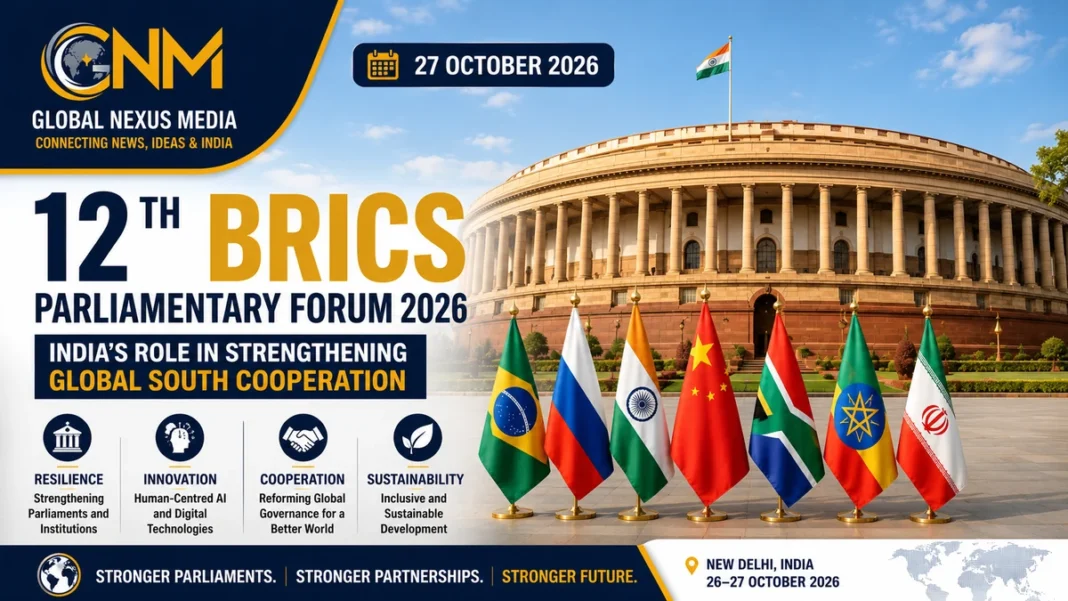
GNM UPSC Special | 27 October 2026
Why in News?
India hosted the 12th BRICS Parliamentary Forum on 26–27 October 2026 at the historic Central Hall of Samvidhan Sadan, Parliament House Complex, New Delhi. The forum was inaugurated by Lok Sabha Speaker Om Birla, and Prime Minister Narendra Modi interacted with parliamentary delegations from BRICS countries.
The central theme was “Strengthening Parliaments for People-Centric Development.” Discussions focused on institutional resilience, human-centred innovation, global governance reforms, and sustainable and inclusive development.
The event is significant for India’s parliamentary diplomacy and its efforts to amplify the concerns of the Global South through international cooperation. Official PIB report, 26 October 2026.
What Is the BRICS Parliamentary Forum?
The BRICS Parliamentary Forum provides a platform for parliamentary leaders and legislators from BRICS member and partner countries to discuss common challenges, exchange legislative practices and strengthen institutional cooperation.
It complements wider BRICS engagement, which includes political and security cooperation, economic and financial issues, and cultural and people-to-people exchanges.
Parliamentary diplomacy is distinct from executive diplomacy. Governments negotiate and implement foreign policy, while parliamentary engagement can encourage dialogue, share legislative experiences, build relationships among elected representatives and support public accountability.
The forum therefore offers an additional channel for cooperation among countries with different political systems, development priorities and international interests.
Key Highlights of the 12th BRICS Parliamentary Forum
According to official announcements from the Lok Sabha Secretariat, the forum was organised in New Delhi under India’s 2026 BRICS chairship.
Its central theme was “Strengthening Parliaments for People-Centric Development”, with deliberations structured around four interconnected pillars.
1. Resilience: Strengthening Institutions
This theme examined how parliaments can strengthen institutional capacity, accountability and continuity, particularly during periods of uncertainty and disruption.
For India, the discussion is relevant to legislative effectiveness, public trust, transparency and democratic oversight.
2. Innovation: Human-Centred AI and Digital Technologies
The forum addressed the role of parliaments in promoting human-centred innovation in artificial intelligence and digital technologies.
The key policy challenge is to encourage innovation while addressing data protection, algorithmic bias, unequal access to technology and accountability.
3. Cooperation: Reforming Global Governance
The forum highlighted parliamentary cooperation as a means of supporting a more representative system of global governance.
This issue matters to developing countries seeking a stronger voice in international decision-making, including debates over the representation and effectiveness of multilateral institutions.
4. Sustainability: Inclusive and Sustainable Development
The sustainability pillar focused on the role of parliaments in supporting a more inclusive future and balancing development with environmental stewardship.Brazil Election 2026: Lula Defeats Flávio Bolsonaro
For developing countries, the challenge is to expand employment, infrastructure, energy access and public services while addressing climate risks and protecting natural resources.
Official pre-event source: PIB — 12th BRICS Parliamentary Forum to be held on 26–27 October 2026.
Why Is the Forum Important for India?
1. Strengthening India’s Global South Leadership
The Global South broadly refers to developing countries across Asia, Africa, Latin America and other regions that share certain development concerns, although their interests are not identical.
These concerns include access to development finance, affordable technology, food and energy security, climate finance, public health and a stronger voice in global institutions.
India has sought to position itself as a partner and advocate for these priorities through multilateral engagement. Parliamentary cooperation provides another avenue for building consensus and exchanging policy experiences.
However, leadership requires more than convening meetings. It also depends on whether dialogue leads to practical cooperation and whether the interests of diverse developing countries are represented fairly.
2. Supporting Reform of Global Institutions
International institutions established in the aftermath of the Second World War face continuing debates over representation, effectiveness and legitimacy.
Developing countries have argued for reforms that better reflect contemporary economic and political realities.
Parliamentary dialogue can help build understanding of these concerns and encourage cooperation on reforms. Nevertheless, the BRICS Parliamentary Forum itself cannot independently change the rules of institutions such as the United Nations Security Council; such reforms require the relevant formal procedures and agreement of participating states.
3. Expanding India’s Parliamentary Diplomacy
India’s engagement with parliamentary delegations can complement government-to-government relations.
Regular exchanges among legislators may support cooperation on legislative practices, public administration, technology, youth participation and women’s representation.
The forum also provides opportunities for bilateral discussions alongside multilateral sessions.
4. Promoting Digital Governance and Responsible AI
Digital technologies are transforming public administration, financial services, education and access to government services.India AI Fellowship 2026: Students Can Get Up to ₹2 Lakh; Check Eligibility and Last Date
Cooperation among BRICS countries can facilitate the exchange of experiences in digital public infrastructure, responsible AI, digital inclusion and the protection of citizens’ rights.
India can contribute lessons from its own digital governance initiatives while learning from the different technological and regulatory approaches adopted by partner countries.
5. Connecting Development with Sustainability
Developing economies need infrastructure, industrial growth, jobs and reliable energy. At the same time, they face climate-related risks and pressure to use natural resources sustainably.
Parliaments can contribute by scrutinising public expenditure, examining legislation, reviewing policy implementation and holding governments accountable for development commitments.
The challenge is to ensure that sustainability policies support a fair transition and do not impose disproportionate costs on vulnerable communities.
BRICS and the Global South: Opportunities and Limitations
BRICS has become an important platform for cooperation among major emerging economies and other participating countries. Its expanding membership and partner engagement create opportunities for broader dialogue, but they also increase the complexity of consensus-building.
Opportunities
- A stronger collective voice: Cooperation can help developing countries articulate shared concerns in international forums.
- Knowledge-sharing: Members can exchange policy experiences in digital governance, public services, infrastructure and development.
- Economic cooperation: Wider BRICS engagement can support discussion on trade, investment and resilient supply chains.
- Institutional dialogue: Parliamentary exchanges can build relationships and improve understanding across different national systems.
- Sustainable development: Countries can discuss practical approaches to climate resilience, inclusive growth and access to technology.
Limitations
- Different national interests: BRICS members do not always agree on security, trade or geopolitical questions.
- Uneven economic capacities: Members have different financial resources, technological capabilities and development priorities.
- Consensus-building challenges: A broader grouping can make it more difficult to reach common positions.
- Implementation gaps: Declarations and discussions do not automatically translate into policies or measurable results.
- Questions of representation: The interests of smaller developing countries may not always align with those of larger emerging economies.
For India, the task is to build practical coalitions without assuming that every BRICS member shares identical strategic interests.
What Should India Focus on Going Forward?
India can strengthen the value of parliamentary cooperation by focusing on measurable and people-centred outcomes.
First, convert dialogue into practical cooperation. Exchanges should identify specific areas for legislative learning, capacity-building and policy collaboration.
Second, promote inclusive digital governance. Cooperation on AI and digital public infrastructure should address accessibility, privacy, cybersecurity and accountability.
Third, strengthen parliamentary capacity. Training, research support and exchanges of legislative best practices can help parliaments respond to complex policy challenges.
Fourth, keep development priorities central. Cooperation should reflect the needs of citizens, including employment, education, health, infrastructure and affordable technology.
Fifth, support a representative multilateral order. India can continue to advocate reforms through established international procedures and partnerships with other developing countries.
Finally, evaluate outcomes. The success of parliamentary diplomacy should be assessed through concrete follow-up measures rather than the number of meetings or statements alone.
Conclusion
The 12th BRICS Parliamentary Forum places parliamentary cooperation at the intersection of democratic institutions, innovation, global governance and sustainable development.
For India, the event provides an opportunity to strengthen international relationships and advance discussions on the concerns of the Global South. Its long-term value, however, will depend on whether dialogue produces meaningful cooperation and practical benefits for citizens.
For UPSC aspirants, the forum connects international relations with governance, institutional accountability, technology and sustainable development. It illustrates how parliamentary diplomacy can complement traditional foreign policy while highlighting the challenges of building consensus among diverse countries.
UPSC Syllabus Mapping
GS Paper II — International Relations
- Important international groupings and agreements involving India.
- India’s relations with developing countries.
- Multilateral institutions and the need for global governance reforms.
- Bilateral, regional and global groupings affecting India’s interests.
GS Paper II — Polity and Governance
- Parliament and democratic institutions.
- Accountability, transparency and institutional effectiveness.
- Parliamentary diplomacy and legislative cooperation.
GS Paper III — Science and Technology
- Artificial intelligence and digital technologies.
- Responsible innovation and digital inclusion.
GS Paper III — Environment
- Sustainable development.
- Balancing economic growth with environmental protection.
Essay Paper
- “Global cooperation must translate dialogue into development.”
- “Technology, democracy and inclusive growth in a changing world.”
Prelims Quick Revision
- BRICS: A multilateral grouping whose cooperation spans political, economic, financial and people-to-people issues.
- Parliamentary diplomacy: Engagement among legislatures and elected representatives to build dialogue and cooperation.
- Global South: A broad, diverse grouping of developing countries with overlapping but not identical development priorities.
- Multilateralism: Cooperation among three or more countries through dialogue, institutions or agreed frameworks.
- Sustainable development: Development that addresses present needs while protecting the ability of future generations to meet their own needs.
Prelims Practice Questions
Q1. Consider the following statements about parliamentary diplomacy:
- It can complement official government-to-government diplomacy.
- It can facilitate exchanges of legislative practices among countries.
- Parliamentary forums can independently amend the UN Charter without following its formal amendment procedure.
Which of the statements given above are correct?
(a) 1 only
(b) 1 and 2 only
(c) 2 and 3 only
(d) 1, 2 and 3
Answer: (b) 1 and 2 only
Explanation: Parliamentary diplomacy can complement official diplomacy and encourage legislative cooperation. Amendments to the UN Charter must follow the Charter’s formal procedures.
Q2. The 12th BRICS Parliamentary Forum held in October 2026 focused on which of the following themes?
(a) Maritime security and naval cooperation
(b) Strengthening Parliaments for People-Centric Development
(c) Establishing a common BRICS currency
(d) Creating a unified defence command
Answer: (b) Strengthening Parliaments for People-Centric Development
Explanation: This was the overarching theme announced by the Lok Sabha Secretariat.
Q3. Consider the following statements about the Global South:
- It is a diverse grouping rather than a single, uniform political bloc.
- All countries commonly described as part of the Global South have identical foreign-policy interests.
- Development finance, technology access and representation in global institutions are important concerns in Global South discussions.
Which of the statements given above are correct?
(a) 1 only
(b) 1 and 2 only
(c) 1 and 3 only
(d) 1, 2 and 3
Answer: (c) 1 and 3 only
Explanation: The Global South contains countries with diverse political systems, economic conditions and strategic interests. Shared development concerns do not mean that their national positions are identical.
Mains Practice Question
Q. “Parliamentary diplomacy can complement traditional diplomacy in advancing the interests of the Global South, but its effectiveness depends on translating dialogue into action.” Discuss with reference to the 12th BRICS Parliamentary Forum 2026. (150 words)
Model Answer
Parliamentary diplomacy enables legislators from different countries to exchange policy experiences, strengthen institutional relationships and discuss common challenges. It complements traditional diplomacy by creating additional channels for dialogue and cooperation.
The 12th BRICS Parliamentary Forum, hosted by India in October 2026, focused on people-centric development through institutional resilience, human-centred innovation, global governance cooperation and sustainability. These priorities align with the concerns of many developing countries regarding digital inclusion, development, environmental protection and fairer international representation.
For India, parliamentary engagement offers an opportunity to strengthen partnerships and amplify Global South concerns. It can also facilitate the exchange of legislative practices and experiences in public administration and technology.
However, differences in national interests, limited consensus and weak implementation can constrain outcomes. Parliamentary forums cannot substitute for formal intergovernmental negotiations or independently reform international institutions.
Their effectiveness therefore depends on clear follow-up mechanisms, practical cooperation, inclusive representation and measurable results. Parliamentary diplomacy is most valuable when it complements official foreign policy and converts shared concerns into tangible public benefits.
Official Sources and Further Reading
- Primary source — Lok Sabha Secretariat, 26 October 2026: Inauguration of the 12th BRICS Parliamentary Forum
- Pre-event announcement — 22 October 2026: Forum schedule, theme and four pillars
- BRICS New Delhi Declaration — 12 September 2026: Official text on resilience, innovation, cooperation and sustainability