

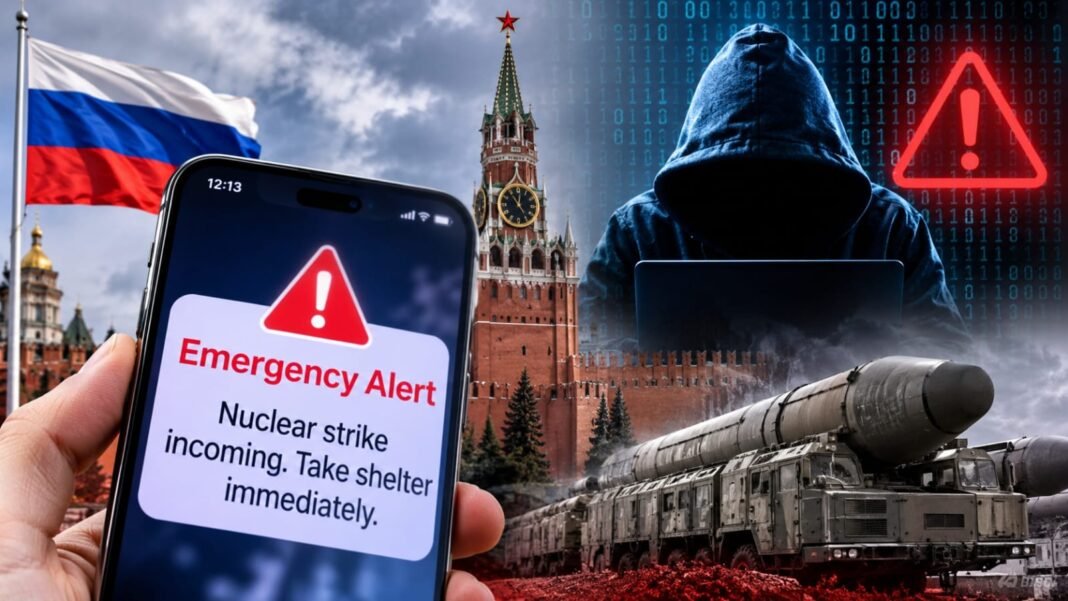
MOSCOW: Russia has reported a massive cyberattack on its Emergencies Ministry mobile application after hackers allegedly used the platform to circulate fake emergency warnings, including alarming messages about an incoming nuclear strike. The incident has raised fresh concerns about the security of digital emergency communication systems, particularly during periods of military tension.
Russia’s Emergencies Ministry confirmed on Monday, November 2, that its mobile application had been targeted in a major cyberattack, allowing attackers to distribute false information to the public. The ministry said specialists were working to address the vulnerability and restore the application’s normal functioning.
Fake Nuclear Threat Messages Circulated
According to reports from Russian media, the attackers sent messages claiming that nuclear warheads had been launched towards multiple Russian regions. Residents were reportedly urged to stock up on food and take shelter in basements.
The Russian newspaper Kommersant reported that similar messages appeared on regional emergency-management channels and the Emergencies Ministry’s communication platforms, including channels serving several Russian regions.
The cyberattack has also raised questions about the possibility of hackers exploiting official communication channels to spread panic during an international security crisis.
Russia has not publicly disclosed the full technical details of the breach, the number of people affected or the identity of those responsible.
Ukraine Also Reports Cyberattack on Emergency Alert App
The incident comes amid a separate cyberattack reported by Ukraine on November 1.
Ukraine’s Air Alert application reportedly displayed false notifications about nuclear and chemical threats, radiation hazards and street fighting in several regions.
Ukraine’s Air Force confirmed that the application had likely been compromised and specifically warned citizens that there was no radiation threat. The country’s authorities urged people to remain calm and follow official announcements.
The Ukrainian government also said that alternative warning channels, including air raid sirens, continued to function.
It remains unclear whether the attacks targeting Russian and Ukrainian emergency communication systems were connected.
What Does This Mean for India’s Emergency Alert System?
The incidents carry an important lesson for India, where mobile-based emergency communication is becoming an increasingly significant part of disaster management.
India launched its indigenous nationwide Cell Broadcast System (CBS) on May 2, 2026, developed by the Centre for Development of Telematics (C-DOT) in collaboration with the Department of Telecommunications, the National Disaster Management Authority (NDMA) and the Ministry of Home Affairs.
The system is integrated with NDMA’s SACHET Integrated Alert System, which distributes geographically targeted emergency warnings to mobile phones.
According to the Ministry of Communications, the technology enables authorities to send near-real-time alerts to mobile devices in specific geographical areas, including during network congestion. It supports multiple languages and mobile networks ranging from 2G to 5G.
The SACHET platform is designed to communicate warnings about natural and man-made emergencies, including cyclones, floods, earthquakes, lightning and industrial hazards.
The government has also stated that the system has been operationalised across all 36 States and Union Territories.
However, the Russian incident highlights an important cybersecurity question: how can authorities ensure that emergency messages reaching millions of people are authentic, protected against unauthorised access and verified before public distribution?
India’s emergency alert infrastructure and Russia’s hacked application are not identical systems, and there is no evidence that India’s platform has experienced a similar breach. Nevertheless, the incident underlines the importance of strengthening cybersecurity, access controls and verification mechanisms in public warning infrastructure.
Cybersecurity Becomes a Public Safety Issue
Emergency alert systems are designed to save lives by delivering accurate information at critical moments. However, if attackers gain access to these platforms, the same technology can potentially be exploited to create confusion, spread misinformation and undermine public confidence.
The Russia-Ukraine incidents demonstrate how cyber operations can extend beyond government websites and military networks to systems directly connected to ordinary citizens.
For India, strengthening digital security alongside disaster preparedness will remain essential as mobile-based warning systems become more widely used.
The central concern is no longer simply


