

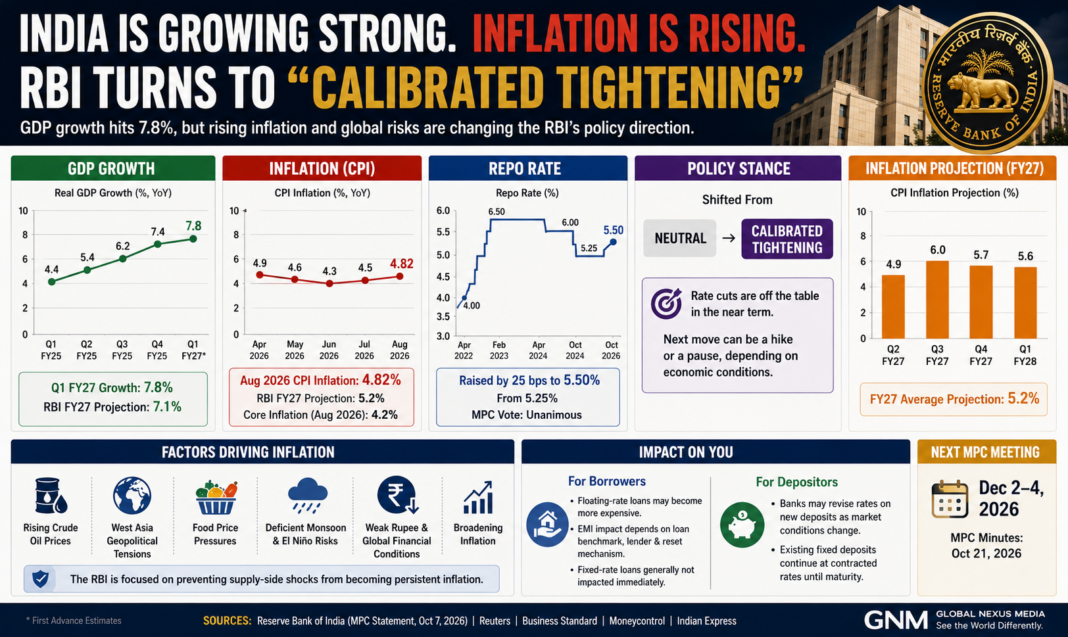
GDP growth has reached 7.8%, but rising inflation and global risks are changing the RBI’s policy direction. What does the 5.50% repo rate mean for borrowers, markets and India’s economy?
By Global Nexus Media | GNM Explains
October 7, 2026 | New Delhi
India’s economy is sending two very different signals at the same time.
On one side, growth remains strong. Real GDP grew 7.8% in Q1 FY27, supported by resilient consumption, investment and services activity.
On the other, inflation risks are becoming harder to ignore.
Consumer price inflation rose to 4.82% in August 2026, while the Reserve Bank of India now expects CPI inflation to average 5.2% in FY27.
That combination has changed the tone of India’s monetary policy.
On October 7, the RBI’s Monetary Policy Committee unanimously raised the policy repo rate by 25 basis points, from 5.25% to 5.50% — the first rate increase in nearly four years.
But the bigger message was not just the rate hike.
The RBI also shifted its policy stance from “neutral” to “calibrated tightening.”
And that could matter more for the months ahead.
RBI’s Message: Growth Is Strong, But Inflation Cannot Be Ignored
The October MPC meeting came against a backdrop of stronger-than-expected economic activity.
The RBI has raised its FY27 real GDP growth projection to 7.1%, up from its earlier estimate of 6.7%.
Quarter-wise, the RBI projects:
- Q2 FY27: 7.2%
- Q3 FY27: 6.9%
- Q4 FY27: 6.8%
- Q1 FY28: 7.1%
The immediate growth picture therefore does not look like an economy in trouble.
Instead, the central bank is dealing with a different problem: how to keep strong growth from being accompanied by persistent inflation.
Reuters reported that the RBI expects headline inflation to average almost 5.8% over the next three quarters, while the central bank has also raised its FY27 inflation fgnm-rbi-calibrated-tightening-explainer-october-2026.webp
Suggested caption:
GNM Explains: India’s 7.8% Q1 FY27 GDP growth, rising inflation, the 5.50% repo rate and the RBI’s shift to calibrated tightening.
Why Did the RBI Raise the Repo Rate?
The answer is not weak economic growth.
It is the opposite.
With growth holding up strongly, the RBI has greater room to focus on inflation without worrying that a small increase in borrowing costs will immediately push the economy into a slowdown.
At the same time, several risks are making the inflation outlook less comfortable.
1. Higher crude oil prices
India imports a large share of its crude oil requirements.
When global oil prices rise, the pressure can spread through transport, manufacturing, logistics and household expenses.
2. Geopolitical uncertainty
The continuing instability in West Asia is creating additional uncertainty for energy prices and global financial markets.
3. Weather and food prices
The RBI has also highlighted risks from an uneven monsoon and possible El Niño conditions.
Food inflation can quickly affect household inflation expectations.
4. Global financial conditions
Higher global bond yields and a stronger dollar can put pressure on emerging-market currencies, including the rupee.
5. Inflation expectations
The RBI is particularly concerned about temporary price shocks becoming persistent.
If households and businesses begin to expect prices to keep rising, companies may pass higher costs into prices and workers may demand higher wages.
That can make inflation harder to control.
What Does “Calibrated Tightening” Actually Mean?
This is the most important part of the October policy decision.
The RBI did not announce a fixed series of future rate hikes.
Instead, it moved from a neutral stance to calibrated tightening.
In simple terms, the RBI is saying:
Rate cuts are not the priority right now.
The next policy move could be another hike — or a pause — depending on how inflation, growth and other economic conditions develop.
Governor Sanjay Malhotra described the approach as a milder, more data-dependent form of tightening rather than a predetermined rate-hike cycle.
That distinction is important.
The RBI is not saying:
“Rates will keep rising.”
It is saying:
“Further easing is off the table for now, and future action will depend on the data.”
What Does the 5.50% Repo Rate Mean for You?
The repo rate is the rate at which the RBI lends short-term funds to banks.
When the policy rate changes, it can eventually influence lending and deposit rates across the financial system.
But the impact on every individual is not automatic or identical.
For Home Loan and Other Floating-Rate Borrowers
Floating-rate borrowers are the most exposed.
If a bank passes the increase through to its lending rate, borrowers could face:
- Higher interest rates
- Higher EMIs
- Or a longer repayment period
However, a 25-basis-point repo hike does not mean every borrower’s EMI automatically rises by exactly 25 basis points.
The actual impact depends on:
- The loan benchmark
- The lender
- The reset frequency
- The outstanding loan amount
- Remaining tenure
- The loan agreement
Fixed-rate borrowers
People with genuinely fixed-rate loans generally have less immediate exposure to a repo-rate change.
What About Fixed Deposits?
A repo-rate hike does not automatically change the interest rate on every FD.
For existing fixed deposits, the contracted rate generally continues until maturity.
For new deposits or deposits being renewed, banks may change rates depending on liquidity conditions, competition and their own funding requirements.
So depositors should not assume that every bank will immediately increase FD rates by 25 basis points.
What Happens to the Rupee?
Interest rates are also connected to currency markets.
A higher domestic interest rate can, in some circumstances, make rupee assets more attractive.
But the exchange rate is influenced by much more than the RBI repo rate.
Oil prices, foreign portfolio flows, the US dollar, global interest rates, trade conditions and geopolitical risks all matter.
On October 7, the rupee remained under pressure despite the RBI’s rate hike, with Reuters reporting the currency close to its record low.
That highlights an important point:
A rate hike alone cannot solve every currency problem.
What About the Stock Market?
Markets do not respond only to whether rates go up or down.
They also respond to what the decision tells investors about the future.
A tighter monetary-policy stance can put pressure on interest-rate-sensitive sectors such as:
- Real estate
- Automobiles
- Consumer finance
- Highly leveraged companies
At the same time, India’s strong economic growth can provide support to corporate earnings and investment.
That creates a complicated market picture:
Higher rates can hurt some sectors, while strong growth can support others.
The RBI’s Bigger Dilemma
The central bank is now walking a narrow line.
Tighten too much
If borrowing costs rise too aggressively, consumption and investment could weake
Businesses may delay expansion.
Households may postpone large purchases.
Tighten too little
If inflation becomes persistent, purchasing power can weaken and inflation expectations can become harder to control.
That is why the RBI is choosing the word “calibrated.”
The objective is not to crush growth.
It is to prevent temporary inflationary pressures from becoming a permanent feature of the economy.
India’s Growth Gives the RBI Some Breathing Room
This is perhaps the most interesting part of the October decision.
The RBI raised the interest rate while simultaneously raising its GDP growth forecast.
That is unusual compared with a traditional crisis-driven rate hike.
The message is clear:
The RBI currently sees India’s growth engine as strong enough to handle some additional monetary tightening.
Q1 FY27 growth of 7.8% provides the central bank with some confidence that a modest increase in borrowing costs will not necessarily derail the broader economy.
But that confidence depends on inflation remaining manageable.
What Should Borrowers Do Now?
For people with floating-rate loans, this is not necessarily a reason to panic.
But it is a good time to check the numbers.
Borrower checklist
1. Check your current interest rate.
2. Find out which benchmark your loan follows.
3. Check the next reset date.
4. Ask your lender whether the rate change will affect EMI or tenure.
5. Avoid taking on unnecessary high-cost debt.
6. If possible, maintain some additional repayment capacity.
The key is to prepare rather than react.
What Happens Next?
The next scheduled RBI Monetary Policy Committee meeting is December 2–4, 2026.
Until then, markets will watch:
- CPI inflation
- Food prices
- Crude oil
- The rupee
- Global interest rates
- Monsoon developments
- Domestic demand
- Credit growth
- Geopolitical developments
The RBI has left the door open.
The next move could be another hike.
It could also be a pause.
The data will decide.
GNM Analysis
India is entering a new phase of monetary policy.
The growth story remains strong.
But inflation has become the variable that policymakers cannot afford to underestimate.
The RBI’s October decision therefore sends two messages at once:
India’s economy is strong.
But the inflation outlook is no longer comfortable enough for easy monetary policy.
The shift to “calibrated tightening” is consequently more significant than the 25-basis-point hike alone.
It tells households, businesses and financial markets that the RBI is prepared to respond if inflation becomes more persistent.
But it also tells them that the central bank does not want to commit itself to a predetermined series of rate increases.
For ordinary Indians, the practical takeaway is simple:
Borrowing could become more expensive, inflation remains a key risk, but India’s underlying growth momentum is still strong.
The next few months will determine whether this is a short policy adjustment — or the beginning of a longer tightening cycle.
THE BOTTOM LINE
GDP growth: 7.8% in Q1 FY27
FY27 GDP forecast: 7.1%
August CPI inflation: 4.82%
FY27 CPI forecast: 5.2%
Repo rate: 5.50%
Rate hike: 25 basis points
Policy stance: Calibrated tightening
Next MPC meeting: December 2–4, 2026
The central question: Can India maintain strong growth while keeping inflation under control?
That is now the RBI’s biggest policy challenge.
Sources
Reserve Bank of India — Monetary Policy Committee, October 2026
Reuters — RBI policy decision and market reaction
Business Standard — Indian markets, bonds and monetary policy
Moneycontrol — RBI policy and economic implications
This article is for general information and analysis. It is not financial or investment advice.
© 2026 Global Nexus Media. All rights reserved.


