

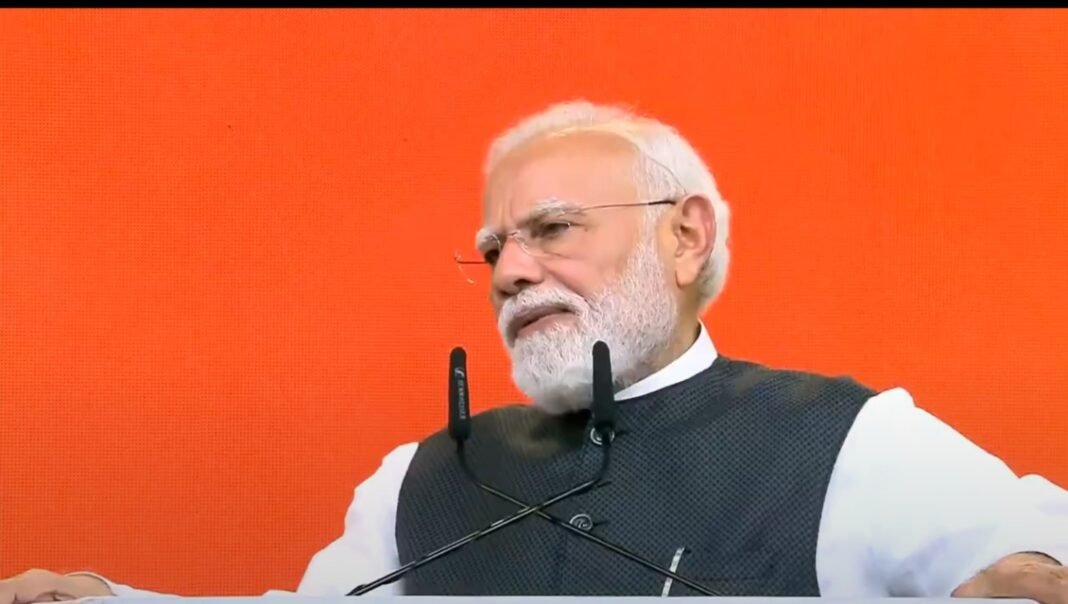
From becoming a top-three economy and global manufacturing hub to hosting the Olympics and taking India deeper into space, PM Modi sets an ambitious direction for Viksit Bharat 2047
By Global Nexus Media | New Delhi
October 7, 2026
Twenty-five years after Narendra Modi first took oath as the Chief Minister of Gujarat, his message on October 7 was not simply about looking back at a long political journey. It was about setting a new direction for India.

Addressing the Viksit Bharat Sankalp Sabha in New Delhi, Modi marked 25 years of continuous service as the head of a government and repeatedly returned to a simple phrase: “We Will Do It.”
The message came with a set of ambitious national goals — from making India a developed nation by 2047 and entering the world’s top three economies to becoming a global manufacturing hub, hosting the Olympics and expanding India’s presence in space. The Financial Express
The milestone therefore became bigger than an anniversary. It was presented as a roadmap for what India could attempt over the next two decades.
From October 7, 2001 to October 7, 2026
Modi’s continuous journey as the head of a government began on October 7, 2001, when he took oath as Gujarat Chief Minister.
He later moved to national politics and became Prime Minister in 2014. He has since served through three Lok Sabha election victories.
Reflecting on the 25-year milestone, Modi said he had never imagined reaching such a point when he first took oath in Gujarat. He described the journey as a result of the continued trust and support of the people rather than as a personal achievement. Moneycontrol
The Prime Minister also paid tribute to India’s democracy and Constitution while thanking citizens and grassroots workers who, he said, had supported his journey.
For a leader who has spent a quarter of a century at the helm of governments, the anniversary naturally carries political significance. But Modi used the occasion primarily to shift the conversation towards India’s next destination.
‘We Will Do It’: Six Goals for the India of 2047
The central message of the address was a series of six ambitions for India.
1. Viksit Bharat by 2047
The overarching goal remains Viksit Bharat — a developed India by 2047, the centenary year of Independence.
The target is not limited to GDP. A developed India would also require better infrastructure, stronger institutions, technological capability, quality education, healthcare, employment opportunities and a higher standard of living.
Modi’s message was built around the belief that India’s scale and demographic strength can be converted into national strength through sustained effort. The New Indian Express
2. India Among the World’s Top Three Economies
The second ambition is to place India among the world’s top three economies.
Achieving that position would require sustained economic growth, higher productivity, greater investment, stronger exports and the creation of millions of productive jobs.
For India, the challenge will be not merely to become larger economically, but to ensure that economic expansion creates opportunities across regions and sections of society.
3. Atmanirbhar Bharat
The third goal is Atmanirbhar Bharat — a more self-reliant India.
Self-reliance does not necessarily mean isolation from global markets. Instead, India’s challenge is to develop domestic capabilities in strategic sectors while remaining globally competitive.
From electronics and defence production to critical technologies, energy and advanced manufacturing, the coming years will test how far India can reduce vulnerabilities while becoming a stronger participant in global supply chains.
4. India as a Global Manufacturing Hub
Manufacturing is another major pillar of the vision.
India has a large workforce and one of the world’s biggest consumer markets. The ambition is to convert those advantages into a stronger manufacturing ecosystem capable of attracting investment, creating employment and increasing exports.
Becoming a global manufacturing hub, however, will depend on skills, infrastructure, logistics, technology, reliable supply chains and the ease of doing business.
The target is therefore not simply to manufacture more in India — but to manufacture products that can compete globally.
5. Hosting the Olympics
Another ambitious target is bringing the Olympic Games to India.
India has expressed interest in hosting the 2036 Olympics, although the country is not the confirmed host for those Games.
The Olympic ambition represents something larger than sport. Hosting the world’s biggest sporting event would require world-class sporting infrastructure, athletes, training systems, logistics and urban infrastructure.
For a country of India’s size, it would also be an opportunity to showcase its organisational and technological capabilities to the world.
6. Stepping Further Into Space
The sixth ambition is India’s growing space journey.
India’s space programme has already moved from satellite launches to more ambitious missions, and the country’s human-spaceflight programme is an important part of the next phase.
Modi’s call to take India’s footsteps further into space reflects a broader ambition: to make India a major space power with stronger capabilities in science, technology, exploration and human spaceflight. The Financial Express

The Power of a Simple Phrase
“We Will Do It.”
The phrase may sound simple, but its political and national messaging is clear.
It changes the language of development from whether India can do something to how India will do it.
Modi used the phrase repeatedly while listing the country’s targets, including Viksit Bharat 2047, a top-three economy, Atmanirbhar Bharat, global manufacturing, the Olympics and space. The audience also joined in the refrain. The Financial Express
But confidence alone cannot deliver these objectives.
India will need factories, laboratories, universities, skilled workers, entrepreneurs, scientists, athletes, infrastructure and globally competitive companies.
And above all, it will require consistency.
From Political Milestone to National Challenge
The significance of October 7, 2026 lies partly in the unusual length of Modi’s continuous tenure as the head of government.
But the more important question is what happens next.
A top-three economy requires sustained growth.
A manufacturing hub requires skills and competitive infrastructure.
Atmanirbhar Bharat requires innovation and globally competitive Indian companies.
An Olympic ambition requires a deep sporting ecosystem.
A stronger space programme requires long-term scientific investment.
And Viksit Bharat ultimately has to be visible not only in economic statistics, but in the everyday lives of India’s citizens.
That is where the real test of the 2047 vision will lie.
Seva Jyoti: A Political Anniversary Becomes a Public Campaign
Across India, programmes were also organised to mark the milestone.
The Seva Jyoti Yatra was organised in districts across Gujarat, while similar programmes were held elsewhere as part of the commemorative campaign. News on Air
In Uttar Pradesh, Chief Minister Yogi Adityanath addressed a Seva Jyoti Yatra–Viksit Bharat Sankalp Sabha in Lucknow, where citizens participated in the programme and a collective pledge linked the event to the Viksit Bharat vision. News on Air
The public participation gave the anniversary a wider political and organisational dimension — turning a personal milestone in Modi’s political career into a campaign centred on India’s long-term national goals.
India’s Next Chapter
From a Global South perspective, India’s ambitions matter beyond India’s borders.
If India becomes one of the world’s largest economies, strengthens its manufacturing base, expands its technological capabilities and develops greater capacity in space and other strategic sectors, the consequences will extend across the Global South and the wider international system.
India’s rise is therefore not only an economic story.
It is also a story about how a major developing country seeks to define its own place in a changing world.
The central question is no longer whether India has the ambition.
The question is whether India can convert that ambition into measurable outcomes.
25 Years Completed. 21 Years to 2047.
On October 7, 2001, Narendra Modi began his journey as Gujarat’s Chief Minister.
On October 7, 2026, he marked 25 years at the head of government.
The next milestone he repeatedly points towards is 2047.
That leaves roughly two decades for India to attempt one of the most ambitious transformations in its modern history.
The political anniversary belongs to one leader.
But the 2047 mission, if achieved, will belong to an entire generation of Indians.
“We Will Do It” is therefore not only a slogan. It is a challenge — to governments, businesses, scientists, entrepreneurs, students, workers and citizens.
The answer will ultimately be written not in speeches, but in India’s factories, classrooms, laboratories, farms, cities, villages and institutions.
GNM VIEW
India’s next chapter cannot be built by governments alone.
It has to be built by Indians.
The vision of Viksit Bharat 2047 is larger than any individual leader or political party. Its ultimate measure will be whether India’s economic rise translates into opportunity, dignity, technological strength, better public services and a stronger position for India in the world.
For a country representing a major voice of the Global South, the journey towards 2047 will be watched far beyond its borders.
From India, Seeing the World Through a Global South Lens.


