

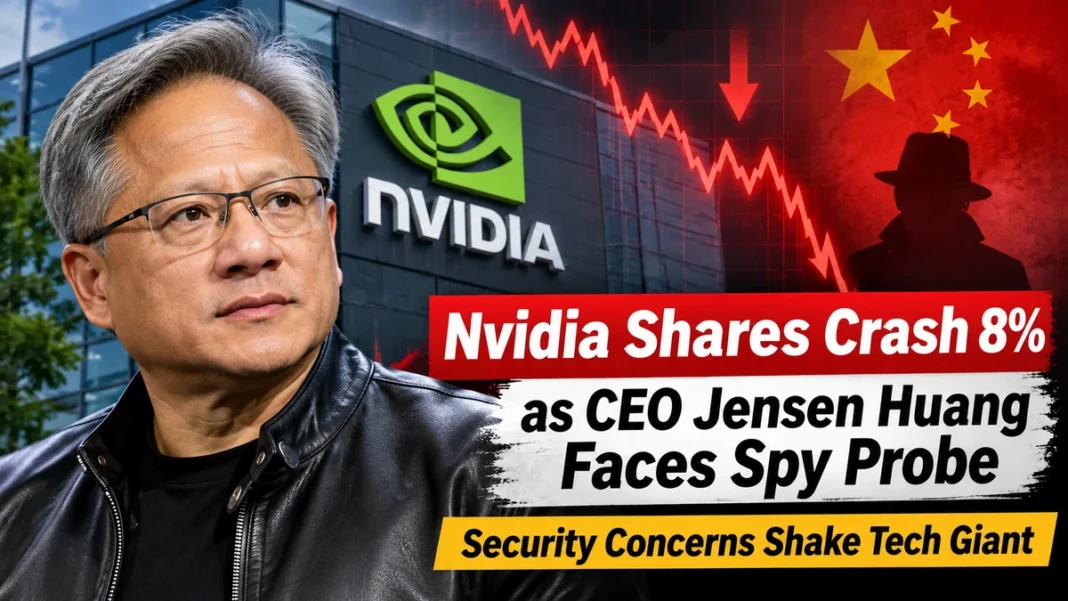
Shares of Nvidia, the world’s leading artificial intelligence chipmaker, fell sharply on Monday after the company announced an independent investigation into reports that its founder and chief executive officer, Jensen Huang, had been targeted by a suspected Chinese intelligence operation.
The investigation follows reports about Huang’s alleged relationship with Alice Huang, a former executive of Singapore-based technology company Megaspeed, who was reportedly identified by US intelligence authorities as a possible Chinese intelligence asset.
The controversy has raised concerns about potential national security implications and corporate governance at one of the world’s most influential technology companies. It has also placed renewed attention on the growing technological rivalry between Washington and Beijing.
According to market reports, Nvidia shares declined by approximately 8% during Monday’s trading, with the company’s market valuation potentially losing hundreds of billions of dollars. The fall came as investors assessed the possible implications of the investigation for the company’s leadership and business operations.
Nvidia Board Announces Independent Investigation
On November 8, Nvidia’s board of directors announced that it would initiate an independent investigation following reports that Huang had been the target of a foreign intelligence effort.
The investigation will be supervised by a committee of independent directors, supported by external legal counsel. The board said the review would examine all available information surrounding the allegations.
In its official statement, Nvidia emphasised that it had no reason to believe that national security or confidential company information had been compromised.
The board also expressed confidence in Huang and his leadership team, adding that the chief executive fully supported the investigation and had agreed to cooperate.
The announcement is significant because Huang has been central to Nvidia’s growth and its position in the global AI industry. His leadership has helped transform the company from a graphics processing unit manufacturer into a major supplier of advanced chips used in artificial intelligence systems and data centres.
Nvidia also confirmed that the investigation would not immediately interrupt Huang’s leadership responsibilities.
Jensen Huang Acknowledges Personal Relationship
The controversy intensified after reports emerged about Huang’s relationship with Alice Huang, a former executive associated with Megaspeed, a Singapore-based company operating in the data-centre and technology sector.
According to media reports, US intelligence authorities suspected Alice Huang of having connections with Chinese intelligence services and gathering information for Beijing.
Jensen Huang reportedly acknowledged having an intimate relationship outside his marriage in a message circulated among Nvidia employees. He apologised to his family, colleagues and the company, admitting that his actions had fallen short of his responsibilities.
However, the reported relationship has raised questions beyond Huang’s personal life because of Nvidia’s strategic importance in the global semiconductor industry.
The company’s advanced processors are essential to the development and operation of sophisticated AI models. Consequently, any potential compromise involving its leadership or sensitive business information could have implications extending beyond the company itself.
Importantly, the allegations of espionage have not been publicly established as proven facts, and Nvidia has said it has no reason to believe its secrets were compromised.
Nvidia Stock Suffers Sharp Decline Amid Investor Concerns
The controversy triggered a significant reaction in financial markets. Nvidia shares fell approximately 8% on Monday, extending the pressure on the company’s stock following an earlier decline in technology shares.
According to Reuters, the fall potentially wiped out around $350 billion in Nvidia’s market value, highlighting the scale of investor concern surrounding the allegations.
Investors are particularly concerned about the possibility of leadership uncertainty at Nvidia. Huang is widely regarded as one of the most influential figures in the global technology industry, and his leadership has been closely associated with the company’s extraordinary growth during the AI boom.
Market analysts have warned that a prolonged investigation could create uncertainty around Nvidia’s future investment decisions, product launches and business relationships.
However, analysts have also pointed out that Nvidia’s technological position remains difficult for competitors to challenge in the short term. Its processors continue to play a central role in the global expansion of artificial intelligence infrastructure.
The investigation has therefore created a distinction between concerns about the company’s leadership and the underlying demand for its products.
China Rejects Espionage Allegations
China has strongly rejected reports linking its intelligence agencies to an alleged operation involving Nvidia’s chief executive.
Chinese Foreign Ministry spokesperson Guo Jiakun dismissed the allegations, describing the claims as unsubstantiated and an attempt to smear China.
Beijing’s response comes at a time when Washington and Beijing are engaged in an increasingly intense competition over advanced semiconductors and artificial intelligence technologies.
The United States has introduced restrictions on exports of advanced AI chips to China, citing national security concerns and the potential military applications of sophisticated computing technology.
Nvidia has been at the centre of this debate because of its dominant position in the AI chip market and its commercial interests in international markets.
The latest controversy could further intensify scrutiny of the company’s dealings with Chinese businesses and its compliance with US export restrictions.
Donald Trump Responds to the Controversy
US President Donald Trump also commented on the allegations, saying that he had not spoken directly with Huang about the matter.
Trump described the Nvidia chief as an honourable person and expressed hope that the situation would be resolved.
The controversy has attracted additional attention because of Huang’s relationship with the US administration and his involvement in discussions concerning America’s AI leadership.
The reported intelligence concerns have also raised questions about how the US government handles information involving influential technology executives and potential threats to national security.
With Nvidia playing a critical role in America’s technological competitiveness, the investigation could become an important issue for policymakers as well as investors.
What the Investigation Could Mean for the Global AI Industry
The developments surrounding Nvidia come at a particularly sensitive moment for the global artificial intelligence industry. The company supplies advanced processors to major technology firms and data-centre operators worldwide, making it an important part of the AI infrastructure ecosystem.
Any prolonged uncertainty surrounding its leadership could influence investor confidence and create temporary disruptions in business planning.
The situation also highlights the growing intersection between corporate leadership, international intelligence and technological competition. As AI becomes increasingly important to economic growth and national security, technology companies are facing greater scrutiny over their international relationships and access to sensitive information.
For now, Nvidia’s board has expressed confidence in Huang, and there has been no official announcement of a leadership change. The investigation will determine whether the reported intelligence concerns have any implications for the company’s operations or security.
The outcome could have consequences not only for Nvidia but also for the broader semiconductor industry and the ongoing technological rivalry between the United States and China.