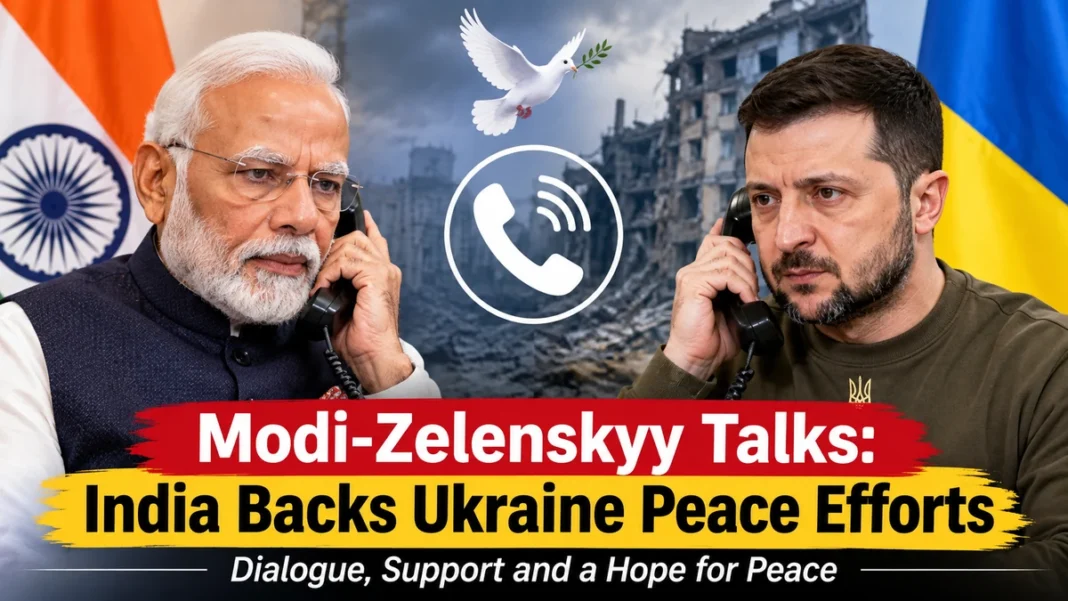
.Prime Minister Narendra Modi held a telephone conversation with Ukrainian President Volodymyr Zelenskyy on Monday, November 9, 2026, to discuss the ongoing Russia-Ukraine conflict and diplomatic efforts to restore peace. During the conversation, Modi reiterated India’s commitment to resolving the conflict through dialogue and diplomacy and expressed New Delhi’s willingness to contribute to international peace efforts.
According to an official statement from the Prime Minister’s Office (PMO), Zelenskyy shared his assessment of recent developments in the conflict. Modi reaffirmed India’s human-centric approach and stressed that the war must be resolved through peaceful negotiations rather than continued military confrontation.
The two leaders also discussed opportunities to expand India-Ukraine cooperation across various sectors, highlighting the importance of maintaining bilateral engagement despite the ongoing geopolitical crisis.
Modi Reaffirms India’s Position on Russia-Ukraine Conflict
India has consistently advocated dialogue and diplomacy as the preferred means of resolving the Russia-Ukraine conflict. During Monday’s conversation, Modi reiterated this position and conveyed India’s readiness to contribute to all efforts aimed at achieving a peaceful settlement.
In a post on X, Modi described his conversation with Zelenskyy as productive. He said the two leaders reviewed their wide-ranging bilateral cooperation and agreed to strengthen relations further.
The Prime Minister also thanked the Ukrainian President for sharing his perspectives on the ongoing conflict, its humanitarian consequences and various initiatives aimed at restoring peace.
India has maintained diplomatic engagement with both Moscow and Kyiv since the conflict began in February 2022. While New Delhi has continued its strategic partnership with Russia, it has also emphasised respect for dialogue, diplomacy and the importance of ending hostilities.
India’s position reflects its effort to maintain constructive relations with both sides while supporting initiatives that could reduce the humanitarian and economic consequences of the war.
Zelenskyy Briefs Modi Ahead of Abu Dhabi Peace Talks
The telephone conversation assumes particular significance as Ukraine prepares for another round of diplomatic discussions involving Russia, Ukraine and the United States in Abu Dhabi, scheduled for November 10 and 11.
According to Zelenskyy’s statement following the conversation, he briefed Modi on the latest diplomatic developments and Ukraine’s preparations for the upcoming meeting.
The Ukrainian President emphasised that Kyiv was approaching the negotiations constructively and expected Russia to demonstrate a similar willingness to de-escalate tensions.
Zelenskyy also acknowledged Modi’s repeated calls for an end to the war, including his direct discussions with Russian President Vladimir Putin.
He stressed that India could play a constructive role by identifying possible diplomatic steps and engaging with other international leaders to bring the conflict closer to an end.
The upcoming discussions in Abu Dhabi are expected to provide another opportunity to explore diplomatic solutions after previous rounds of negotiations failed to produce a comprehensive settlement.
Black Sea Grain Exports and Food Security Also Discussed
An important aspect of the conversation was the issue of food security and restrictions affecting grain exports through the Black Sea.
According to Zelenskyy’s account, the two leaders discussed the disruption of grain shipments and the wider consequences of blocked maritime routes for the global economy.
Ukraine is an important agricultural exporter, particularly of wheat, maize and other essential food commodities. Disruptions to its exports have affected international agricultural markets and raised concerns about food availability, particularly in countries dependent on imports.
Zelenskyy said India was ready to mediate efforts to establish food corridors and expressed Ukraine’s expectation of continued Indian support in this regard.
He also highlighted that restrictions on maritime trade have consequences extending beyond the countries directly involved in the conflict, affecting food supplies and economies across the world.
However, the Indian government’s official statement on the telephone conversation did not specifically mention an agreement on establishing food corridors. This detail was conveyed separately in the Ukrainian President’s account.
India-Ukraine Relations Remain an Important Part of the Discussion
Apart from the conflict, Modi and Zelenskyy discussed measures to strengthen bilateral cooperation across different sectors.
India and Ukraine have maintained diplomatic and economic relations for decades, with cooperation extending to areas including pharmaceuticals, agriculture, education, technology and trade.
Despite the geopolitical challenges created by the war, both countries have expressed interest in maintaining their partnership and exploring further opportunities for cooperation.
The latest conversation reflects India’s continued engagement with Ukraine while preserving its broader diplomatic relationships.
India has also been engaging with several international partners on issues connected to the conflict, including the safety of civilian shipping, the restoration of grain exports through the Black Sea and the protection of energy infrastructure.
External Affairs Minister S. Jaishankar has previously highlighted these issues as areas where diplomatic engagement could help reduce the wider consequences of the conflict.
India’s Diplomatic Role in the Search for Peace
The latest Modi-Zelenskyy conversation highlights India’s continuing efforts to support a peaceful resolution of the Russia-Ukraine war.
New Delhi’s diplomatic approach involves maintaining communication with both Russia and Ukraine while advocating negotiations and a reduction in hostilities.
With renewed peace discussions scheduled in Abu Dhabi, India’s engagement could become particularly significant in addressing humanitarian concerns, food security and the wider economic consequences of the conflict.
Although the latest conversation has not produced an announced peace agreement or ceasefire, it demonstrates continued diplomatic engagement at the highest political level.
The success of the upcoming negotiations will depend on whether the parties involved can find common ground on security concerns, de-escalation and the conditions required for a lasting settlement.
For India, the priority remains encouraging dialogue, protecting humanitarian interests and supporting international efforts to bring an end to the prolonged conflict.