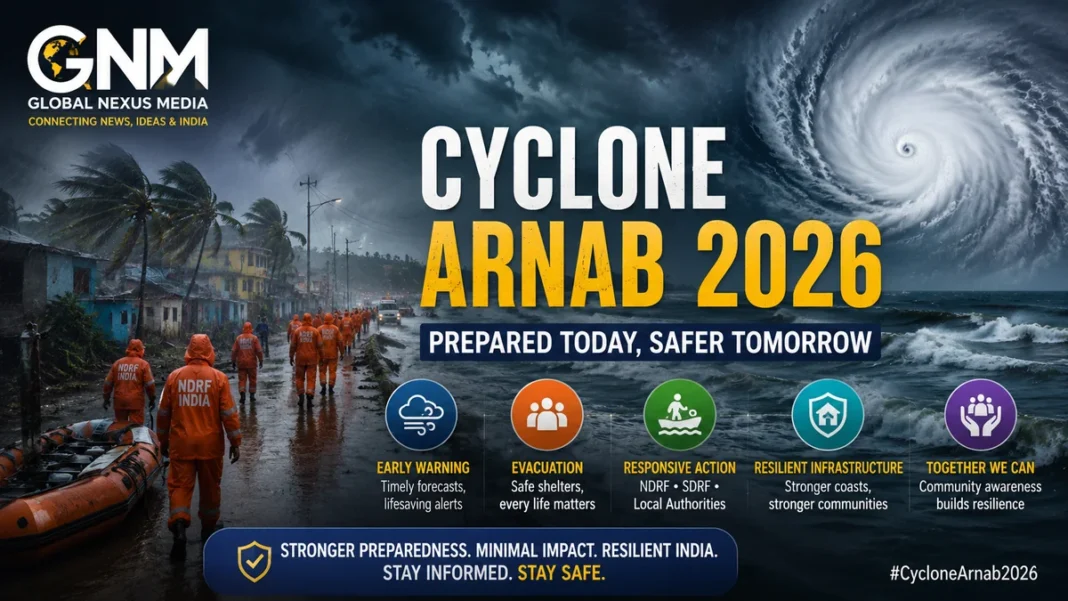
GNM UPSC Special | Current Affairs | 28 October 2026
Why in the News?
Very Severe Cyclonic Storm Arnab is affecting India’s eastern coastline, with the India Meteorological Department (IMD) reporting that the landfall process began early on 28 October along the Andhra Pradesh coast. The system was forecast to cross the coast between Bapatla and Visakhapatnam, near Yanam, with maximum sustained winds of around 125–135 km/h and gusts reaching 150 km/h.
Authorities in Andhra Pradesh and Odisha have undertaken evacuations and other precautionary measures. The National Crisis Management Committee (NCMC) reviewed preparedness, while the Ministry of Civil Aviation assessed the potential impact on airport and flight operations.
Important: Cyclone-related conditions and official warnings can change rapidly. Readers should consult the latest IMD bulletins and state disaster management advisories for the current situation.
What Is Cyclone Arnab?
A tropical cyclone is an intense low-pressure weather system that develops over warm tropical oceans. It can bring destructive winds, heavy rainfall, coastal flooding and storm surges.
Cyclone Arnab developed over the Bay of Bengal and intensified into a very severe cyclonic storm, according to official meteorological updates.Cyclone Arnab Threatens Andhra Coast as Four States Prepare for Severe Weather
Major threats associated with the cyclone
- High-speed winds: Damage to houses, electricity infrastructure, trees, communication networks and transport
- Heavy to extremely heavy rainfall: Flash floods, waterlogging and river flooding.
- Storm surge: An abnormal rise in sea level that can inundate low-lying coastal areas.
- Disruption of essential services: Possible interruption of power, transport, aviation, communications and healthcare.
- Secondary risks: Landslides in vulnerable areas, contamination of drinking water and damage to agriculture and fisheries.
A cyclone’s impact depends not only on wind speed but also on its track, forward speed, rainfall, coastal geography, population exposure and the quality of local preparedness.
India’s Response: Key Developments
1. Early warnings and coordination
The IMD monitored the storm and issued forecasts and warnings. The National Crisis Management Committee reviewed preparedness and coordination among relevant authorities.
Timely, understandable warnings give local administrations and communities more time to evacuate, secure property and prepare emergency services.
2. Evacuation and shelter arrangements
Reports on 28 October indicated large-scale evacuations in vulnerable areas of Andhra Pradesh and Odisha. Authorities also arranged shelters and deployed emergency personnel.
Evacuation is most effective when shelters are accessible to older people, persons with disabilities, pregnant women, children and people without private transport.
3. Protection of transport and critical infrastructure
The Ministry of Civil Aviation reviewed operational readiness as the cyclone threatened coastal aviation services. Airport operations and flight schedules may be affected by severe weather.
Electricity networks, telecommunications, roads, ports, hospitals and drinking-water systems also require advance protection and contingency planning.
4. Inter-agency coordination
Cyclone response requires cooperation between the Union government, state governments, district administrations, meteorological agencies, disaster-response forces, police, health services and local communities.
The key objective is to convert weather forecasts into timely action on the ground.Odisha Cyclone Alert:
How Does India Manage Cyclone Disasters?
India’s disaster management system operates through several institutions and stages.
| Institution | Main role |
|---|---|
| India Meteorological Department (IMD) | Cyclone monitoring, forecasting and weather warnings |
| National Disaster Management Authority (NDMA) | National disaster management policies and guidelines |
| National Disaster Response Force (NDRF) | Specialised response, rescue and relief operations |
| National Crisis Management Committee (NCMC) | High-level coordination during major crises |
| State Disaster Management Authorities | State-level planning and coordination |
| District administrations | Evacuation, local implementation, shelters and relief |
| Indian National Centre for Ocean Information Services (INCOIS) | Ocean information, including tsunami and storm-surge-related services within its mandate |
The Disaster Management Act, 2005, provides the principal statutory framework for disaster management in India.
India’s cyclone preparedness has developed through improved forecasting, communications, evacuation planning, community awareness and institutional coordination. However, preparedness must be assessed through outcomes—including lives protected, evacuation coverage, infrastructure resilience and the speed of recovery.
Why Is Early Warning So Important?
A forecast alone cannot prevent a disaster. It must reach the right people in time and be followed by practical action.
An effective early-warning system includes four connected elements:
- Risk knowledge: Identifying vulnerable communities, infrastructure and evacuation routes.
- Monitoring and forecasting: Detecting the hazard and estimating its likely track and intensity.
- Communication: Sending timely and understandable warnings through multiple channels.
- Response capability: Ensuring that people can evacuate, reach shelters and obtain emergency assistance.
A gap in any one of these elements can increase losses. For example, a warning may be scientifically accurate but ineffective if remote communities receive it late or lack safe transport.
Key Challenges in Cyclone Management
Coastal vulnerability
Low-lying settlements, informal housing and densely populated coastal areas face greater exposure to storm surges and flooding.
Infrastructure resilience
Power lines, roads, ports, communication systems and public buildings may be damaged even when evacuation is successful.
Last-mile communication
Fishers, remote villages, migrant workers and people with limited digital access may not receive or understand warnings in time.
Livelihood losses
Agriculture, fisheries, tourism and small businesses can suffer significant damage. Recovery support must address both immediate relief and long-term livelihoods.
Urban flooding and drainage
Heavy rainfall can overwhelm drainage systems, especially where wetlands and natural drainage channels have been degraded.
Disaster risk reduction and climate adaptation
Long-term planning must account for coastal erosion, sea-level rise, changing exposure patterns and the need to avoid construction in high-risk zones.
Way Forward
India can strengthen cyclone resilience through the following measures:
- Improve last-mile warnings: Combine mobile alerts, local-language announcements, radio, television and community networks.
- Strengthen resilient infrastructure: Apply hazard-sensitive standards to homes, hospitals, schools, power systems and communication networks.
- Expand community preparedness: Conduct regular evacuation drills and involve local governments, self-help groups, fishers and civil-society organisations.
- Protect vulnerable groups: Provide accessible shelters, transport and essential medicines, and make arrangements for people with special needs.
- Use science and technology: Integrate satellite observations, Doppler weather radar, GIS-based vulnerability mapping and reliable forecasting models.
- Build resilient livelihoods: Improve crop insurance, fisheries support, emergency credit and transparent compensation mechanisms.
- Restore natural buffers: Protect mangroves, wetlands, dunes and other coastal ecosystems where ecologically appropriate.
- Strengthen recovery planning: Assess damage quickly, restore essential services and rebuild infrastructure to reduce future risks.
Conclusion
Cyclone Arnab highlights the importance of combining accurate forecasting with effective administration, community participation and resilient infrastructure. India’s disaster management success should not be judged solely by the number of warnings issued or personnel deployed, but by whether people receive timely assistance, avoid preventable harm and recover sustainably.
For India, the long-term priority is to move from disaster response towards anticipatory action, risk reduction and resilient development.
UPSC Special: Exam-Ready Notes
Syllabus Mapping
- GS Paper III: Disaster management; infrastructure; environmental risks and resilience.
- GS Paper II: Government policies, institutions and coordination between different levels of government.
- Essay: Climate change, sustainable development, technology and human security.
Quick Revision
- Cyclone: An intense low-pressure system developing over warm tropical oceans.
- IMD: India’s principal agency for meteorological monitoring and cyclone warnings.
- NDMA: National-level disaster management policy and guidelines.
- NDRF: Specialised disaster response and rescue.
- NCMC: High-level coordination for major crises.
- Disaster Management Act: Enacted in 2005.
- Early warning: Effective only when monitoring, communication and response capacity work together.
- Disaster risk reduction: Measures to prevent new risk, reduce existing risk and manage residual risk.
Prelims Practice Questions
Q1. Consider the following statements about tropical cyclones:
- They are associated with intense low pressure.
- They can cause storm surges along coastal areas.
- Accurate forecasting alone guarantees that disaster losses will be avoided.
Which of the statements given above are correct?
A. 1 only
B. 1 and 2 only
C. 2 and 3 only
D. 1, 2 and 3
Answer: B — 1 and 2 only.
Explanation: Forecasting is crucial, but effective communication, evacuation, infrastructure and response capacity are also necessary to reduce losses.
Q2. Which of the following is the principal statutory framework for disaster management in India?
A. Environment (Protection) Act, 1986
B. Disaster Management Act, 2005
C. National Green Tribunal Act, 2010
D. Epidemic Diseases Act, 1897
Answer: B — Disaster Management Act, 2005.
Explanation: The Act provides the legal and institutional framework for disaster management in India.
Q3. Consider the following pairs:
- IMD — Meteorological forecasts and cyclone warnings
- NDRF — Specialised disaster response
- NDMA — National disaster management policy and guidelines
Which of the pairs given above are correctly matched?
A. 1 only
B. 1 and 2 only
C. 2 and 3 only
D. 1, 2 and 3
Answer: D — 1, 2 and 3.
Explanation: Each institution has a distinct role in India’s disaster management framework.
Mains Practice
Question (GS Paper III): “Effective disaster management requires more than accurate forecasting; it requires preparedness, coordination and resilient infrastructure.” Discuss with reference to cyclone management in India. (150 words)
Model Answer
Accurate forecasting is essential for reducing cyclone-related losses, but it cannot independently prevent disasters. Effective management requires a complete system that connects early warnings with timely action.
The India Meteorological Department monitors cyclones and issues forecasts. Institutions such as the National Disaster Management Authority, National Disaster Response Force, state authorities and district administrations contribute to planning, coordination, evacuation, rescue and relief. Cyclone Arnab’s impact on the eastern coast highlights the importance of preparedness and inter-agency coordination.
However, challenges remain. Vulnerable coastal settlements, inadequate last-mile communication, fragile infrastructure, urban flooding and livelihood losses can increase disaster risks. People without safe transport or accessible shelters may be unable to respond effectively to warnings.
India should strengthen local-language alerts, evacuation drills, cyclone-resilient infrastructure, ecosystem protection and post-disaster recovery systems. Vulnerable communities must be included in planning.
Conclusion: A disaster-resilient India requires a shift from reactive relief to anticipatory action, risk reduction and resilient development.
Sources and Verification
- Press Information Bureau, 26 October 2026: National Crisis Management Committee reviews cyclone preparedness
- Press Information Bureau, 27 October 2026: Ministry of Civil Aviation reviews Cyclone Arnab situation and operational readiness
- India Meteorological Department: Official press-release page
- Hindustan Times, 28 October 2026: Cyclone Arnab live updates
Editorial note: Cyclone conditions and official assessments remain time-sensitive. Update the article with the latest IMD bulletin and verified damage or casualty figures before republishing any subsequent developments.