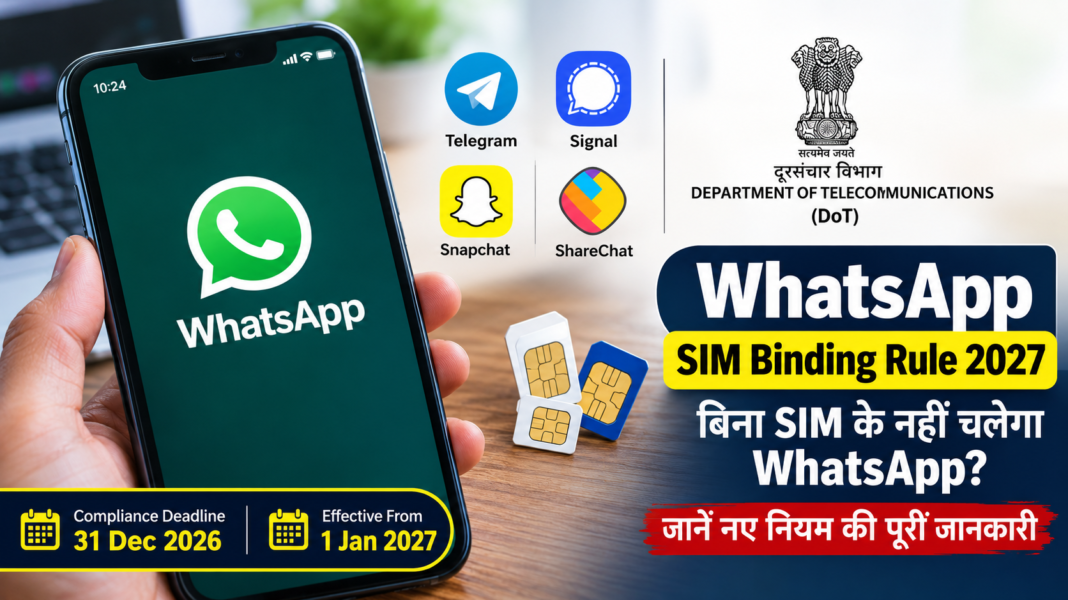
India’s Department of Telecommunications has issued SIM Binding directions for app-based communication services, including WhatsApp and other messaging platforms. Companies have been given until December 31, 2026, to comply with the requirements. The move aims to reduce the misuse of mobile numbers in cybercrime. Here is what the new framework means, which apps could be affected, and what users should know before January 1, 2027.
WhatsApp SIM Binding Rule 2027: What Users Need to Know
WhatsApp users in India may need to pay closer attention to the SIM card linked to their accounts as the government moves to strengthen mobile-number verification for messaging services.
The Department of Telecommunications (DoT) has introduced directions requiring covered app-based communication services to maintain a prescribed connection between an account and the SIM associated with its registered mobile number. The companies have been given until December 31, 2026, to comply with the requirements.
The development has raised concerns about whether WhatsApp will stop working on phones without a SIM card from January 1, 2027. However, the issue requires careful understanding. The compliance deadline does not, by itself, establish that every WhatsApp account will automatically stop working on that date. The actual impact will depend on the applicable requirements and how the service implements them.
What Is the SIM Binding Rule?
SIM binding is a system designed to connect a messaging account with the SIM card associated with the mobile number used to register that account.
For example, a user may create a WhatsApp account using an Indian mobile number and then continue using the account over Wi-Fi. In some situations, users can also access their accounts on linked devices even when the registered SIM is not present in the device being used.
The SIM Binding framework is intended to strengthen the connection between the registered number and the associated SIM. Covered services must implement the prescribed requirements rather than allowing account access to operate without the required SIM association.
The exact effect on individual users will depend on the technical implementation and the applicable rules for each service.
When Will the New Rule Be Implemented?
The DoT issued directions concerning SIM binding for app-based communication services on November 28, 2025. Companies were initially given 90 days to comply. The deadline was later extended to December 31, 2026.
The key dates are:
- November 28, 2025: SIM Binding directions were issued.
- December 31, 2026: Extended compliance deadline for the covered companies.
- January 1, 2027: The first day after the stated deadline, when the compliant framework is expected to be in place.
Users should understand the difference between a compliance deadline and a confirmed date for a particular feature to stop working. The deadline requires companies to meet the applicable directions; it does not necessarily mean every user will experience an immediate service interruption.
Which Messaging Apps Could Be Affected?
The directions have been reported to cover several app-based communication services, including WhatsApp, Telegram, Signal, Snapchat, Arattai, ShareChat, Josh and JioChat.
These platforms offer different services and account features, so the impact may not be identical across all of them. The requirements and implementation details for each covered service should be checked against the official directions and company announcements.
For users, the main concern is whether an account can continue operating in a particular situation when the SIM associated with its registered mobile number is not present or available.
Why Has the Government Introduced SIM Binding?
The main objective is to reduce the misuse of mobile numbers through internet-based communication platforms.
Messaging apps are widely used for personal communication, business transactions, customer support and sharing information. However, they can also be misused to distribute fraudulent messages, impersonate individuals, send suspicious links and target people with financial scams.
Fraudsters may use mobile numbers to create a false sense of trust. Victims can receive messages that appear to come from familiar contacts, businesses or official organisations. In some cases, criminals attempt to obtain banking details, passwords or one-time passwords through these interactions.
By strengthening the connection between messaging accounts and their registered SIM cards, the government aims to make certain forms of misuse more difficult and support efforts to investigate cybercrime.
However, SIM binding cannot eliminate every type of online fraud. Account takeovers, social engineering, malicious links and other scams can still occur. Users must continue to follow basic digital safety practices.
What Will Happen to WhatsApp Web and Desktop?
WhatsApp Web and desktop applications allow users to access their accounts on computers and other linked devices. This makes the SIM Binding issue particularly important for people who regularly use WhatsApp on a laptop or office computer.
Separate discussions have also concerned the management of web sessions. Earlier reports referred to a proposed six-hour logout requirement. Subsequent clarification indicated that session management would follow a risk-based approach rather than a universal, fixed six-hour logout rule.
Therefore, it would be inaccurate to state that all WhatsApp Web users will necessarily be logged out every six hours from January 1, 2027.
SIM binding and web-session management are separate matters. Users should check official WhatsApp updates for information about linked devices, session security and any changes to account access.
How Could the Rule Affect Everyday Users?
The potential impact will depend on how people use their messaging accounts and how the covered services implement the requirements.
Users who keep their registered SIM in their primary phone may find that their usual account setup remains largely unchanged, depending on the final implementation.
People who remove the registered SIM but continue using the account over Wi-Fi may need to pay closer attention to new verification or access requirements. Those who frequently switch phones or depend on linked devices should also monitor official guidance.
Businesses that use messaging apps to communicate with customers may need to review their account arrangements if the implementation affects their existing setup.
At this stage, users should not assume that every secondary device or SIM-free use case will automatically become unavailable. Specific restrictions should be confirmed through official instructions from the relevant service.
What Should WhatsApp Users Do Now?
Users do not need to panic or uninstall their messaging apps because of the approaching deadline. A few simple precautions can help them prepare for any changes.
- Keep access to your registered number: Make sure you can receive verification messages or calls when required.
- Check official announcements: Follow updates from WhatsApp, Telegram and other services you use.
- Review linked devices: Understand which devices are connected to your account and remove any that you no longer recognise.
- Never share OTPs: Do not share verification codes, passwords or banking details with anyone.
- Avoid suspicious links: Be careful with messages that promise rewards, threaten account suspension or ask for urgent payments.
- Verify important information: Do not rely solely on viral posts or forwarded messages to understand the new requirements.
People who use messaging apps for work should also review official guidance before changing their devices or account arrangements.
Will WhatsApp Completely Stop Working Without a SIM in 2027?
The short answer is that users should not treat this claim as a confirmed, universal shutdown announcement.
The DoT’s SIM Binding directions and the December 31, 2026, compliance deadline are the basis of the discussion. However, the precise effect on individual accounts, Wi-Fi access and linked devices depends on the applicable requirements and the implementation by the relevant services.
Users should distinguish between a requirement for companies to comply with SIM binding and a claim that WhatsApp will become entirely unusable on every device without a SIM. The latter needs specific official confirmation before it can be reported as a certainty.
Conclusion
India’s SIM Binding framework is intended to strengthen the link between mobile numbers and accounts on covered messaging platforms. The move forms part of broader efforts to address mobile-number misuse and cybercrime.
With December 31, 2026, set as the stated compliance deadline, users should watch for further announcements before the beginning of 2027. The practical impact may vary according to the app, account setup and technical implementation.
For now, the most reliable approach is to follow official government directions and platform updates rather than assuming that WhatsApp will automatically stop working for everyone without a SIM card on January 1, 2027.