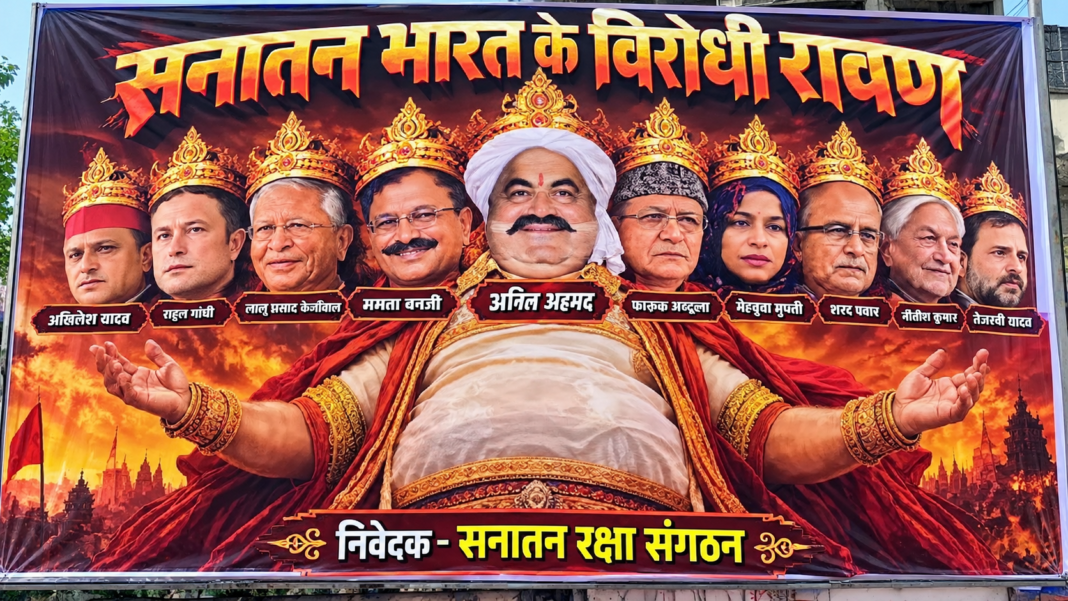
Posters carrying the message “Sanatan Bharat Ke Virodhi Ravan” have drawn attention in Lucknow, Uttar Pradesh. The banners depict several political leaders as the heads of Ravana, a figure from the Hindu epic Ramayana. The Sanatan Raksha Sangathan is named at the bottom of the posters. The display raises questions about political messaging, religious symbolism and the use of public imagery in political debate.
Posters Featuring Political Leaders Seen in Lucknow
Sanatan Bharat Posters carrying the slogan “Sanatan Bharat Ke Virodhi Ravan” have appeared in an image circulating from Lucknow, Uttar Pradesh. The banners feature the faces of several prominent political figures arranged around a central image of Ravana, the ten-headed king from the Ramayana.
The Hindi slogan translates roughly to “Ravana of those opposing Sanatan Bharat.” The wording uses a familiar figure from Hindu mythology to convey a political message. The names printed beneath the faces identify several leaders, including Akhilesh Yadav, Rahul Gandhi, Yogi Adityanath, Arvind Kejriwal and other political figures.
The banners also carry the words “Nivedak – Sanatan Raksha Sangathan” at the bottom, identifying the organisation named in the display. However, the image alone does not establish who commissioned the posters, who installed them or whether the organisation has issued a separate statement explaining their purpose.
Political Figures Depicted as Ravana’s Heads
The most noticeable feature of the posters is the use of Ravana’s multiple heads to display the faces of political leaders. In the Ramayana, Ravana is the principal antagonist in the story of Lord Rama. His image is widely associated with Dussehra, when effigies of Ravana are traditionally burned to symbolise the victory of good over evil.
The posters use this cultural reference in a political context. By placing political figures within Ravana’s image and using the accompanying slogan, the display appears to criticise the individuals shown in relation to the idea of Sanatan Bharat
The message is presented through visual symbolism rather than a detailed written explanation. The banners do not, by themselves, establish the specific actions or statements for which each leader has been included.
The political figures shown belong to different political parties and represent different ideological positions. Their appearance together on the same banner creates a collective political message, although the precise reasoning behind the selection of each individual has not been independently established.
Religious Symbolism in Political Messaging
Religious imagery has long been used in public campaigns, demonstrations and political communication in India. Familiar figures and stories can convey a message quickly, particularly when posters combine images, slogans and recognisable public personalities.
Ravana is an especially powerful symbol because his role in the Ramayana is widely known. Using his image in a political banner can communicate criticism without requiring a lengthy explanation. At the same time, such imagery can be provocative because it connects contemporary political figures with a character traditionally portrayed as an antagonist.The interpretation of a poster can vary depending on the viewer’s political views and understanding of the religious reference. The image should therefore be distinguished from verified claims about the conduct, beliefs or actions of the people depicted.
What Is Known About the Lucknow Posters?
Sanatan BharatThe available image is labelled Lucknow, Uttar Pradesh, and carries the date October 18, 2026. It also includes the English overlay “Sanatan Bharat Ke Virodhi Ravan: Posters Spread Across Lucknow.”The image provides visible evidence of the banner design, its slogan, the political faces and the organisation named at the bottom. However, the precise locations where the posters were displayed, the number of banners installed, the date of installation and the identity of the people responsible have not been independently confirmed for this report.No verified statement from the organisation, police or local administration has been established from the supplied image. It would therefore be premature to report an official reaction, a complaint, a police investigation or any legal action.
Political Message Draws Attention
The “Sanatan Bharat Ke Virodhi Ravan” posters combine religious symbolism with political criticism. Their design places several political personalities within a single visual representation of Ravana, while the accompanying slogan frames the display around the idea of Sanatan Bharat.The development highlights how religious and cultural references can become part of public political expression. However, the wider circumstances surrounding the banners remain unclear.Further confirmation from the organisation named on the posters and relevant local authorities would be needed to establish who arranged the display, its stated purpose and whether any official response followed.