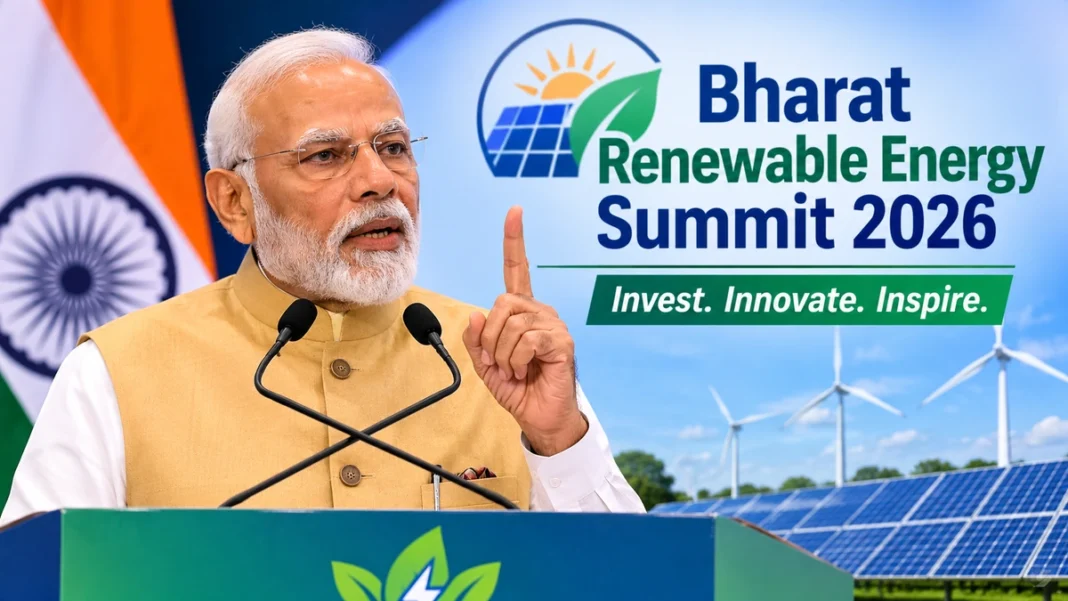
Prime Minister Narendra Modi on Monday called for accelerating India’s transition towards clean energy, highlighting the importance of renewable power in strengthening the country’s energy security, economic resilience and long-term development.
Addressing the inaugural session of the Bharat Renewable Energy Summit & Expo 2026 at Bharat Mandapam in New Delhi, Modi said India must continue expanding its renewable energy capacity and reduce its dependence on conventional fossil fuels. He also invited domestic and international investors to explore opportunities in India’s rapidly growing clean energy sector.
The Prime Minister highlighted India’s progress in renewable energy development and expressed confidence that the country would achieve its target of 500 GW of non-fossil fuel-based energy capacity by 2030. He also outlined the country’s ambition to add approximately 500 GW of renewable energy capacity over the next 10 to 11 years.
PM Modi Links Energy Security With Economic Growth
Referring to the ongoing global energy uncertainties and the crisis in West Asia, Modi said India’s investments in renewable energy over the past decade had helped strengthen its ability to withstand international disruptions.
He emphasised that energy security is closely connected with economic security and that excessive dependence on fossil fuels can expose countries to global supply disruptions and price volatility.
The Prime Minister said India’s economic growth remained strong despite international challenges and stressed that clean energy would play a central role in ensuring a stable and sustainable energy future.
He also encouraged investors to participate in India’s renewable energy expansion, pointing to the country’s policy stability and growing opportunities across the sector.
According to Modi, investment opportunities worth more than Rs 20 lakh crore are expected to emerge in India’s renewable energy sector by the end of the decade.
Solar Power, Battery Storage and Green Hydrogen in Focus
The Prime Minister stressed the need to expand solar energy infrastructure across public institutions and government facilities. He called for connecting government buildings, schools, colleges, hospitals and street-lighting systems with solar power.
He highlighted that more than 44,000 government buildings had already been connected to solar energy, generating annual savings of approximately Rs 700 crore.
Modi also underlined the importance of developing indigenous energy storage technologies and expanding battery storage capacity to address the intermittent nature of renewable power generation.
Green hydrogen was another major focus of his address. Highlighting India’s ambitions under the National Green Hydrogen Mission, the Prime Minister said the country was making progress towards establishing an annual green hydrogen production capacity of 5 million tonnes.
He also pointed to the importance of the Green Energy Corridor, which is designed to strengthen electricity transmission infrastructure and facilitate the evacuation of power generated by renewable energy projects.
Bharat Renewable Energy Summit 2026 Brings Global Stakeholders Together
The four-day Bharat Renewable Energy Summit & Expo 2026 is being organised from November 2 to 5 at Bharat Mandapam, New Delhi, under the theme ‘Invest. Innovate. Inspire.’
The event is expected to bring together representatives from more than 130 countries, including over 40 ministers, policymakers, investors, financial institutions and industry leaders. Nine international country partners are participating, including Australia, Denmark, France, Germany, the Netherlands, Norway, Sweden, the United Kingdom and the European Union.
Thirteen Indian states and Union Territories are also showcasing their renewable energy potential, investment opportunities and manufacturing capabilities.
The summit is being organised alongside the ninth session of the International Solar Alliance Assembly and the fourth International Conference on Green Hydrogen. The three events are intended to strengthen international cooperation in solar energy, green hydrogen, investment and emerging clean technologies.
More than 400 exhibitors are expected to showcase technologies and solutions covering solar and wind power, energy storage, green hydrogen and other renewable energy segments.
India Moves Towards Its 2030 Renewable Energy Target
India has made considerable progress in expanding its non-fossil fuel energy capacity. According to government figures, the country’s total installed non-fossil fuel capacity reached approximately 308 GW as of September 30, 2026.
Solar energy remains a major contributor to this expansion, with installed capacity reaching approximately 171 GW. Wind, hydropower, biomass and nuclear energy also contribute to the country’s non-fossil energy portfolio.
However, achieving the 500 GW target will require substantial investments in power generation, transmission infrastructure, battery storage and domestic manufacturing.
The government has indicated that approximately $220 billion in investment will be needed between 2027 and 2030 to support the expansion of clean energy capacity and related infrastructure.
The Bharat Renewable Energy Summit is expected to provide a platform for attracting investment, encouraging technological innovation and establishing international partnerships as India advances towards its clean energy ambitions.