

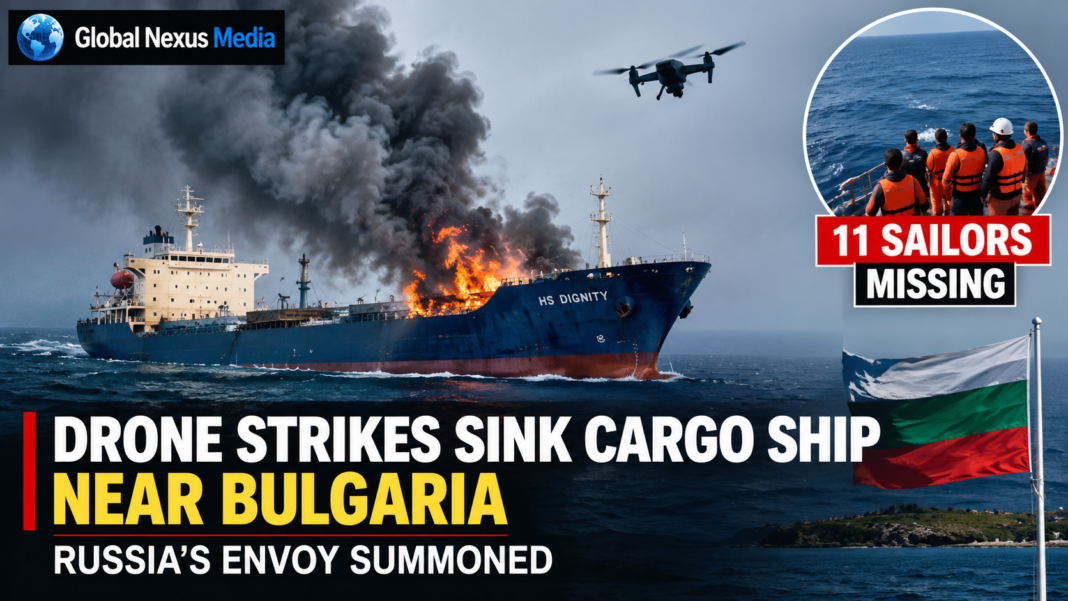
Eleven sailors were reported missing after a drone attack sank a cargo vessel near Bulgaria’s Black Sea coast on October 13, 2026. A second merchant ship was also hit, but all 15 crew members were rescued. Bulgaria summoned Russia’s ambassador as authorities investigated the attacks and international leaders expressed concern over maritime security.
Eleven sailors were reported missing after a drone attack sank a cargo vessel near Bulgaria’s Black Sea coast on October 13, 2026. A second merchant ship was also hit, but all 15 crew members were rescued. Bulgaria summoned Russia’s ambassador as authorities investigated the attacks and international leaders expressed concern over maritime security.
Second Vessel, Chelsea 3, Also Hit by Drones
The second vessel, Chelsea 3, was struck by three aerial drones while operating off Bulgaria’s Black Sea coast near Byala.
The ship was sailing under the Maltese flag and was Ukrainian-operated, according to published reports. Its 15-member crew included seven Ukrainian nationals and eight Azerbaijani nationals.
Bulgarian authorities confirmed that all 15 crew members were evacuated. Five sailors received medical attention for injuries described in reports as minor.
The successful evacuation prevented further reported loss of life aboard the second vessel. Nevertheless, the attacks on two commercial ships within a short period have intensified concerns about the security of civilian maritime traffic and the potential consequences for international trade.
The incidents also demonstrate how the effects of drone warfare can extend beyond military targets, placing civilian crews and commercial operators at risk
Bulgaria Summons Russian Ambassador
The attacks prompted a strong diplomatic response from Bulgarian Prime Minister Rumen Radev, who condemned the incidents and announced that Russian Ambassador Eleonora Mitrofanova would be summoned for discussions.
Radev said Bulgaria lacked clear and conclusive evidence to attribute responsibility to a particular side. However, he argued that the outcome of the attacks appeared to benefit Russia.
The Russian ambassador reportedly said she had no information from Russia’s Defence Ministry about the incidents and raised the possibility of third-party involvement.
The diplomatic developments have placed additional pressure on relations between Sofia and Moscow. However, the identity of those responsible for the attacks has not been conclusively established in the reports available.
Establishing the origin of the drones and gathering reliable evidence will be essential to determining responsibility. Political allegations must therefore be distinguished from the findings of an official investigation.
Ukraine and European Union Condemn the Attacks
The attacks also drew condemnation from Ukraine and European leaders.
Ukrainian Foreign Minister Andrii Sybiha accused Russia of threatening civilian lives and maritime security. Ukrainian officials have argued that attacks on commercial shipping could undermine international food security because the Black Sea is an important route for agricultural exports.
European Commission President Ursula von der Leyen condemned the incidents, warning that the Black Sea had become another area of escalation in the Russia-Ukraine war. She called for those responsible to be held accountable.
NATO Secretary General Mark Rutte also addressed the growing security concerns, indicating that the alliance would adjust its defensive posture as necessary.
These reactions underline fears that the conflict could increasingly affect commercial shipping and civilian infrastructure beyond the principal battlefield. However, international condemnation does not independently establish who carried out the latest attacks.
Why the Black Sea Matters to Global Trade
The Black Sea is a strategically important commercial corridor connecting regional ports with international markets. It plays a significant role in transporting agricultural commodities, including grain, as well as other goods.
Russia and Ukraine are major participants in global grain markets. Consequently, disruptions to shipping in the region can have implications for exporters, importers and international supply chains.
Attacks on merchant vessels may increase insurance costs, complicate shipping arrangements and force companies to reconsider their routes. If disruptions continue, transportation delays and higher operating costs could affect businesses involved in international trade.
The latest attacks also follow earlier incidents involving commercial vessels near Bulgaria. Reuters reported that another ship sank after a drone attack in the region on October 6, illustrating the continuing security risks facing civilian shipping.
Search Operations and Investigation Remain Critical
Bulgarian authorities face two immediate priorities: locating the missing sailors and determining who was responsible for the attacks.
The government has sought cooperation with international partners and discussed strengthening maritime and airspace surveillance. The incidents have also renewed attention to the security of shipping routes near the territory of a NATO and European Union member.
For the families of the 11 missing sailors, the search for survivors remains the most urgent concern. For shipping companies and governments, the attacks raise wider questions about protecting civilian vessels in a region increasingly affected by military operations.
Although diplomatic tensions have intensified, the central question remains unanswered: who launched the drones?
Until investigators establish the origin of the attacks, responsibility cannot be treated as confirmed. The outcome of the investigation will be important not only for Bulgaria’s security response but also for international efforts to protect commercial shipping in the Black Sea.


